
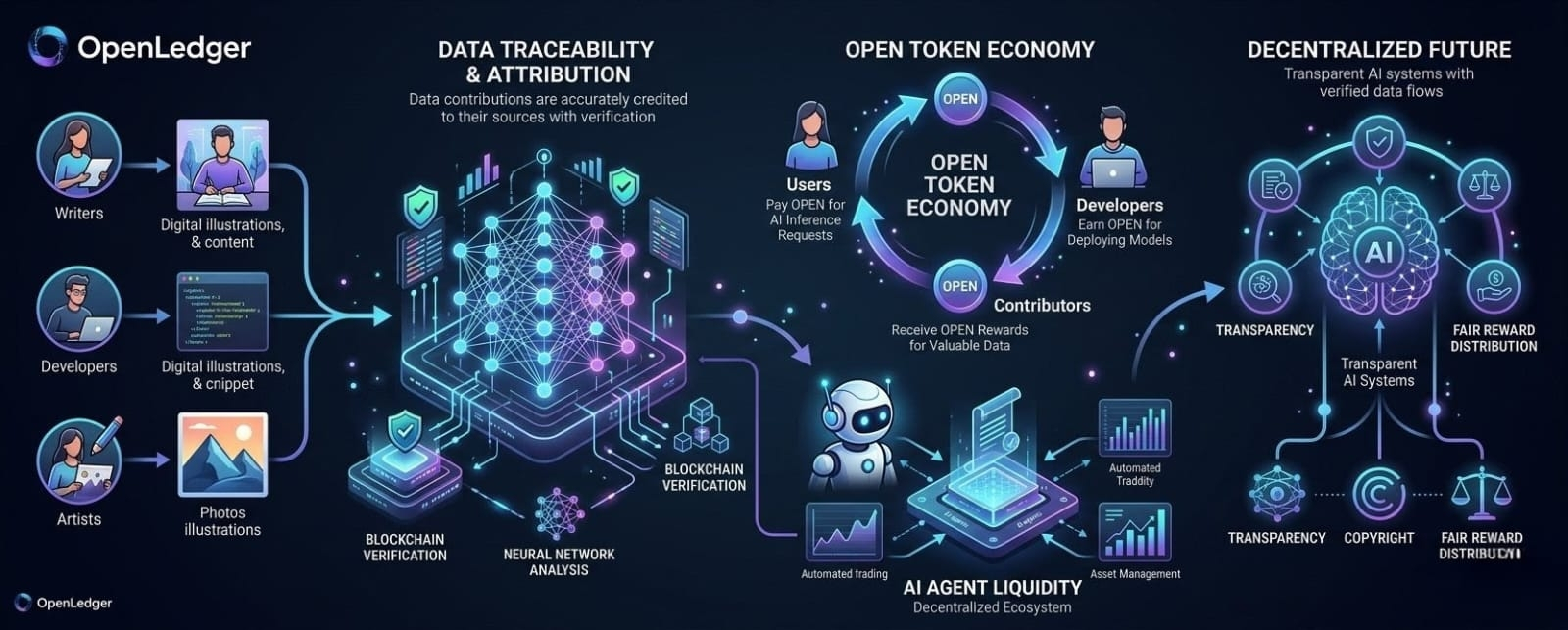
OpenLedger (OPEN) arrives at a moment when the worlds of artificial intelligence and blockchain are starting to blend together in ways that once sounded impossible. AI is no longer some futuristic experiment hidden inside research labs. It has become part of daily life. People use it to write content, generate art, automate businesses, trade markets, build software, and manage tasks that once required entire teams. The speed of this transformation is honestly hard to process sometimes. Every few months, another breakthrough appears, and suddenly the technology feels even more embedded into modern life than before.
But behind all the excitement, there’s a growing conversation that doesn’t get enough attention: who actually benefits from the AI economy?
Most AI systems today are trained using enormous amounts of publicly available data. Articles, conversations, code, images, videos, tutorials, reviews, social posts, and countless other forms of digital content all contribute to training these powerful models. The internet itself has effectively become the raw material for artificial intelligence. Yet the people who create that content rarely see any direct reward from the systems being built on top of it.
That imbalance is one of the reasons OpenLedger has gained attention. The project is trying to introduce a different way of thinking about AI infrastructure. Instead of allowing a handful of centralized companies to control the entire pipeline — the data, the models, the monetization, and the profits — OpenLedger wants to create a decentralized ecosystem where contributors, developers, validators, and AI builders all participate in the value being generated.
It’s a bold idea, and honestly, one that feels increasingly relevant as AI becomes more powerful every year.
At its core, OpenLedger presents itself as an AI-focused blockchain designed to unlock liquidity for data, models, and autonomous AI agents. Now, that phrase can sound overly technical at first, but the underlying concept is actually simple. The project believes that data should not just be collected and consumed silently by large platforms. Instead, data should become something traceable, verifiable, and economically valuable for the people contributing it.
Think about how the internet currently works. Millions of people create valuable information every day without really owning any part of the systems built from it. Writers publish articles. Developers upload code. Artists share creative work. Communities answer questions, post reviews, and generate discussions that AI systems later learn from. Over time, those contributions become part of massive datasets powering billion-dollar technologies.
OpenLedger is essentially asking a very direct question: what if contributors could actually share in that value?
That question sits at the center of the entire project.
One of the more interesting aspects of OpenLedger is its focus on attribution. The platform talks heavily about mechanisms designed to identify how data contributes to AI models and outputs. In theory, if your data helps improve a model or influences useful AI responses, you could potentially receive rewards through the ecosystem.
Now, to be fair, this is an incredibly difficult technical challenge. Modern AI models are extraordinarily complex. They process huge amounts of information through neural networks that even researchers sometimes struggle to fully interpret. Determining exactly which piece of data influenced a specific output isn’t easy at all. In fact, explainability remains one of the biggest unsolved problems in machine learning.
But that’s also what makes OpenLedger fascinating. It’s trying to tackle problems most projects avoid because they’re too difficult.
The project’s native token, OPEN, functions as the economic layer behind the ecosystem. It’s used for network activity, transactions, AI inference requests, governance, and reward distribution. But unlike many crypto projects that create tokens mainly for speculation, OpenLedger is attempting to tie its token directly to AI usage and contribution systems.
That creates an entirely different narrative compared to older blockchain projects.
In many traditional crypto ecosystems, tokens often revolve around trading, staking, or governance without much connection to real-world utility. OpenLedger, on the other hand, is positioning OPEN as something tied to the actual operation of AI infrastructure. Users interacting with AI models may pay using OPEN. Developers deploying models may earn OPEN. Contributors whose data supports the ecosystem may also receive rewards.
The vision is ambitious because it attempts to build a circular AI economy rather than just another blockchain network.
And timing matters here.
Over the last few years, the AI industry has started facing growing criticism around transparency, copyright, ownership, and ethics. Artists worry about AI systems trained on creative work without permission. Writers question how their content is being used. Developers debate open-source contributions and model licensing. Governments are beginning to discuss regulation. At the same time, users are becoming increasingly aware that AI systems don’t simply appear out of nowhere — they are built using human-generated information on a massive scale.
This broader environment creates an opportunity for projects like OpenLedger.
The idea of decentralized AI infrastructure may have sounded niche a few years ago, but today it feels far more relevant. There’s a growing belief in parts of the tech world that AI may become too important to remain fully centralized.
That doesn’t necessarily mean decentralized systems will replace large AI corporations anytime soon. Realistically, centralized AI companies still have enormous advantages in funding, compute power, infrastructure, and research capabilities. But blockchain projects are increasingly exploring ways to complement or challenge parts of that system.
OpenLedger is part of that movement.
Another reason the project stands out is its interest in AI agents. This is where things start feeling genuinely futuristic. AI agents are more advanced than traditional chatbots. Instead of simply answering prompts, agents can perform tasks, interact with applications, coordinate workflows, and make decisions with limited human input.
Many researchers believe autonomous agents could become one of the next major shifts in AI development. Imagine systems capable of handling financial transactions, managing online businesses, negotiating services, analyzing data, or coordinating digital operations almost independently.
Now combine that idea with blockchain technology.
Suddenly you have the possibility of AI systems interacting economically on-chain. Agents could potentially pay for services, access decentralized data, execute transactions, or even earn revenue autonomously. OpenLedger appears to be positioning itself for that kind of future.
Of course, there’s a big difference between vision and execution.
The project still faces enormous challenges, and it’s important not to ignore them. The decentralized AI space is becoming crowded very quickly. New projects continue entering the market with competing ideas around decentralized compute, AI marketplaces, GPU sharing, inference systems, and data monetization. Standing out in this environment won’t be easy.
Technical complexity is another major hurdle. Attribution systems sound exciting in theory, but implementing them effectively at scale is incredibly difficult. AI models don’t naturally provide clean explanations for how they make decisions. Building transparent, verifiable reward systems around AI contributions is a massive undertaking.
Then there’s adoption.
Every blockchain project talks about changing the future, but long-term success ultimately depends on whether people actually use the ecosystem. OpenLedger needs developers building applications, contributors providing valuable data, users interacting with AI services, and a community willing to participate over time. Without meaningful adoption, even strong ideas can struggle.
Still, what makes OpenLedger compelling isn’t just the technology itself. It’s the broader direction the project represents.
For years, the internet has operated through centralized ownership models where users generate value while platforms capture most of the profits. Social media companies monetized attention. Data companies monetized behavior. AI companies are now monetizing intelligence built on publicly available information.
Projects like OpenLedger reflect growing attempts to rethink that structure.
The project is essentially built around the belief that contributors should not remain invisible inside AI economies. Data should have traceability. Intelligence should have transparency. Participation should have measurable value.
Whether OpenLedger ultimately succeeds or not, these conversations are becoming increasingly important as AI grows more powerful and integrated into everyday life.
And that’s really the bigger story here.
OpenLedger isn’t just another cryptocurrency trying to ride market hype. It’s part of a much larger movement questioning how the next generation of digital economies should function. Who owns intelligence? Who benefits from automation? Who gets rewarded when machines learn from human knowledge?
Those are no longer abstract philosophical questions. They’re becoming real economic questions with enormous implications for the future of technology.
Maybe OpenLedger becomes a major infrastructure layer for decentralized AI. Maybe it evolves into a specialized ecosystem serving a smaller niche. Or maybe it simply helps push the industry toward more transparent and fair AI systems.
But regardless of where it ultimately ends up, the project captures something important about the current moment in technology. AI is changing the internet rapidly, and people are beginning to realize that ownership, attribution, and economic participation may matter just as much as the intelligence itself.
That realization could shape the next era of the digital world far more than most people currently understand.