

Everyone still talks about AI infrastructure like it’s 2023.
More compute. Bigger models. Faster inference. Cheaper execution.
But the deeper AI adoption goes, the clearer one thing becomes:
The real bottleneck may not be intelligence production.
It may be value attribution.
Because once AI starts generating measurable economic value, the hardest question becomes brutally simple:
Who deserves to get paid?
Not philosophically. Financially.
And that’s where OpenLedger starts looking less like an “AI chain” and more like foundational economic infrastructure for the AI era.
Most people still underestimate how dangerous opaque AI economics become at scale.
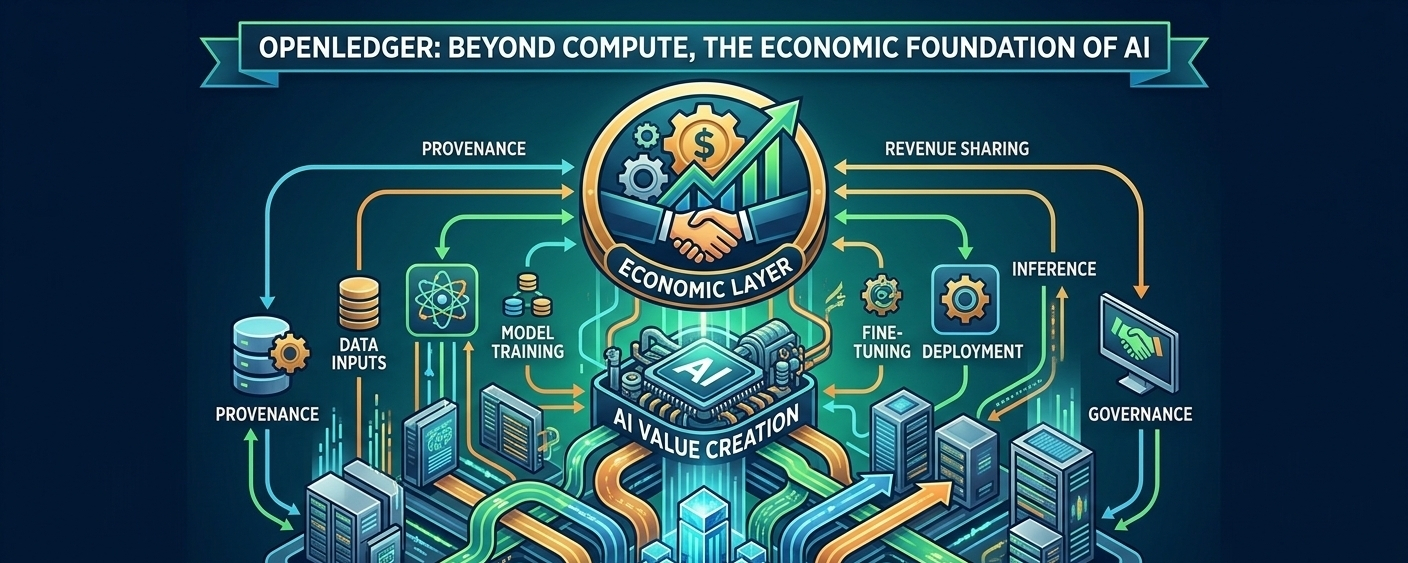
An enterprise AI model today can involve:
– licensed datasets
– proprietary enterprise data
– third-party fine tuning
– multiple deployment layers
– distributed inference systems
Now imagine those outputs generating millions in value.
Who contributed what?
Who can verify provenance?
Who captures revenue?
Who arbitrates disputes?
Traditional AI stacks barely answer these questions.
That’s why OpenLedger feels early.
Because while most projects chase computational throughput, OpenLedger appears to be targeting something much harder:
Trusted attribution infrastructure.
And if AI evolves into a true economic network rather than isolated software products, attribution becomes unavoidable.
Not optional.
Unavoidable.

The market still prices AI mostly through compute narratives because compute is easy to understand.
But history shows something different:
The biggest systems are rarely controlled by raw production power alone.
Financial markets scaled through settlement systems.
Advertising scaled through attribution systems.
Streaming scaled through royalty infrastructure.
Cloud scaled through billing abstraction.
Economic coordination always becomes the hidden moat.
That’s the part many investors still miss about $OPEN.
If OpenLedger succeeds, the token may not function merely as utility fuel.
It could evolve into a coordination asset for AI value distribution itself.
That’s a much larger narrative.
Because the future AI economy will demand:
– provenance
– auditability
– contribution tracking
– economic legitimacy
– trust-minimized accounting
Especially once regulators, enterprises, and institutional capital fully enter the space.
And unlike hype-driven AI narratives, this problem does not disappear with better models.
Smarter AI actually makes attribution MORE important.
The stronger the outputs become, the more valuable the underlying economic coordination layer becomes.
That’s why OpenLedger feels intellectually different from most AI crypto projects.
It’s not trying to become another compute marketplace.
It’s attempting to build financial grammar for machine-generated economies.
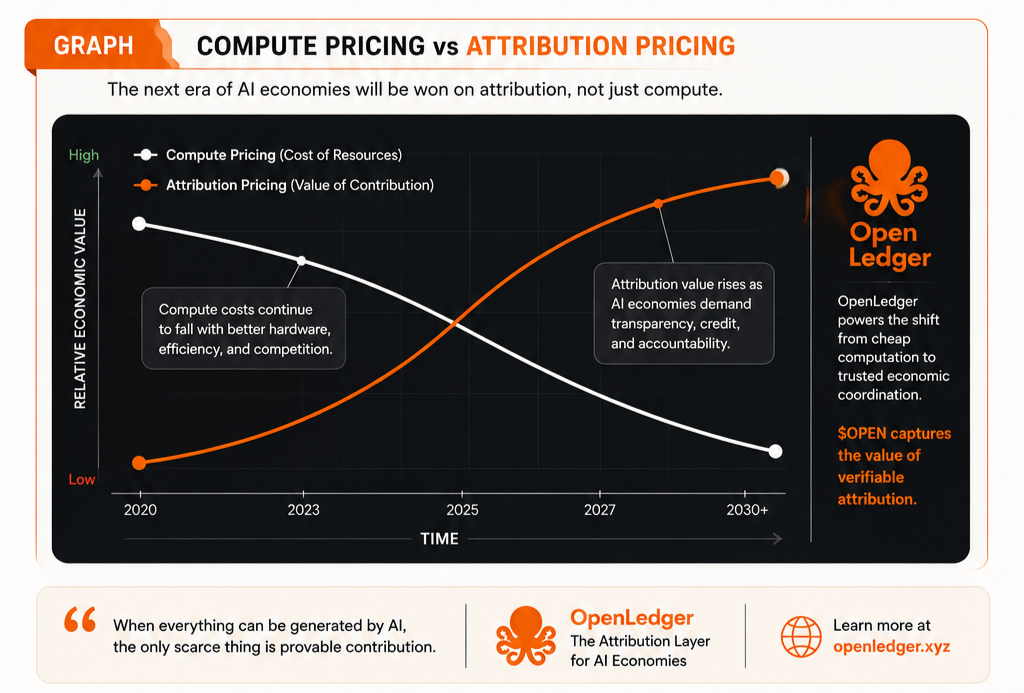
And if that thesis plays out, the market may eventually realize something uncomfortable:
The biggest value in AI may not come from generating intelligence…
…but from governing who owns the value intelligence creates.
$OPEN might be one of the first serious bets on that future.