I didn’t take it seriously at first. Another infrastructure layer for AI, another attempt to coordinate incentives around data, models, contribution, ownership. I’ve been around long enough to remember when “shared compute” was supposed to flatten power structures. Then storage networks. Then decentralized indexing. Every cycle comes with its own language for trust. Eventually the language starts sounding interchangeable.
OpenLedger landed in that part of my brain where old infrastructure ideas go to wait.
Not dismissed exactly. Just… suspended.
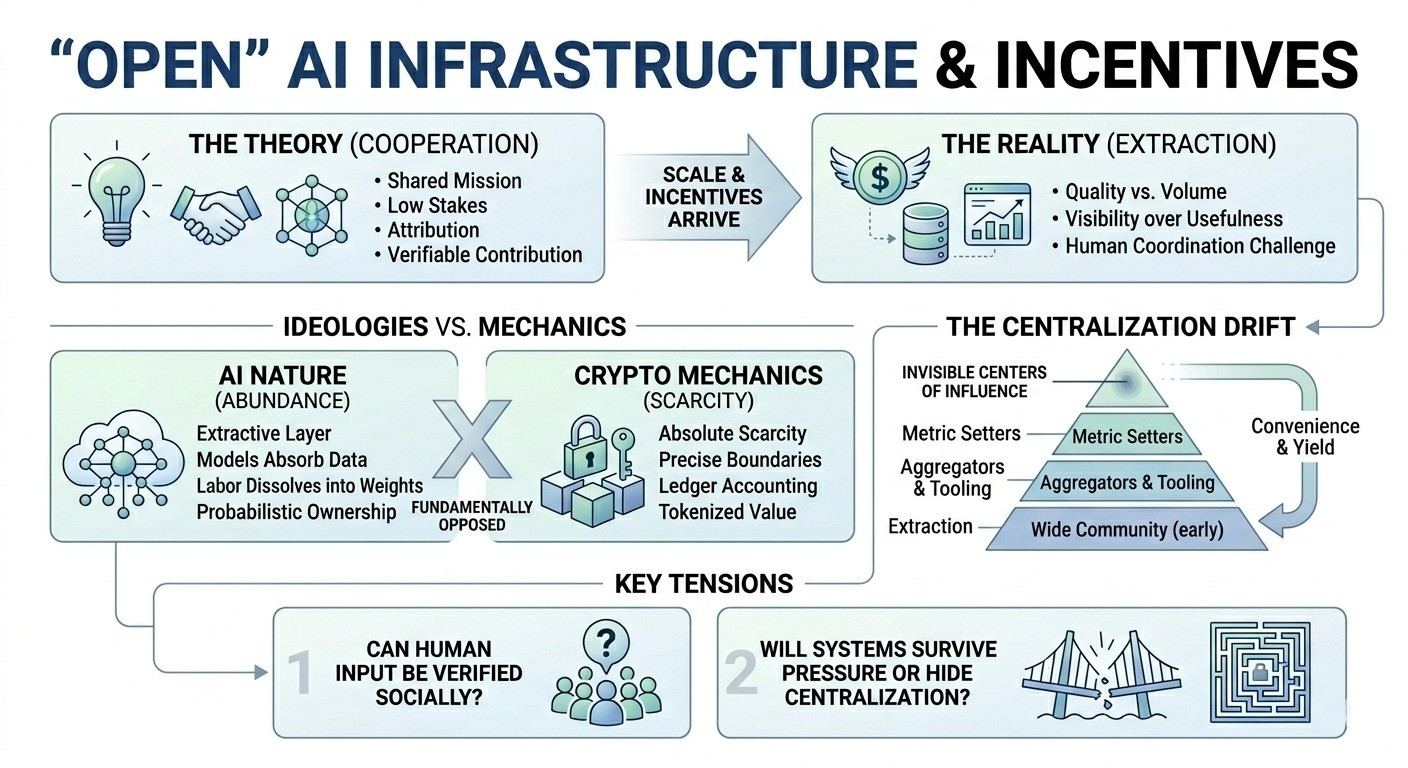
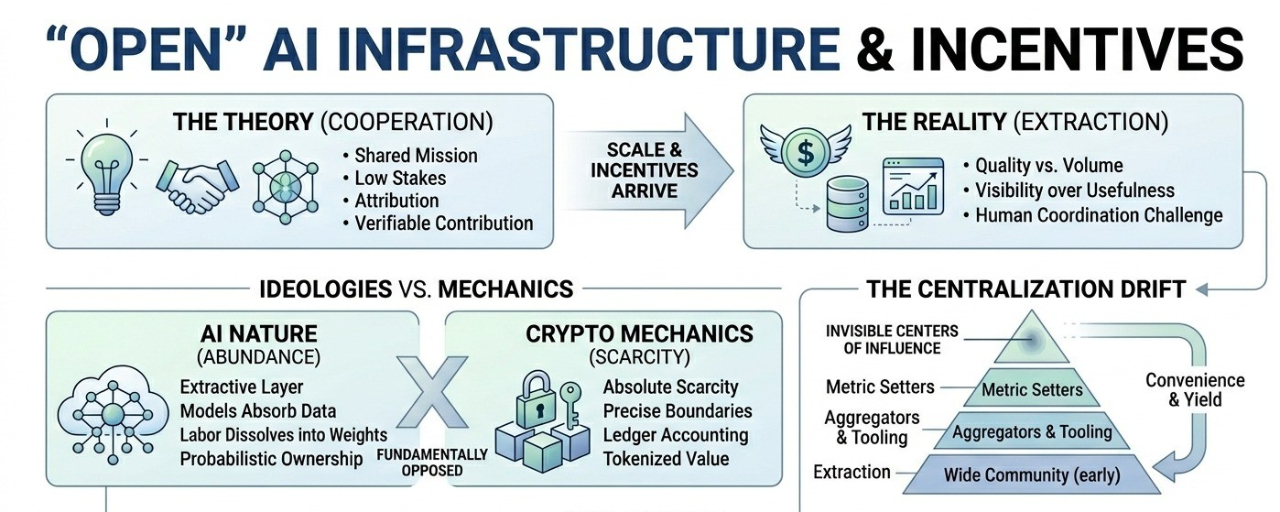
Because on paper, it hits familiar nerves. Attribution. Verifiable contribution. AI systems that supposedly remember who gave what, who trained what, who deserves value when outputs start circulating. It’s hard to argue against the premise in the abstract. AI has already turned data into this strange extractive layer where nobody really knows where anything came from anymore. Models absorb everything. Labor dissolves into weights. Ownership becomes probabilistic.
So when something tries to build accounting systems around that chaos, part of me pays attention.
Even if another part immediately assumes it breaks later.
Maybe that’s too harsh. But I keep coming back to how fragile these systems become once incentives stop behaving academically. Attribution sounds reasonable until money shows up. Then contribution quality starts collapsing into contribution volume. Then verification becomes its own economy. Then people optimize for visibility inside the metric instead of usefulness outside it.
We’ve seen this pattern too many times in crypto already. Not the exact form, but the shape of it.
The problem isn’t really the technology. It almost never is. Most infrastructure works well enough in contained environments. Small communities. Early contributors. Shared mission. Low stakes. The failure usually starts when the system succeeds enough to attract extraction.
That’s where things start to feel uncomfortable.
Because AI infrastructure isn’t passive infrastructure. It absorbs human behavior constantly. Every dataset carries incentives inside it. Every attribution mechanism becomes vulnerable to gaming. Every “open” coordination layer slowly accumulates invisible centers of influence — the people with better tooling, better aggregation pipelines, better positioning.
And eventually someone starts acting like a platform whether they intended to or not.
I think that’s the part people underestimate when they talk about decentralized AI systems. Not whether models can coordinate. Whether humans can. At scale. Under pressure. Over time.
It works in theory. Most things do.
But I’ve watched enough supposedly neutral systems drift toward quiet centralization to stop trusting architectural intent. Especially once financial incentives attach themselves to participation. Once data becomes yield-bearing, behavior changes fast. People stop asking whether information is useful and start asking whether it’s monetizable. Those are very different filters.
That part keeps bothering me more than it should.
Because underneath all the language around openness and contribution tracking, there’s a harder question sitting there unresolved: can human input actually be verified meaningfully once the system becomes economically important? Not symbolically verified. Not cryptographically signed. I mean socially verified. Contextually verified. Can a network distinguish genuine insight from optimized noise once enough capital depends on pretending the difference exists?
I’m not sure it can.
And maybe OpenLedger understands that better than most projects trying to occupy this space. Maybe that’s why I haven’t fully ignored it. There’s at least an implicit acknowledgment that the invisible layers matter. Provenance matters. Coordination matters. Not just model outputs.
Still, infrastructure stories in crypto have a way of aging strangely. The systems that survive usually survive by becoming less open than they originally claimed. Or by hiding centralization behind operational complexity nobody has time to inspect anymore.
Then trust decays gradually. Quietly. No dramatic collapse. Just layers of dependency nobody notices until they fail all at once.
I keep thinking about that with AI systems specifically. How quickly people surrender visibility once outputs become useful enough. How little transparency most users actually demand after convenience arrives.
And whether attribution systems are really built for that kind of pressure, or just for the version of the future where everyone still behaves cooperatively long enough for the math to look convincing.