
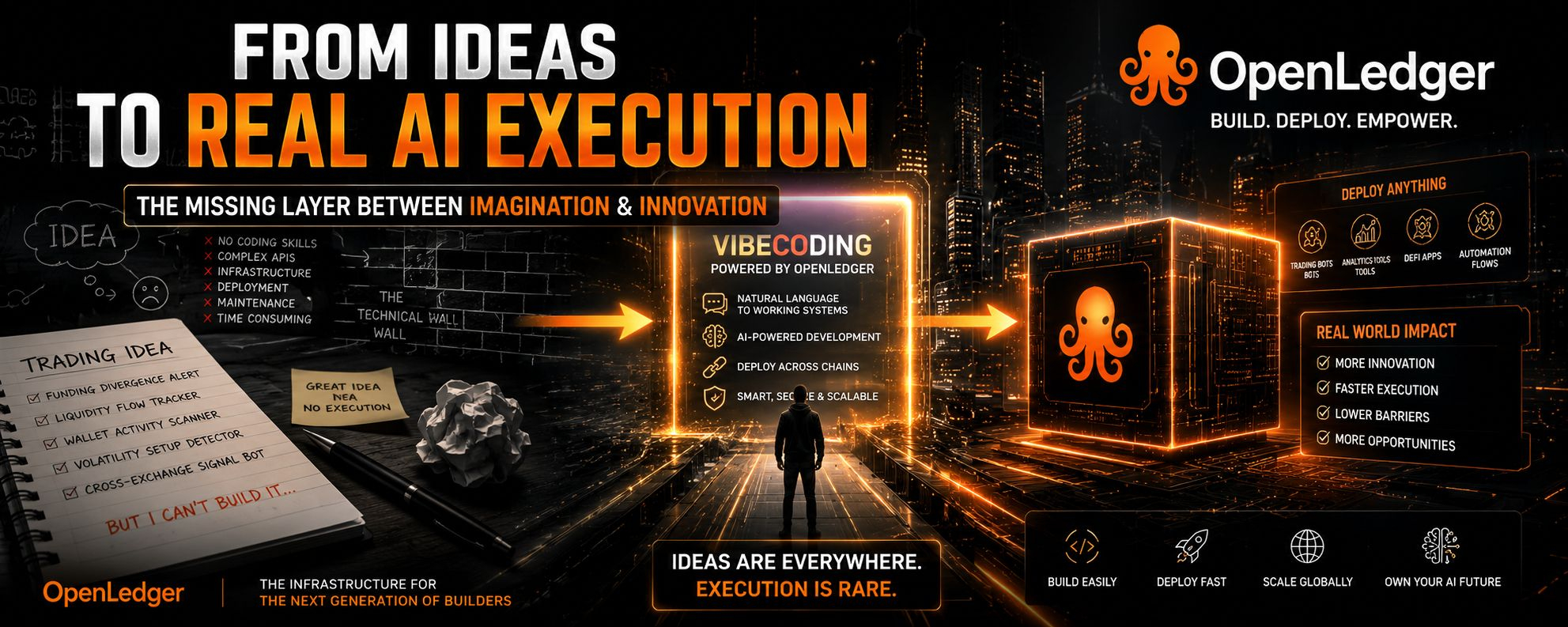
@OpenLedger I’ve spent a long time watching different trends move through crypto, and one thing I’ve learned is that the loudest narratives are rarely the ones that matter most in the long run. Every cycle introduces new buzzwords, new promises, and new projects claiming they will completely transform the industry. Most of them create temporary excitement, attract attention for a few months, and eventually disappear once the market realizes the actual utility never matched the narrative. That’s why I’ve become much more interested in projects solving structural problems instead of simply creating hype around existing ideas. The more I’ve studied @OpenLedger, the more I feel like it may be targeting one of the most overlooked limitations in both AI and crypto at the same time: the massive gap between human ideas and real execution.
One of the biggest misconceptions people have about innovation is assuming that good ideas are rare. Honestly, I don’t think ideas are the problem anymore. I think execution is. Every day there are traders, analysts, researchers, and creators discovering opportunities, patterns, workflows, and systems that could potentially become valuable tools or products. The issue is that most of those ideas never leave the imagination stage because the technical barrier between “thinking” and “building” is still extremely high for normal users. I’ve personally experienced this frustration many times. There have been moments where I noticed unusual market behavior early, whether through funding changes, liquidity movement, wallet activity, or volatility structures that repeatedly created opportunities before the wider market recognized them. The strategy itself often felt very clear in my head, but transforming that understanding into something functional was always the difficult part.
What initially sounds like a relatively simple idea quickly becomes a complicated technical process. Suddenly you need APIs, infrastructure management, hosting, automation systems, database handling, wallet integrations, smart contract interactions, debugging, monitoring, and security protections just to create a tool capable of surviving under real market conditions. Most traders are not full-stack engineers, and most engineers are not experienced traders. Because of that separation, countless potentially valuable ideas never get tested properly. They remain trapped inside notes apps, screenshots, unfinished plans, or temporary discussions that eventually disappear. I honestly believe this hidden inefficiency is far larger than people realize. Crypto moves fast, and by the time many people figure out how to build around an idea, the market opportunity itself is already gone.
That’s the reason vibecoding immediately caught my attention when I started reading deeper into @OpenLedger. Not because I believe AI can magically replace developers overnight, but because reducing the friction between imagination and execution could fundamentally change how innovation happens across crypto ecosystems. If users can explain workflows naturally and AI-assisted systems can help transform those instructions into functioning products, the speed of experimentation increases dramatically. More strategies can be tested, more niche products can emerge, and more individuals who were previously excluded from building gain the ability to participate directly. That changes far more than just productivity. It changes who gets to innovate in the first place.
What makes this moment particularly important is timing. A few years ago, this entire concept would probably have struggled badly under real conditions. AI models were inconsistent, blockchain tooling was fragmented across ecosystems, development standards were unstable, and cross-chain infrastructure often created more complexity than opportunity. Even experienced builders faced major limitations trying to create reliable systems. But the environment today looks very different. AI models have improved significantly, blockchain infrastructure is slowly becoming more mature, developer tooling is stabilizing, and interoperability across ecosystems is gradually becoming more practical. Both technological curves are finally reaching a point where vibecoding feels technically possible instead of purely theoretical. That convergence matters because major shifts often happen when multiple technologies mature simultaneously rather than independently.
At the same time, I think it’s important to remain realistic about the risks that come with this transition. Easier building does not automatically create safer systems. In fact, reducing technical barriers can sometimes increase the speed at which weak ideas spread. If AI-assisted workflows are interacting with real capital, flawed assumptions can become expensive mistakes very quickly. Markets do not care whether an error was caused by a human developer or generated through AI assistance. Poor logic still produces losses. Weak risk management still destroys accounts. Fragile automation systems still fail under pressure. That’s why I believe judgment becomes even more important in an environment like this. AI may reduce technical friction, but it cannot replace deep understanding of market structure, risk management, or strategic thinking. The people who benefit most from vibecoding probably won’t be lazy users searching for instant profits. It will more likely be experienced thinkers who already understand markets deeply enough to guide these systems intelligently.
The larger shift I keep thinking about is what happens once building itself becomes accessible to a much larger percentage of the market. Historically, technical ability created a massive competitive advantage because only a small number of people could actually transform ideas into usable products. But if execution becomes dramatically cheaper and faster, then the competitive landscape changes completely. The advantage starts moving away from simply “who can build” toward “who can think better, adapt faster, and test ideas more intelligently.” In that kind of environment, originality becomes more valuable than repetition. Copy-paste strategies probably die faster because more participants can deploy similar systems rapidly. Meanwhile, traders and researchers capable of continuously generating new insights gain a much larger edge because they can finally build around their ideas without relying entirely on external development teams.
This is why I think @OpenLedger could eventually become far more significant than many people currently expect. Not because it promises overnight transformation, and not because AI narratives are popular right now, but because infrastructure that lowers the barrier between human creativity and functional deployment can reshape how crypto products, automation systems, and decentralized applications evolve over time. If vibecoding succeeds beyond the demo phase and begins producing tools people genuinely continue using under live conditions, the implications become enormous. Entire categories of builders who were previously locked out of development suddenly become participants in innovation. That could accelerate experimentation across trading, analytics, decentralized finance, automation, and countless other sectors inside Web3.
For me, the most important question now is not whether AI narratives will continue attracting attention. They obviously will. The real question is which projects are building infrastructure capable of surviving after hype cycles fade. Narratives eventually slow down. Speculation eventually cools off. But infrastructure that genuinely improves how people create, build, and operate inside digital ecosystems tends to survive much longer than temporary excitement. Historically, some of the biggest long-term winners in technology are the projects that quietly become foundational layers beneath future innovation rather than the projects generating the loudest short-term attention.
That’s ultimately why I keep watching OpenLedgerso closely. I’m not looking at it purely through the lens of price action or short-term momentum. I’m looking at it as part of a larger environmental shift happening between AI, crypto infrastructure, and human creativity itself. And if this direction continues evolving successfully, I honestly think many people will eventually realize that the real value was never just about AI generating code. The real value was about removing the invisible wall that prevented millions of people from turning their ideas into reality in the first place.
