
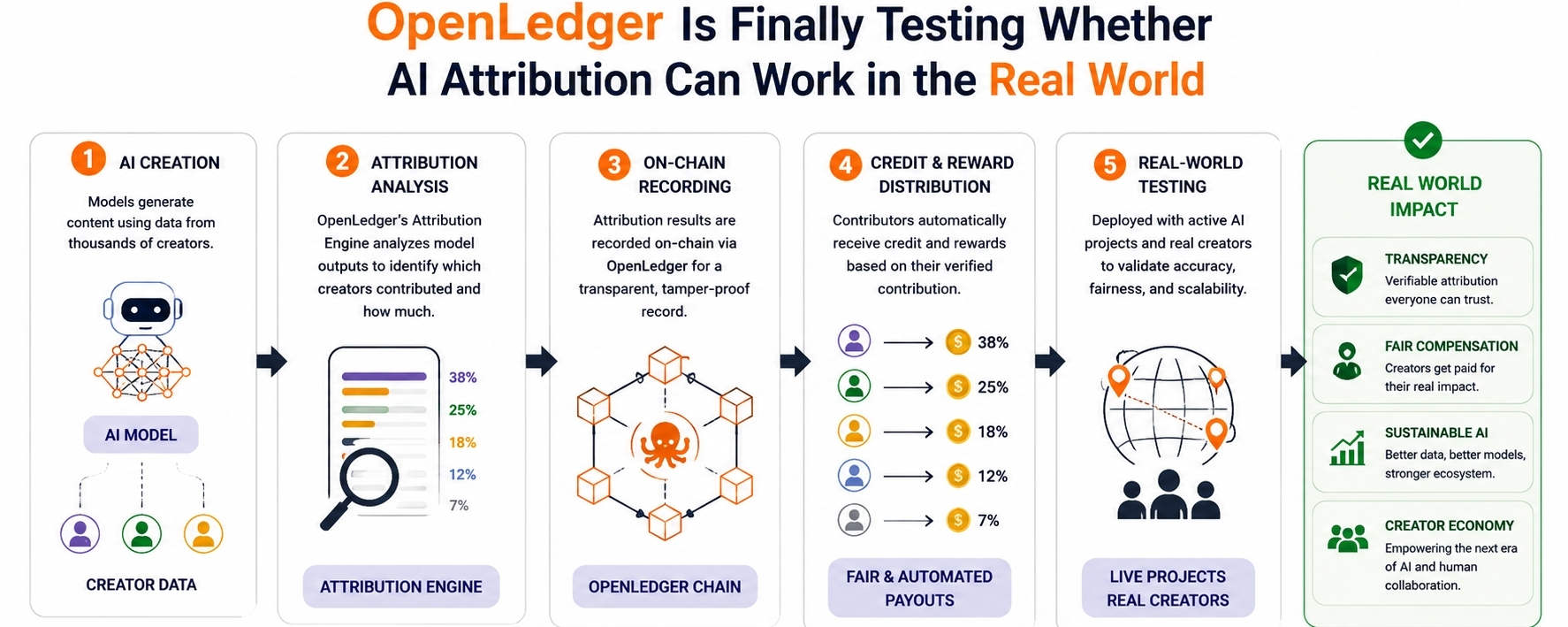
A few months ago, I honestly couldn’t tell if OpenLedger was building something that could become real infrastructure for AI systems, or if it was just another project packaging the “AI + blockchain” idea in a smarter way.
The vision sounded interesting from the start. A system where data contributors, model creators, and AI participants could actually be tracked and compensated fairly makes sense in theory. But for a while, most of it still felt conceptual. There were demos, incentive models, token discussions, and big ideas about “Payable AI,” but not much that proved the system could operate outside of controlled narratives.
That’s why the recent shift matters.
For the first time, OpenLedger feels like it’s moving from an idea into an actual operating system people can test in the real world. The launch of the OPEN mainnet changed my perspective more than any announcement before it.
Not because of price action or exchange listings. Those things don’t tell me much anymore. Crypto markets are very good at turning unfinished infrastructure into speculation long before the infrastructure earns real trust.
What matters more is that OpenLedger is now trying to run attribution and compensation in a live environment instead of just talking about it.
That changes the conversation completely.
The question is no longer, “Should AI contribution tracking exist?” Now the question is, “Can this system actually survive real usage?”
And those are very different questions.
Once you move into production, the problems become much less theoretical. Attribution sounds clean until models start remixing datasets, compressing information, fine-tuning outputs, and layering abstractions on top of abstractions. Suddenly it becomes harder to know who contributed what, who deserves compensation, and whether the accounting still makes sense at scale.
That’s the part I’m watching carefully now.
I don’t think OpenLedger has solved those issues yet, but at least they’re finally testing them in an environment where the flaws can’t hide behind presentations and roadmap graphics.
Another update that genuinely changed how I look at the project was the partnership with Story Protocol around rights-cleared AI training and automated royalty distribution.
That integration feels more important than most crypto partnerships because it connects OpenLedger to a real pressure point in AI right now: ownership and provenance.
The AI industry is already running into legal and ethical problems around copyrighted material, unclear licensing, and training transparency. Most projects still treat those issues like future problems. OpenLedger seems to be operating under the assumption that attribution and traceability will eventually become necessary infrastructure.
I actually think that’s a reasonable bet.
But this is also where the gap between architecture and adoption becomes obvious.
A system like this only matters if people actually accept the tradeoffs that come with it.
Model builders need to be willing to work within attribution frameworks. Enterprises need to trust the accounting. Contributors need to believe payouts are fair and worth participating in.
That’s a much harder challenge than launching a blockchain.
Right now, OpenLedger has momentum at the infrastructure level, but I’m not convinced it has proven economic gravity yet. There’s a difference between people experimenting with a system and people depending on it.
I think that distinction gets blurred a lot in crypto.
There were also several ecosystem partnerships announced recently, including integrations involving DeepNode AI, 4EVERLAND, LayerZero, and broader AI tooling connections.
Some of those updates are useful. Some still feel early.
The LayerZero integration probably matters more than people realize because if OpenLedger’s attribution economy ever becomes meaningful, being isolated on one chain would create friction very quickly. Cross-chain accessibility makes the system more flexible and harder to trap inside a single ecosystem.
But at the same time, partnerships alone don’t impress me much anymore.
In crypto, integrations are easy to announce. What matters is whether they become difficult to remove later. Real infrastructure creates dependency. Most of these relationships still feel optional for now.
That could change, but it hasn’t happened yet.
One thing I do appreciate is that OpenLedger has stayed relatively focused. A lot of AI blockchain projects eventually drift into vague claims about autonomous agents, decentralized intelligence, or infinite AI marketplaces without ever defining what their actual leverage is.
OpenLedger keeps coming back to attribution, compensation, and accountability.
At least that’s coherent.
Whether it becomes valuable depends on whether the broader AI ecosystem starts treating attribution as operational infrastructure instead of just ethical language people mention in interviews.
I’m still not fully convinced that shift is guaranteed.
I’m also cautious about the way network metrics are being interpreted right now. Node counts, transaction numbers, ecosystem activity, and model creation statistics can look impressive, but crypto systems are extremely good at generating activity before they generate real demand.
The important test comes later.
What happens when incentives cool down? What happens when speculative attention fades? What happens when builders have to choose OpenLedger because it genuinely solves a painful problem, not because rewards are attractive?
That’s when you find out whether the system has durability.
The token side matters here too, even beyond price speculation. If future unlock pressure grows faster than actual network utility, the entire incentive structure can become unstable. Contributors lose confidence in payouts. Builders hesitate to commit long term. The economy starts feeding on itself instead of supporting productive usage.
I don’t think OpenLedger has failed that test.
But I also don’t think it has passed it yet.
Overall, my view is definitely more positive than it was a few months ago.
The mainnet launch matters. The attribution infrastructure matters. The IP-focused integrations matter. Those are meaningful developments, not just cosmetic progress.
At the same time, the hardest questions are still unanswered.
Can attribution remain accurate and efficient at scale? Will developers willingly adopt transparent compensation systems? Will enterprises trust blockchain-based verification enough to build around it? And most importantly, will this infrastructure become necessary or simply optional?
That’s still unclear.
My confidence has moved from “interesting concept” to “credible early infrastructure experiment.”
That’s real progress.
But the update that would truly change my mind isn’t another partnership announcement or exchange listing. It would be seeing a serious AI product operating under real commercial pressure that genuinely depends on OpenLedger’s attribution layer in a way that would be painful to remove.
That’s the point where this stops feeling experimental and starts feeling like infrastructure with staying power.
Maybe OpenLedger isn’t trying to win the AI race overnight. Maybe it’s trying to solve the uncomfortable problem everyone knows exists but keeps delaying.
Because sooner or later, AI will have to answer a difficult question: who deserves credit, who gets paid, and who carries the cost?
That future still feels uncertain.
But uncertainty doesn’t make the problem smaller — it makes the stakes bigger.
If OpenLedger can prove its system still works when incentives weaken, pressure rises, and real businesses depend on it, the conversation changes completely.
Until then, I’m not treating this as a finished success story.
I’m watching it as a live experiment that could quietly become essential — or expose just how hard accountable AI really is.
