
Sometimes a new project appears and people immediately call it “the future.” But after hearing that phrase too many times in crypto and AI, it becomes difficult to believe everything at first glance. One term that is becoming more common now is “AI-native blockchain.” It sounds powerful, but it also raises an important question:
Is this really a new technological direction, or is it simply old blockchain ideas being presented with smarter marketing?
This question naturally comes to mind when looking at [OpenLedger](https://www.openledger.xyz?utm_source=chatgpt.com).
At first, OpenLedger looks like another blockchain network. But when you go deeper, the idea behind it feels slightly different. Here, AI is not being treated as just an extra feature added on top of blockchain. Instead, AI is positioned as the core system itself — the engine that keeps everything running.
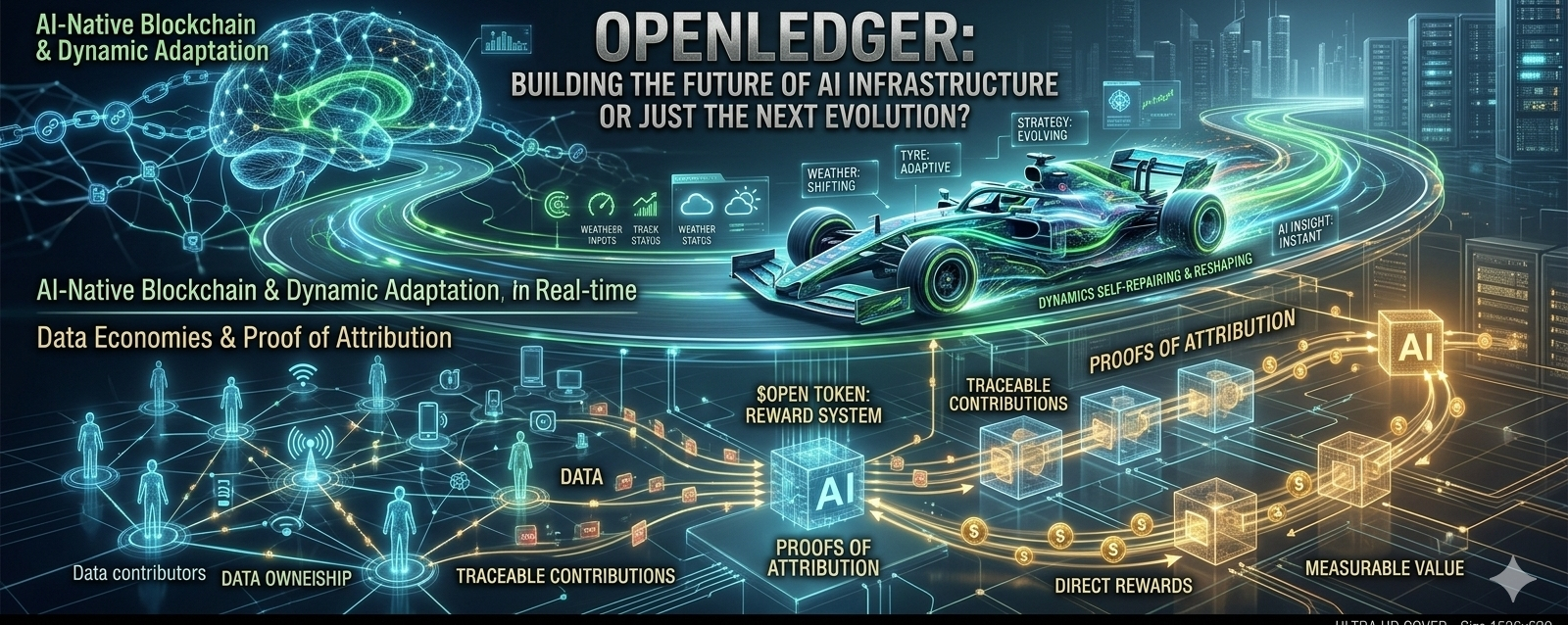
One comparison used by OpenLedger is Formula 1 racing. At first, the example may sound dramatic, but it actually explains the concept quite well. In Formula 1, nothing stays the same for long. Weather changes, tire conditions shift, competitors move faster or slower, and teams constantly adjust their strategies in real time.
OpenLedger wants its AI system to work in a similar way.
The network continuously watches data, analyzes changes, and reacts instantly. Their idea of “Datanets” and on-chain intelligence creates a system that never truly stops observing. Instead of waiting for instructions, the AI keeps learning from live information all the time.
This creates an interesting possibility.
Traditional AI systems usually work like black boxes — users provide input and receive output, but the process inside remains unclear. OpenLedger is trying to move away from that model. Their vision is to make AI systems more transparent, traceable, and economically connected.
In simple words, they want every important contribution to have measurable value.
One of the most interesting parts of the project is something called “Proof of Attribution.” The idea is straightforward but powerful: if data helps train or improve an AI model, the people providing that data should receive recognition and rewards.
According to the system, contributors can earn rewards through the $OPEN token depending on how much value their data creates.
This touches one of the biggest questions in the modern AI economy:
If data is the fuel of AI, then who truly owns that fuel?
For years, large technology companies have collected massive amounts of user data while ordinary contributors received almost nothing in return. OpenLedger seems to challenge that structure by trying to create a system where contributions are visible and rewarded directly.
Still, there are difficult questions surrounding this idea.
Can every contribution really be measured accurately? Some forms of value are obvious, while others are invisible. Certain data may influence AI models in ways that cannot easily be tracked or quantified. Measuring human contribution inside intelligent systems may become far more complicated than expected.
Another challenge is speed.
OpenLedger promotes dynamic decision-making, where AI models continuously adapt as new information arrives. While this sounds advanced, reacting too quickly can sometimes create instability. In financial markets, trading systems, or decentralized networks, too much adaptation may lead to overreactions instead of better decisions.
So the real challenge is balance.
How can a system remain flexible without becoming chaotic?
Despite these uncertainties, the direction itself remains fascinating. OpenLedger is not simply trying to build a faster blockchain or a smarter chatbot. The project appears to be exploring a much bigger idea — a future where AI, blockchain, ownership, and data economies operate together as one connected environment.
That may be the real innovation here.
Not necessarily the technology alone, but the change in mindset.
AI is no longer being presented as a static tool that waits for commands. Instead, it becomes something alive, adaptive, and economically aware — a constantly evolving system connected to real-time information and human contribution.
Whether OpenLedger fully succeeds or not is still impossible to say today. It may become an important foundation for future AI infrastructure, or it may simply represent one step in a much larger evolution already beginning across the industry.
But one thing is becoming increasingly clear:
The relationship between AI, data, and ownership is changing rapidly. And projects like OpenLedger are pushing that conversation into a completely new direction.
Maybe this is not yet the final future of AI infrastructure.
But it could very well be the beginning of it. 🚀