@OpenLedger keeps sitting in the back of my mind.
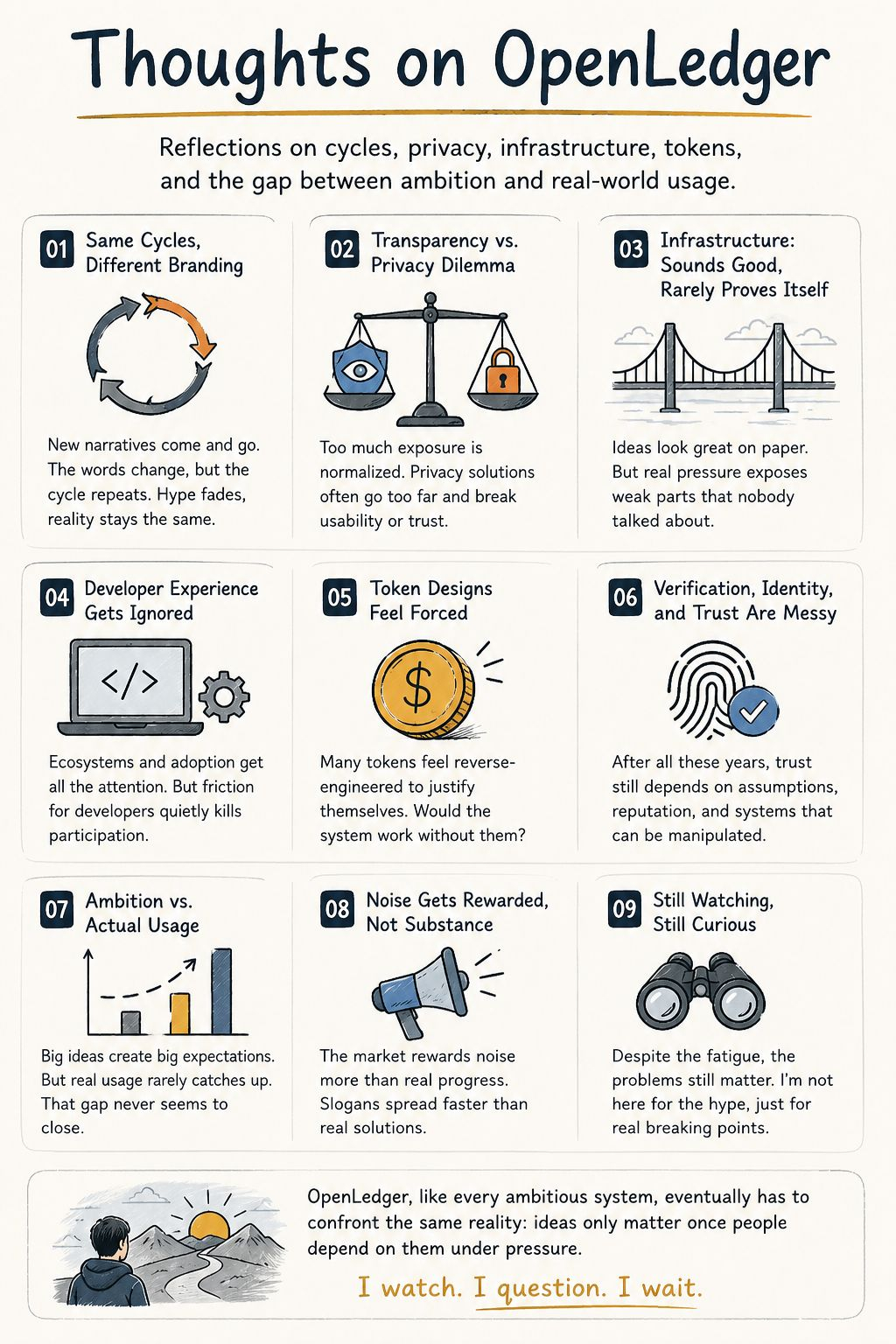
Mostly because I’ve spent years watching the same cycle repeat itself under different branding.
The names change.
The slogans change.
The excitement changes.
But the behavior rarely does.
Every few months there’s another narrative that suddenly becomes impossible to escape.
Everyone starts repeating the same language.
The same confidence.
The same predictions.
And after a while the words stop feeling real.
They start sounding recycled.
That’s probably the part that exhausts me the most.
this project makes me think about that constantly.
The distance between ambition and reality.
Between storytelling and actual usage.
That gap never seems to close properly.
No matter how polished the presentation looks.
Everything sounds revolutionary before real pressure arrives.
Then suddenly the weak parts become visible.

Quietly.
Almost slowly.
Infrastructure is another thing I’ve become skeptical about over time.
Not because the ideas are bad.
But because theory is easy.
Real-world pressure is different.
Everything works perfectly inside controlled environments.
Everything scales inside presentations.
Then actual users arrive.
Actual behavior arrives.
And systems start revealing what they really are.
OpenLedger keeps reminding me that impressive ideas mean very little without durability.
Especially in spaces where narratives m0vE faster than reality.
Another thing I can’t stop noticing is how normalized exposure has become online.
Everything feels designed around visibility now.
Constant visibility.
Too much visibility.
And somehow people accepted that as normal behavior.
At the same time, privacy systems often swing too far in the opposite direction.
They become restrictive.
Awkward.
Difficult to trust.
Difficult to use naturally.
That balance still feels unresolved.
And honestly, I’m not sure the industry knows how to solve it yet.
OpenLedger keeps pulling me back toward those same questions.
Questions around trust.
Questions around identity.
Questions around verification.
Because after all these years those systems still feel fragmented and unreliable.
People talk endlessly about trustless environments.
But trust itself never disappears.
It just moves somewhere else.
Usually into assumptions people don’t openly discuss.
That contradiction keeps showing up everywhere.
Developer experience is another issue that quietly matters more than people admit.
Everyone talks about adoption.
Communities.
Growth.
Ecosystems.
But very few people talk about friction.
The small frustrations.
The exhausting parts of actually building things.
I haVe watched projects receive endless attention and still slowly fade away because building on them felt unnecessarily difficult.
N0T because the vision was small.
Because execution never matched the ambition.
That disconnect shows up constantly.
The more time I spend observing projects like OpenLedger, the harder it becomes for me to take token structures seriously at face value.
A lot of them feel forced.
Like they were designed backward.
Added because the market expected them to exist.
I keep asking myself the same question repeatedly.
Would the system still matter without the token attached to it?
That question filters out more projects than people probably realize.
What really stays with me about OpenLedger isn’t excitement.
It’s observation.
I’ve become more interested in breaking points than promises.
I watch where systems fail.
Where incentives distort behavior.
Where communities stop asking real questions and start repeating slogans instead.
The market still rewards noise faster than substance.
That has not changed.
Maybe that’s why polished narratives don’t impress me anymore.
I’ve seen too many of them collapse once real pressure arrived.
Still, I keep watching OpenLedger.
Not because I fully trust the industry.
But because unresolved problems still matter.
And real systems only reveal themselves when people actually depend on them.