
Sometimes crypto feels like it keeps circling back to the same question in different forms what should actually be owned on chain? First it was money, then art, then liquidity positions then real world assets. Now the conversation is slowly moving toward something stranger but honestly pretty interesting, AI models, data and agents.
I’ve noticed that when people talk about AI and crypto together, the discussion often gets stuck at the surface. Either it becomes pure hype, or it turns into a technical debate that most regular users scroll past. But OpenLedger’s idea around $OPEN caught my attention because it touches something deeper: what happens when AI models are not just tools sitting behind apps, but economic objects that can be used rewarded accessed and maybe even compete for liquidity?
That is where the idea of AI model liquidity starts to make more sense. In DeFi, we already understand liquidity pretty well. A token without liquidity is hard to trade. A protocol without liquidity is hard to use. A market without liquidity feels dead, even if the idea behind it is good. So when we apply that thinking to AI models, it raises a new question: can useful models have their own economic activity around them?
From my perspective this is one of the more underrated angles in the AI crypto space. A good AI model is not just code. It is trained on data shaped by contributors, used by applications and improved over time. If people are calling that model, paying for inference, staking around it, or rewarding the data behind it then the model starts to look less like a passive product and more like an active market participant.
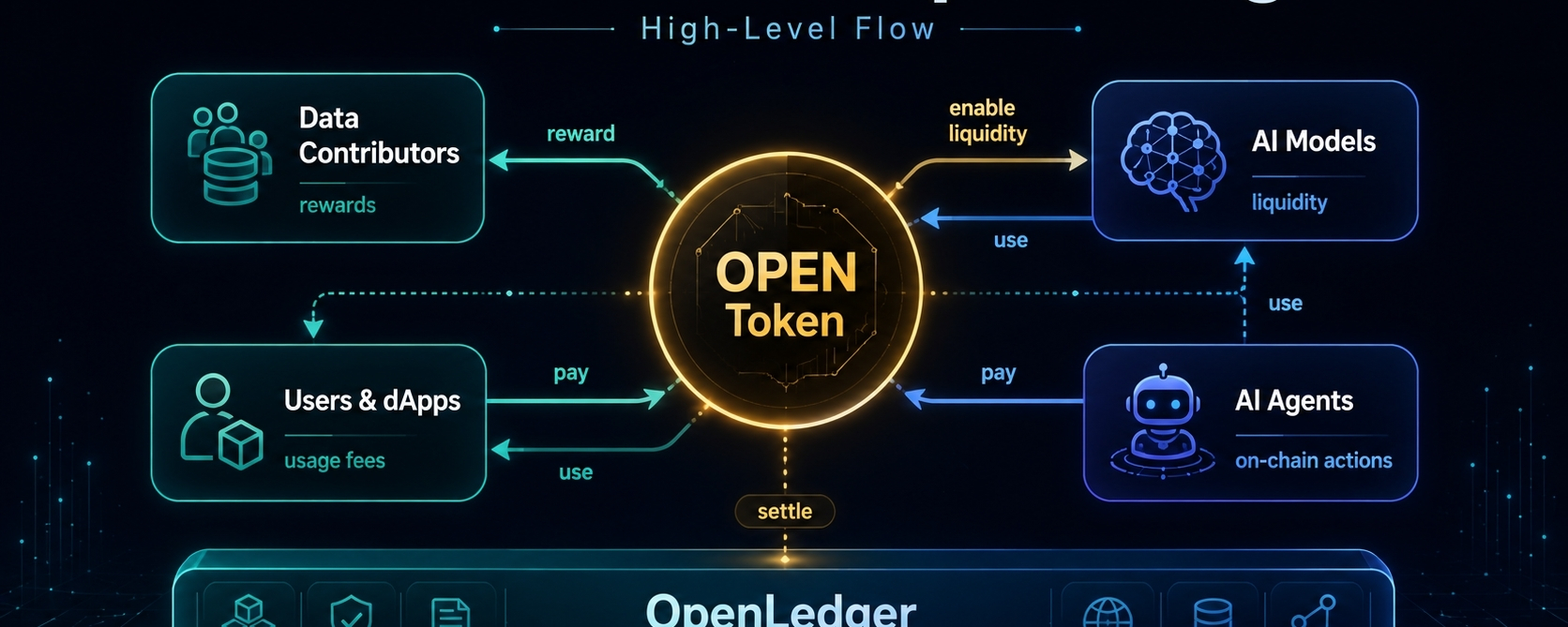
OPEN seems to sit in the middle of that system. It is used to pay for activity on the OpenLedger AI blockchain, including model related actions and inference usage. That may sound simple, but the important part is what it connects. Users need access, developers need revenue, data contributors need attribution, and agents need an economic rail to operate.
One thing that stood out to me is the Proof of Attribution concept. In normal AI systems, data often disappears into the machine. Someone contributes knowledge, content, behavior, or training material and after that it becomes nearly impossible to know what mattered. @OpenLedger is trying to make that influence traceable, so contributors can be rewarded when their data helps shape model outputs.
That changes the feeling of the AI stack. Instead of everything flowing upward into one closed model owner, value can move around the network. A useful dataset can matter. A better model can earn usage. A developer who creates something people actually use can receive activity based rewards. It feels closer to how crypto people already think about participation.
The liquidity part becomes more interesting when you imagine models as assets with demand. Suppose there are two AI models on chain. One is rarely used, while another handles lots of inference calls because builders keep plugging it into apps and agents. In a normal Web2 setup that usage might stay hidden inside a company dashboard. On chain, it can become visible economic activity.
That visibility matters. Crypto markets are very good at turning activity into signals. Not always perfect signals, of course. We have all seen empty hype get liquidity before useful products do. But over time. usage fees rewards and participation can tell a story. If an AI model is genuinely useful, the market can start to notice through activity rather than just announcements.
AI agents add another layer to this. An agent is not just a model answering a prompt. It can take actions. It can interact with contracts, move funds within permissions, call tools, route tasks, and maybe make decisions based on live conditions. Once agents do that on chain, they begin to behave like economic actors.
Sometimes I wonder if this is where crypto gets genuinely weird again, in a good way. We are used to humans trading tokens, bots arbitraging pools, and protocols managing incentives. But agents that consume models, pay fees, generate income, and interact with liquidity could become a new type of participant. Not human not exactly a company, not just a script either.
For Open,the question becomes how smoothly it can support that activity. If agents need to deploy call models pay for inference reward contributors, and operate inside an AI focused chain, then the token is not just sitting there as a speculative symbol. It becomes part of the plumbing. That does not automatically make it valuable, but it does make the design more meaningful than just attaching a token to an AI narrative.
The comparison I keep coming back to is gas in early smart contract networks. At first, many people treated gas as an annoying fee. Over time it became clear that gas was also a coordination mechanism. It priced activity, limited spam, paid validators, and gave the network a shared unit of execution. OPEN appears to be aiming for something similar, but around AI activity instead of only basic smart contract activity.
There is still a lot that needs to be proven. Model liquidity sounds good in theory, but markets only care when real users show up. Developers have to build useful agents. Data contributors need to believe the reward system is fair. Users need a reason to choose open AI rails over closed tools that are already fast and convenient. None of that is guaranteed.
And honestly, that is healthy to admit. Crypto has had too many cycles where every new phrase gets treated like destiny. “AI agents as on chain economic actors sounds exciting, but the real test is boring and practical. Can they do useful work? Can attribution be trusted? Can liquidity form around real demand instead of temporary farming? Can builders make tools people return to after the incentive campaign ends?
What’s interesting is that #OpenLedger is at least pointing toward a future where AI value is not trapped in one place. If models, datasets, agents, and users can interact through a shared token economy, the ownership map starts to look different. More modular. More open. Maybe messier too, but crypto has always been messy before it becomes useful.
For everyday users, I think the main thing is not to treat this as a simple token story. It is more of an infrastructure experiment. OPEN is trying to support the movement of value between the people and systems that make AI work. That includes model builders, data contributors, validators, users, and eventually agents that may operate with their own on chain patterns.
From my perspective, the bigger idea is that AI and crypto are slowly meeting at the level of incentives. Not just “AI token” branding, not just chatbots with wallets, but actual economic loops around intelligence, usage, and contribution. If that direction works, the next wave of on chain activity may not only come from traders clicking buttons. Some of it may come from agents, models, and data markets quietly doing work in the background.