
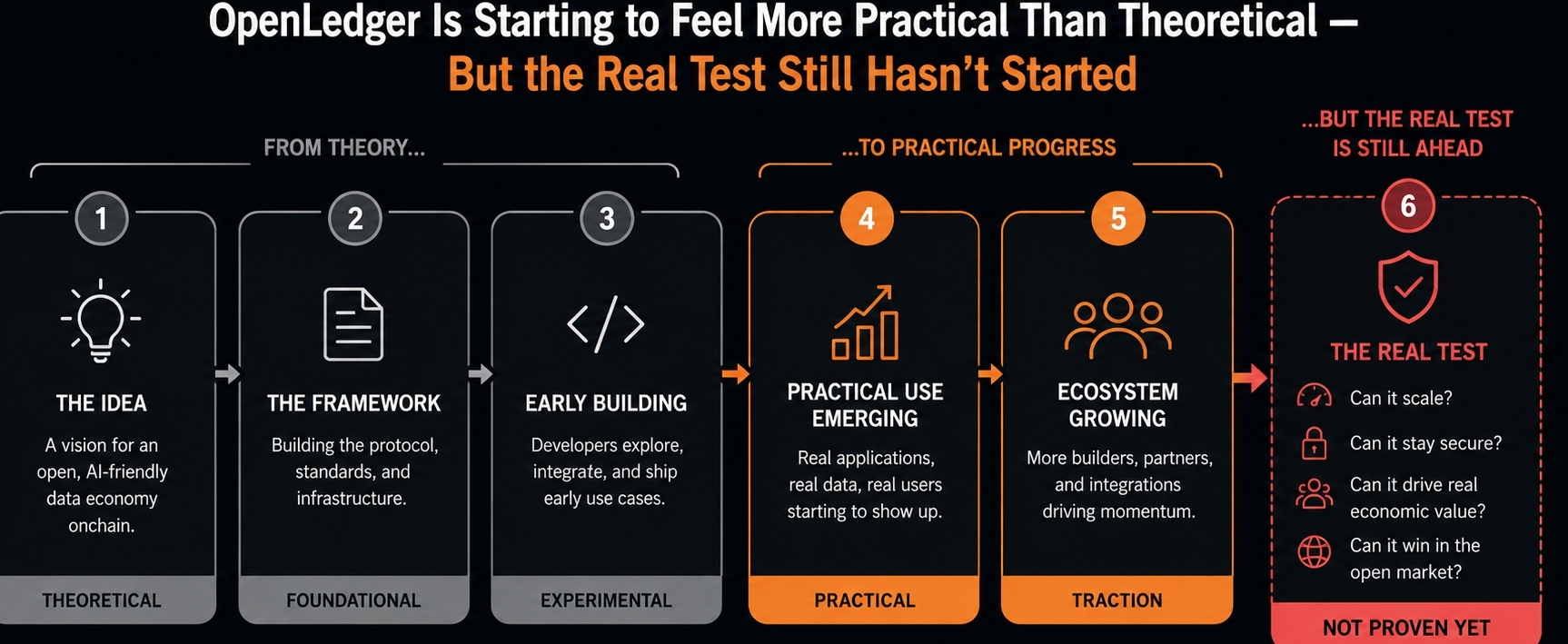
A few months ago, I still wasn’t sure what to make of OpenLedger.
Not because the idea was confusing — the AI + blockchain space has actually become pretty easy to decode at this point. Everyone talks about decentralized intelligence, data ownership, agent economies, and monetization layers. The language is familiar now.
What’s harder is figuring out which projects are actually moving toward something usable, and which ones are just getting better at sounding inevitable.
That’s the lens I’ve been using lately with OpenLedger.
Not: Is the vision ambitious?
Almost all of them are ambitious.
The better question is: Do the recent updates materially improve the system, or are they mostly ecosystem motion without real behavioral change?
And honestly, after revisiting the project recently, I think OpenLedger has started to look more coherent than it did earlier on. Not necessarily proven. Not mature. But more focused.
That matters more than hype.
Earlier, I felt like the project was trying to touch too many narratives at once — AI infrastructure, decentralized data, model ownership, agent economies, liquidity layers. Individually, those ideas make sense. Together, they can easily become a vague “future of AI” package where nothing is concrete enough to evaluate properly.
Lately though, I can see a clearer direction forming underneath it all.
OpenLedger seems less interested in becoming “another AI chain” and more interested in becoming an accounting and incentive layer for AI activity itself.
That’s a much more interesting position.
Because the real problem around AI right now isn’t lack of models. It’s lack of transparent ownership and compensation structures around the things that make models useful in the first place — data, fine-tuning, contributions, inference activity, agents, coordination.
Most AI systems today absorb value silently. People contribute data, behaviors, content, or training signals, and eventually that value disappears into closed platforms.
OpenLedger is trying to keep that value visible and economically trackable.
At least conceptually, that’s meaningful.
But this is also where I think reality becomes uncomfortable.
Designing a system that rewards contributions is easy in theory. Designing one that survives manipulation is the real challenge.
And I think OpenLedger is approaching the stage where that distinction starts to matter more than announcements.
Because once incentives enter a system, exploitation enters too.
Low-quality datasets. Spam agents. Artificial activity. Reward farming. Fake contribution loops. Copied outputs disguised as participation.
That’s the environment these systems eventually face.
So when I look at recent OpenLedger progress, I’m not really paying attention to ecosystem size anymore. I care more about whether the infrastructure is becoming resistant to bad behavior.
Some updates do point in the right direction.
The stronger focus on verifiable contributions, transparent attribution, and reward coordination feels more practical than the earlier “AI economy” abstraction layer the project leaned into. It’s starting to sound less like a broad narrative and more like infrastructure.
That’s an improvement.
Still, I don’t think the difficult part has actually started yet.
Right now, OpenLedger benefits from possibility.
A lot of AI-native systems do.
People project future demand onto them because AI itself is moving so quickly that almost every supporting narrative feels temporarily plausible. The danger is that speculative momentum can hide structural weaknesses for a long time.
That’s why I’m cautious about treating integrations, launches, or ecosystem growth as proof.
Those things matter, but only under pressure.
Would the system still function well if participation doubled? If incentives dropped? If bad actors arrived at scale? If builders needed reliability instead of experimentation?
That’s where projects stop being concepts and start becoming infrastructure.
For developers, I think OpenLedger is becoming more interesting — but also more complicated.
The attractive part is obvious. If builders can plug into a shared attribution and monetization layer for AI outputs, that removes a huge amount of friction from creating AI-based applications. Most builders today still rely heavily on centralized distribution and payment systems.
So the idea of portable AI economics is genuinely powerful.
But the tradeoff is complexity.
The more layers you add around contribution tracking, validation, staking, ownership, and reward logic, the harder the developer experience becomes. And most infrastructure projects underestimate how much simplicity matters.
Builders tolerate ideology for a while. Eventually they optimize for reliability.
That’s why I still think OpenLedger is in a transition phase rather than a breakthrough phase.
The project feels smarter now than it did earlier. More internally aligned. Less dependent on buzzwords. Closer to a real economic thesis.
But I’m not convinced the system has proven durability yet.
And to be fair, maybe it’s too early to expect that.
AI itself is still unstable territory. Nobody fully knows what the long-term architecture around agents, decentralized training, or machine-to-machine economies will actually look like. OpenLedger is essentially building around assumptions that the market hasn’t fully validated yet.
That makes this both interesting and risky.
My confidence has definitely shifted upward compared to before, but mostly because the project now feels like it’s narrowing toward a specific problem instead of expanding endlessly outward.
That’s healthy.
The future update that would genuinely change my mind isn’t another ecosystem announcement or growth metric.
I want to see evidence that participation remains valuable even when speculation cools down.
Real usage. Sustained builder activity. Contribution systems that can’t be gamed easily. AI applications that continue operating because the infrastructure is actually useful, not because rewards temporarily attract traffic.
That’s the line I’m watching now.
Because if OpenLedger can eventually prove that decentralized AI coordination works under stress — not just during optimism — then the project becomes much harder to dismiss as another temporary AI-crypto cycle.
And honestly, that’s the first time I can say that possibility feels somewhat believable to me.
What makes this interesting now isn’t the size of the narrative around OpenLedger. It’s the possibility that the project is slowly moving from imagination into consequence.
Because once AI systems start assigning ownership, value, and incentives in real time, the conversation changes completely.
Then it’s no longer about futuristic concepts. It becomes about who controls intelligence, who gets paid by it, and who gets left invisible inside it.
And that’s the part I think most people still underestimate.
Right now, OpenLedger still lives in the space between promise and proof. But some systems become important long before they become undeniable.
The next phase won’t be decided by announcements. It’ll be decided by pressure.
And if this infrastructure still works when the easy optimism disappears, then OpenLedger may end up being remembered less as another AI crypto project — and more as one of the first attempts to build an actual economy around machine intelligence before the rest of the market realized it needed one.
