
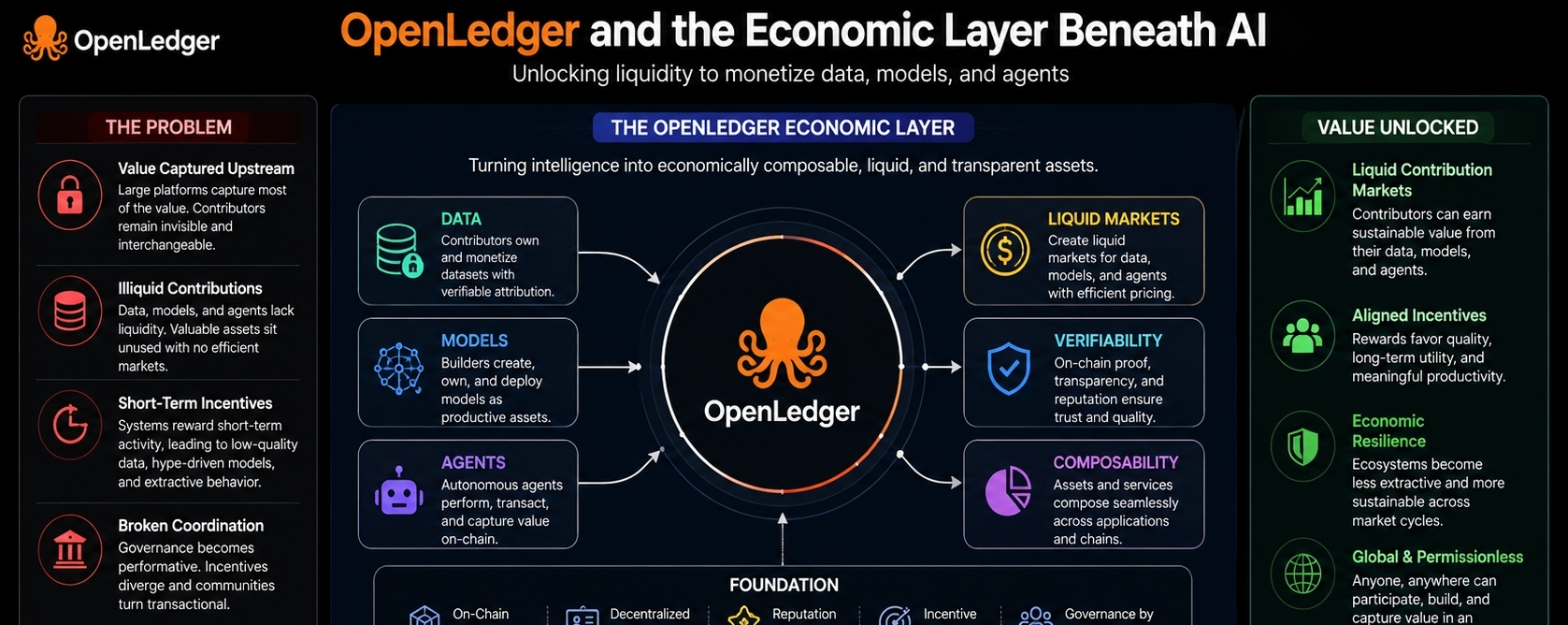
I have spent enough time watching crypto cycles to notice a pattern that repeats more often than people admit. Markets usually reward the loudest layer first, then years later they begin pricing the infrastructure underneath it. In AI, most attention still flows toward applications, model announcements, and benchmark wars. But beneath all of that sits a harder question that very few systems are seriously trying to solve: who actually captures the value created by intelligence itself?
OpenLedger exists inside that question.
I do not think the project becomes interesting because it combines AI and blockchain. That narrative alone is already overcrowded. What makes it worth studying is that it approaches intelligence as an economic coordination problem rather than a branding exercise.
For years, large platforms captured most of the upside while the contributors supplying the raw material remained economically invisible. Data providers rarely owned downstream value. Smaller model developers operated without meaningful leverage. Independent researchers improved systems they could never fully participate in. Infrastructure providers became replaceable the moment margins tightened. The flow of value was centralized long before the technology itself matured.
I see OpenLedger as a response to that imbalance.
The deeper issue was never only ownership. It was liquidity. Not trading liquidity in the usual DeFi sense, but liquidity around contribution itself. Valuable datasets often remain trapped because there is no efficient market structure around them. Models become static products instead of productive assets capable of generating ongoing economic activity. Autonomous agents can create measurable value yet still struggle to build durable economic identity on-chain.
Most systems acknowledge these inefficiencies indirectly while continuing to operate inside them. OpenLedger appears to confront them directly.
That distinction matters because crypto has already gone through multiple cycles of rewarding activity that looked productive until market conditions changed. I watched liquidity mining turn into emission dependency. I watched governance become symbolic participation rather than real stewardship. I watched protocols optimize for temporary growth metrics that collapsed once incentives weakened. Bull markets often hide structural fragility better than any marketing campaign ever could.
AI networks now risk inheriting the same weaknesses.
I think many people underestimate how quickly incentive structures distort behavior once real capital enters a system. Data providers begin optimizing for volume over quality. Builders chase benchmark visibility instead of long-term usefulness. Agent ecosystems fill with automation that creates measurable activity but very little durable economic value. On paper, growth looks healthy. Underneath, the system slowly becomes extractive.
That is why OpenLedger’s design philosophy matters more than short-term adoption metrics.
The protocol treats intelligence as an economic layer that requires attribution, coordination, and monetization infrastructure. I see that as a more grounded approach than simply attaching AI terminology to conventional token mechanics. The goal is not only to tokenize exposure to AI growth. The larger ambition appears to be creating financial rails where data, models, and agents can participate in shared value creation without relying entirely on centralized intermediaries.
Whether that works at scale remains uncertain. But the problem itself is real.
I also think the broader market still misprices scarcity inside AI economies. Most attention stays focused on compute because compute is easier to quantify. But scarcity increasingly exists elsewhere. High-quality proprietary datasets are scarce. Trustworthy outputs are scarce. Specialized models trained around difficult domains are scarce. Reliable autonomous behavior is scarce. Verification mechanisms around machine-generated work are scarce.
The next generation of AI infrastructure may depend less on who owns the biggest model and more on who builds the most efficient systems for coordinating these scarce resources economically.
That creates tension between centralized and decentralized systems. Closed platforms benefit from opacity because opacity concentrates leverage. Open systems benefit from transparent attribution because attribution allows contribution to become investable. I think OpenLedger is positioning itself inside that transition rather than outside it.
What I find most important is that the project cannot be judged purely through the lens of short-term token performance. Too many crypto participants still evaluate infrastructure as if every protocol exists only to maximize near-term price movement. But infrastructure tends to matter slowly before it matters suddenly.
The harder test for OpenLedger will come later.
It will come when speculation cools down and contribution becomes less financially attractive. It will come when market volatility pressures participants into short-term extraction. It will come when governance decisions create unavoidable trade-offs between growth, sustainability, and decentralization. Every serious protocol eventually reaches the point where incentive design matters more than narrative momentum.
I think that moment reveals what a system truly is.
Some protocols survive because markets remain euphoric long enough to hide structural weaknesses. Others survive because they solve coordination problems that continue existing regardless of market conditions. Historically, the second category tends to shape industries more deeply over time.
That is why I view OpenLedger less as a trend and more as an experiment around economic structure. The protocol is attempting to answer a difficult question that will likely become more important over the next decade: how should value move in economies increasingly shaped by machine intelligence?
I do not think the answer will emerge cleanly. Many AI-crypto projects will overpromise. Some will confuse speculative demand with actual utility. Others will create systems where incentives look sustainable only during expansion phases. Markets eventually expose those weaknesses.
But I also think the need for decentralized coordination around data, models, and agents will continue growing regardless of narrative cycles. Intelligence is slowly becoming infrastructure, and infrastructure eventually demands ownership systems capable of operating across borders, participants, and machines without relying entirely on centralized control.
That is the longer horizon where OpenLedger starts to matter.
Not because it guarantees success. Not because it promises immediate transformation. But because it is trying to build economic architecture around a shift that already appears underway. Quiet protocols often leave the deepest impact because they focus less on attention and more on unresolved structural problems.
I believe OpenLedger belongs in that conversation
