Most days in crypto I am not hunting for the cleanest story. I am usually hunting for the part of the story that still feels badly named.
That sounds minor, but naming matters in markets. Once a project gets placed into the wrong bucket, capital starts judging it with the wrong checklist. AI token. Data token. Agent project. Infrastructure play. These labels move fast across the timeline, and sometimes they flatten the actual thing being built.
I had that feeling with OpenLedger.
At first glance, it is easy to throw it into the same crowded AI infrastructure pile. There are too many of those already. Every week there is another dashboard, another agent layer, another GPT wrapper wearing a token economy costume. I have traded enough of these narratives to know the pattern. First comes the big language about ownership and intelligence. Then comes a chart that runs ahead of usage. Then everyone starts asking where the real demand is.
So I try to be careful with OpenLedger. I do not want to treat it like another AI headline. The frame that keeps staying with me is different.
OpenLedger may be building a barcode system for AI.
Not a barcode in the literal retail sense. More like the missing identification layer for intelligence. That matters because AI today still produces a strange kind of nameless value. A model gives an answer. A dataset improves performance. A contributor adds useful knowledge. An agent makes a decision. Somewhere in that chain, value appears, but the origin gets blurred.
Who created the signal? Which data mattered? Which model version used it? Who deserves credit if that intelligence keeps producing economic output later?
Right now, a lot of that disappears into the machine.
That is not only unfair. More importantly for markets, it is inefficient. If a system cannot identify where value came from, it cannot price that value properly. It can only guess. Crypto is very good at guessing for a while, especially when the narrative is hot, but guessing is not the same as durable settlement.
This is why the barcode idea feels useful to me. A barcode does not make a product valuable by itself. It makes the product readable. It lets the system know what the item is, where it moved, who handled it, and how it fits inside a larger supply chain. Once that exists, inventory becomes easier to track. Payments become cleaner. Fraud becomes easier to detect. Routing becomes more efficient.
AI has models, outputs, prompts, datasets, agents, and contributors. What it lacks is clean market memory.
OpenLedger seems interesting because it is trying to make intelligence traceable before the AI economy becomes too large and too messy to audit. That is the part I keep circling back to. If AI outputs become more important to trading, research, automation, customer service, gaming, and on-chain execution, then provenance stops being a nice feature. It becomes infrastructure.
Think about a small operator building a niche AI model for crypto research. Not some giant general model. Just a focused model trained on market structure, token unlocks, liquidity behavior, governance events, wallet flows, and maybe sector-specific data. The model gets better because contributors keep feeding it useful corrections and domain knowledge. Maybe one person improves how it reads liquidity depth. Another improves its ability to detect fake volume. Another helps it understand validator economics.
If that model later creates value, how does the system know which contributions mattered?
In the normal internet model, everything blends together. The final product gets monetized, while the contribution trail becomes foggy. In a better system, each meaningful contribution could carry a record. Not just a vanity score. Not just a profile badge. A usable history that says this input improved this model, this model powered this output, and this output created measurable usage.
That is where OpenLedger could become more than an AI narrative.
It could become an accounting layer for intelligence.
I am not saying that lightly. Accounting sounds boring until money starts moving. Then it becomes the whole game. Markets need ledgers because memory matters. If AI is going to create economic output, then somebody has to track the path between contribution, usage, reputation, and reward. Otherwise the system turns into another black box where the people providing useful intelligence get priced at zero while the interface captures the upside.
Still, the risk is real.
Attribution is hard. Everyone wants credit once rewards exist. Low quality contributors will try to farm the system. Bots will try to manufacture activity. Model improvement is not always easy to measure. A contribution can look useful on the surface and still add noise underneath. If the scanner is weak, the barcode becomes decoration.
That is the key failure mode.
OpenLedger only works if the attribution layer becomes trusted enough that builders actually care about it. Developers must feel that it helps them source better intelligence, reward better contributors, and build stronger models. Contributors must feel their work is not disappearing. Validators or verification participants must have meaningful roles that are not just symbolic. The OPEN token must sit near real coordination, access, validation, or settlement demand. If it sits too far away from actual usage, the thesis gets weaker.
This is what I would watch, more than short-term price action.
Are useful models being built with traceable contribution histories? Do contributors keep showing up after early incentives fade? Does the system separate quality from spam? Do builders treat attribution as a needed primitive, or only as a story for fundraising and marketing? Does token demand come from real flow, or just from attention around AI?
That is the difference between infrastructure and narrative dressing.
The timing also matters. A few years ago, this might have been too early. AI had not yet entered every workflow. Crypto infrastructure was still dealing with basic friction. L2s were less mature. Wallet tooling was worse. Proof systems were more experimental. Now the environment feels different. AI agents are becoming more believable. Modular infrastructure gives builders more design room. On-chain coordination is cheaper. Data ownership and attribution are becoming practical market questions, not abstract debates.
The bigger shift is that intelligence may need supply chain logic.
We already accept this in physical markets. We want to know where food came from, who manufactured a part, whether a product is authentic, and how it moved across the system. AI output may need similar treatment. Not because every user will care. Most users will not. But serious builders, traders, institutions, and agents may care a lot when money, risk, and reputation are involved.
A nameless answer is fine for casual search.
It is less fine when capital moves because of it.
That is where OpenLedger’s idea becomes worth tracking. It is not just trying to make AI more open. It is trying to make intelligence legible enough to be priced, routed, verified, and rewarded. Maybe the market understands that later. Maybe it does not. Maybe the execution breaks somewhere between attribution theory and real contributor behavior.
I am not treating it like a clean call.
I am just watching the shape of the thing. Because if AI keeps eating workflows, the next valuable layer may not be the loudest model. It may be the system that can prove where intelligence came from before the market trusts it with real capital.

Artikel
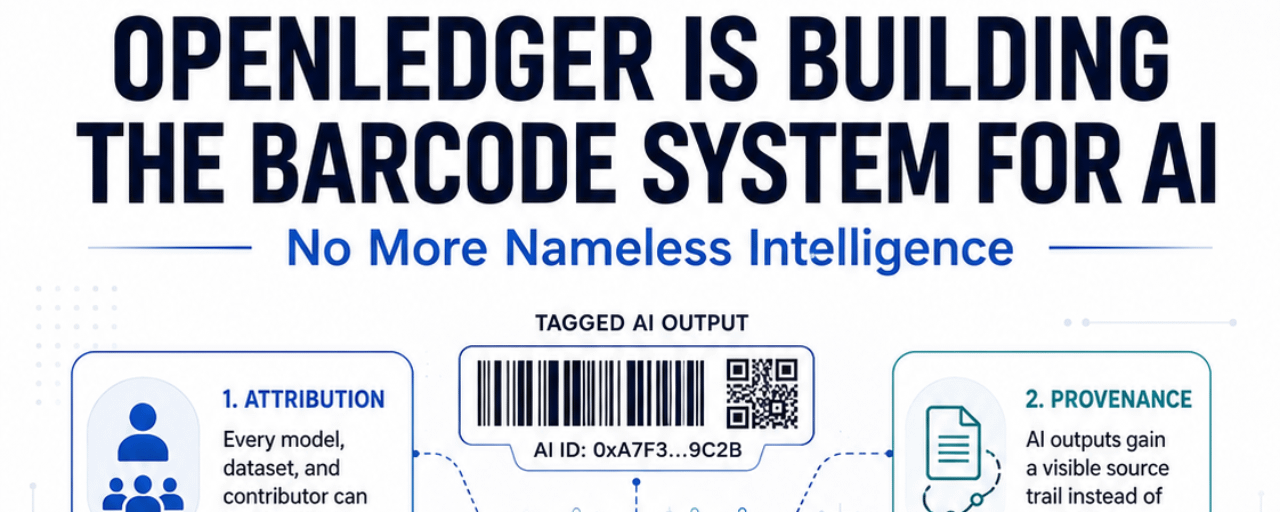
OpenLedger is building the barcode system for AI no more nameless intelligence.