
The blockchain industry talks endlessly about interoperability, but most people only notice the problem when they actually try moving assets between chains.
Suddenly, the process becomes confusing. Different wallets, wrapped assets, bridge approvals, gas mismatches, delayed confirmations, and security concerns all appear at once. Even experienced users sometimes hesitate before transferring funds because one wrong step can create unnecessary risk.
That is one reason OpenLedger’s approach toward cross chain infrastructure caught my attention.
After reading through OpenLedger’s documents, ecosystem explanations, technical descriptions, and architecture discussions, I started viewing the project less as “another AI blockchain” and more as infrastructure trying to remove friction from intelligent decentralized systems. The EVM Bridge is a good example of that direction because it quietly solves a problem that affects both users and developers across modern blockchain ecosystems.
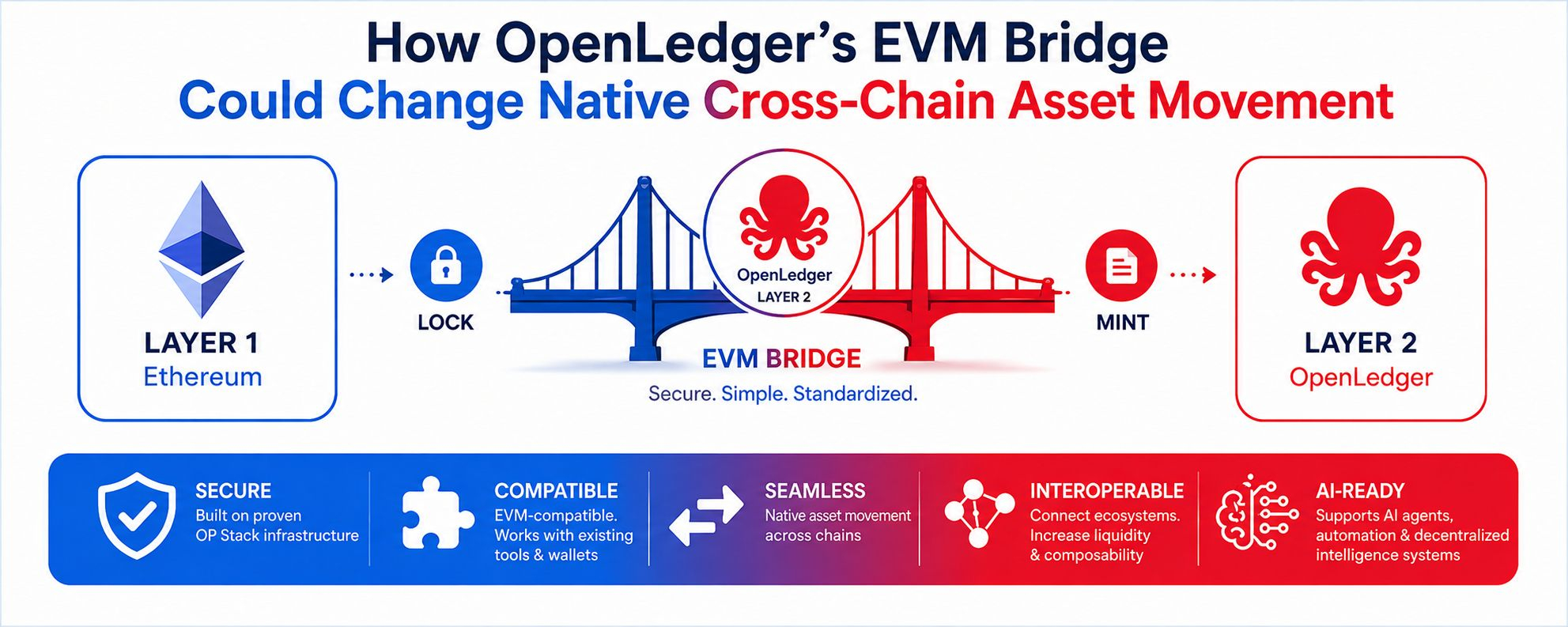
OpenLedger is built as an EVM-compatible Layer-2 environment designed around AI infrastructure, attribution systems, decentralized data contribution, and scalable execution. Instead of forcing developers into a completely unfamiliar framework, the network follows Ethereum standards and supports existing wallets, contracts, and tooling. That compatibility matters more than many people realize.
Historically, one of the biggest barriers in blockchain adoption has been ecosystem fragmentation. Liquidity sits on one network, applications live on another, and users constantly move assets between environments just to participate. Bridges were created to solve that problem, but the reality is that many bridge systems became overly complicated. Some introduced unnecessary trust assumptions, while others relied heavily on custom architectures that later exposed security weaknesses. Research around bridge exploits has repeatedly shown that complexity often increases systemic risk.
What makes OpenLedger interesting to me is that the project appears intentionally conservative in its bridge philosophy.
According to discussions surrounding OpenLedger’s implementation, the bridge architecture relies heavily on canonical OP Stack components such as the Standard Bridge, CrossDomainMessenger, and OptimismPortal infrastructure instead of introducing heavily modified experimental systems. The OPEN token bridging process reportedly follows the standard mint-and-burn structure commonly associated with OP Stack ecosystems. Assets lock on Layer 1, mint on Layer 2, and reverse during withdrawals.
That may sound like a small technical detail, but I actually think it is one of the smartest decisions the project could make.
In crypto, simplicity is underrated.
A lot of bridge disasters happened because teams attempted to build overly ambitious custom systems before proving long-term reliability. OpenLedger seems to understand that infrastructure supporting AI execution, decentralized coordination, and asset movement should prioritize predictability first. A bridge does not need to feel flashy. It needs to feel dependable.
From my perspective, this could become especially important if OpenLedger succeeds in expanding its AI-driven ecosystem.
The network is positioning itself around verifiable AI infrastructure, Proof of Attribution, decentralized datasets, intelligent automation, and AI-native applications. In environments like that, cross-chain movement becomes more than a convenience feature. It becomes operational infrastructure.
Imagine AI agents operating across decentralized systems while interacting with multiple liquidity environments simultaneously. Those systems cannot afford fragmented asset accessibility. If AI-powered applications are expected to execute tasks autonomously, then moving value between ecosystems must become smoother, faster, and more standardized.
That is where OpenLedger’s EVM compatibility may quietly become a major advantage.
Because the network follows Ethereum-compatible standards, developers do not need to completely relearn tooling before integrating applications or assets. Wallet behavior remains familiar. Smart contract logic becomes easier to port. Existing Ethereum infrastructure can interact with OpenLedger more naturally. Even the psychological barrier for developers decreases when the environment feels recognizable.
I also think the bridge matters because it could improve native asset mobility instead of encouraging isolated liquidity silos.
Many blockchain ecosystems struggle because users bridge assets into networks but rarely move them back efficiently. Liquidity becomes fragmented, users experience friction, and ecosystems lose composability. A well-structured EVM bridge creates continuity between environments rather than forcing users to choose only one chain permanently.
For OpenLedger, that continuity could support broader participation in AI-powered decentralized systems.
The project’s broader architecture already emphasizes transparent contribution tracking, decentralized data economies, and attribution-based incentives through Proof of Attribution mechanisms. Cross-chain accessibility could strengthen that model by allowing users and developers from different ecosystems to interact with OpenLedger infrastructure without abandoning their existing blockchain environments entirely.
Another thing I personally appreciate is that OpenLedger seems focused on infrastructure practicality rather than excessive marketing language.
A lot of blockchain projects advertise interoperability as if simply connecting chains automatically solves adoption problems. In reality, interoperability only matters when users trust the movement layer itself. Security, consistency, auditability, and operational clarity matter far more than flashy terminology.
OpenLedger’s direction appears closer to that practical mindset.
The bridge is not being presented as a magical innovation reinventing blockchain communication. Instead,
it looks more like an effort to create reliable movement rails using established EVM infrastructure while supporting the project’s larger AI and decentralized attribution ecosystem. Honestly, that restraint makes the architecture feel more credible to me.
As blockchain ecosystems continue evolving toward AI-integrated applications, autonomous execution, and decentralized intelligence systems, cross-chain asset movement will likely become even more important than it is today.
In that environment, projects that reduce friction without sacrificing reliability may quietly become foundational infrastructure.
And from what I have seen in OpenLedger’s documentation and technical direction, its EVM Bridge could become one of those foundational pieces.