@OpenLedger The crypto industry has entered a stage where narratives alone are no longer enough to sustain long-term attention. In earlier cycles, a project could survive purely through hype, marketing, and temporary momentum, but the market today feels far more mature than it did just a few years ago. Users have become more experienced, developers are thinking beyond short-term trends, and investors are slowly starting to pay attention to infrastructure instead of only speculation. After watching the evolution of blockchain technology over the past several years, I’ve started believing that the projects most likely to dominate the next phase of the industry are not necessarily the loudest ones, but the ones quietly building the systems capable of supporting where decentralized technology is actually heading. That is exactly why @OpenLedger #OpenLedger has recently started standing out to me in a much deeper way than most AI-related projects currently entering the market.
At first glance, many people may assume OpenLedger is simply another blockchain project attempting to capitalize on the growing excitement surrounding artificial intelligence. The AI narrative has become one of the strongest forces in both traditional technology markets and crypto ecosystems, so naturally countless projects are trying to position themselves inside that movement. But the more I analyze OpenLedger’s broader direction, the more I think the real value proposition goes far beyond basic AI automation or simple predictive tools. In my opinion, the project appears to be positioning itself around one of the most important long-term sectors emerging inside blockchain technology: infrastructure capable of supporting decentralized AI systems operating efficiently across fragmented ecosystems.
That distinction matters far more than most people currently realize. Over the past few years, AI has dramatically improved the speed of information processing across industries. Models can now identify patterns faster, analyze market conditions in real time, process enormous amounts of data, and automate tasks that previously required constant human involvement. But inside crypto, the conversation around AI often remains surprisingly shallow. Most discussions focus heavily on trading signals, automated strategies, or predictive analytics, while ignoring the deeper problem that intelligent systems still require reliable environments where execution can happen efficiently. Intelligence alone does not solve fragmentation, liquidity distribution, interoperability limitations, or execution bottlenecks. And honestly, I think this is where many current AI narratives inside crypto start becoming disconnected from reality.
The blockchain industry itself has changed dramatically between 2023 and 2026. Ethereum remained dominant as the foundational smart contract ecosystem, but the broader market evolved into a highly fragmented multi-chain environment. Layer 2 networks like Arbitrum, Optimism, and Base expanded rapidly while alternative ecosystems continued building independent liquidity hubs, user communities, and application layers. Initially, this growth looked entirely positive because users gained access to lower transaction fees, faster execution speeds, and more specialized ecosystems. But over time, fragmentation created an entirely new set of problems that slowly became impossible to ignore. Liquidity became spread across chains, users constantly needed bridges to move assets, developers were forced to maintain multiple integrations, and even basic workflows started requiring unnecessary complexity simply to interact across ecosystems.
Most people accepted these inefficiencies as a normal part of crypto evolution, but I personally don’t think they remain sustainable long term. As blockchain adoption increases, users will naturally begin expecting smoother systems, faster interoperability, and environments where liquidity and execution can move across ecosystems without excessive friction slowing everything down. This shift becomes even more important once AI systems begin interacting with decentralized networks more actively. An intelligent system may identify opportunities instantly, but if the infrastructure underneath it is fragmented or inefficient, the advantages of that intelligence quickly disappear. Delays during bridging, isolated liquidity pools, inconsistent execution environments, and disconnected ecosystems all reduce the effectiveness of autonomous systems operating at scale.
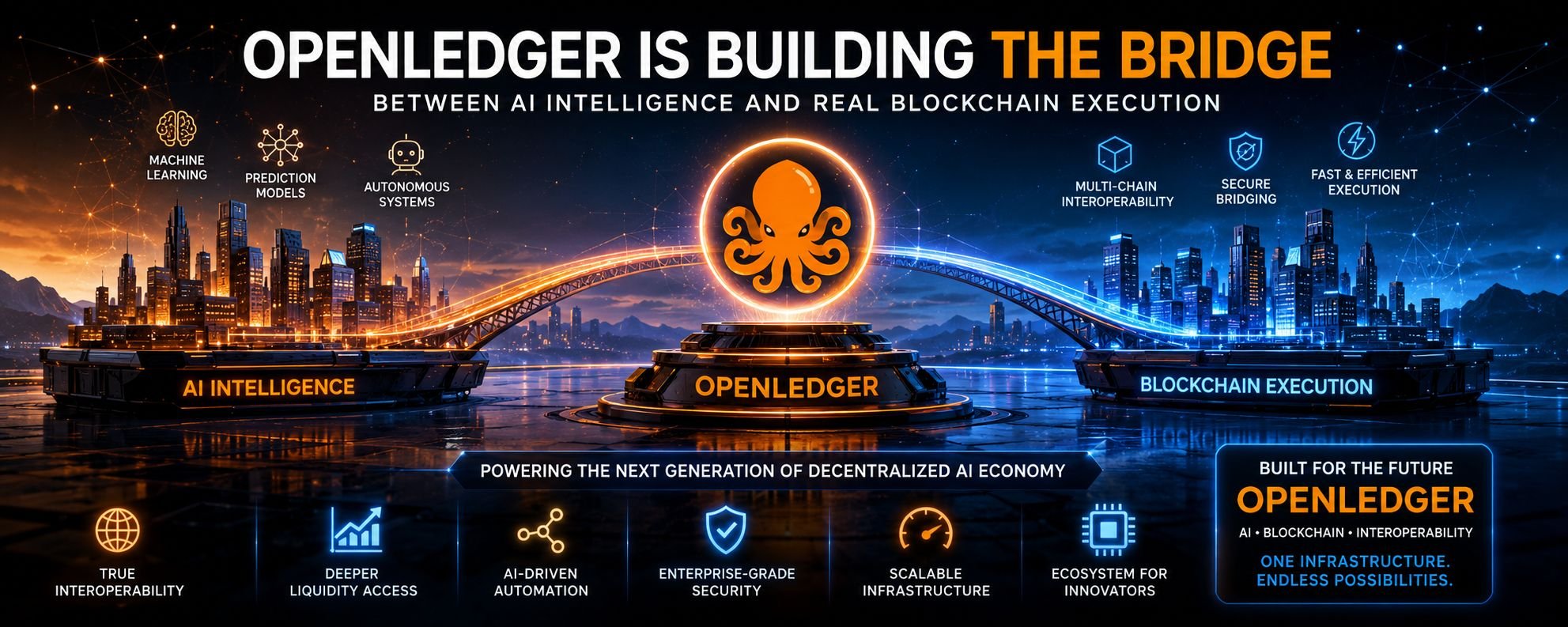
That is exactly why OpenLedger’s direction feels strategically important to me. Instead of focusing only on short-term AI excitement, the project appears to be positioning itself around the infrastructure layer required for decentralized AI ecosystems to actually function efficiently over time. I think this is a much larger opportunity than many people currently understand. The future of AI inside crypto will likely depend less on who creates the most attractive market predictions and more on which projects build environments where intelligent systems can interact, execute, and scale across decentralized networks without constant friction.
This is also why interoperability infrastructure matters so much moving forward. I no longer see interoperability as simply a convenience feature designed to help users transfer assets between chains. I think interoperability is gradually becoming one of the foundational pillars of the entire blockchain industry. If the future becomes increasingly multi-chain, then the ability for liquidity, data, smart contracts, and execution layers to interact smoothly across ecosystems becomes absolutely essential. Without interoperability, the industry risks becoming a collection of isolated networks constantly competing against each other while sacrificing efficiency in the process.
OpenLedger’s movement into interoperability solutions like EVM bridging feels connected to this broader vision. Many people still underestimate how important efficient cross-chain infrastructure may become over the next several years. Bridges are often viewed only as tools for transferring assets between ecosystems, but I think their long-term significance is much larger than that. Effective interoperability infrastructure can reduce operational friction across the entire market. It can improve execution speed, simplify decentralized coordination, expand liquidity accessibility, and create environments where AI-driven systems can function far more effectively than they currently do.
From a trader’s perspective, I believe infrastructure improvements like these can eventually create larger long-term impacts than short-term price movements themselves. Many inefficiencies inside crypto markets are not caused by poor trading strategies alone. Sometimes the biggest issue is simply infrastructure friction. Capital may exist on the wrong chain while opportunities disappear elsewhere. Bridging delays may reduce flexibility during volatile market conditions. Fragmented liquidity can create unnecessary complications when execution speed matters most. These problems may appear small individually, but over time they compound in ways that significantly reduce efficiency and performance.
That is why infrastructure projects often become far more valuable later than the market initially expects. In the early stages, most attention naturally flows toward hype-driven narratives because infrastructure development rarely feels emotionally exciting. But historically, the systems reducing friction underneath industries are often the layers that eventually become the most important. The internet evolved in a very similar way. During the early years, most people focused primarily on websites, applications, and visible platforms while the networking infrastructure quietly transformed global communication behind the scenes. Over time, it became obvious that the infrastructure itself was enabling everything else to scale.
I think crypto may now be approaching a similar transition. The conversation is slowly shifting away from isolated ecosystems competing for dominance and toward connected environments capable of interacting more efficiently together. In that kind of future, infrastructure supporting interoperability, scalable execution, and autonomous decentralized systems may become significantly more valuable than most people currently expect.
Of course, none of this guarantees success. Infrastructure projects face enormous technical pressure, especially when interoperability, AI systems, and decentralized execution environments are combined together. Security remains critical, and the blockchain industry has already experienced enough bridge exploits and ecosystem failures to understand how dangerous weak infrastructure can become. Strong vision alone is never enough. Execution quality, scalability, reliability, and adoption ultimately determine whether projects survive long term.
Still, when I analyze OpenLedger’s broader positioning, I think the project is aiming at one of the most important sectors emerging inside blockchain technology today. Instead of simply building another temporary AI narrative, it appears focused on creating infrastructure capable of supporting how intelligent decentralized ecosystems may actually function in the future. Personally, I believe that approach gives OpenLedger a far more strategic position than many people currently realize.
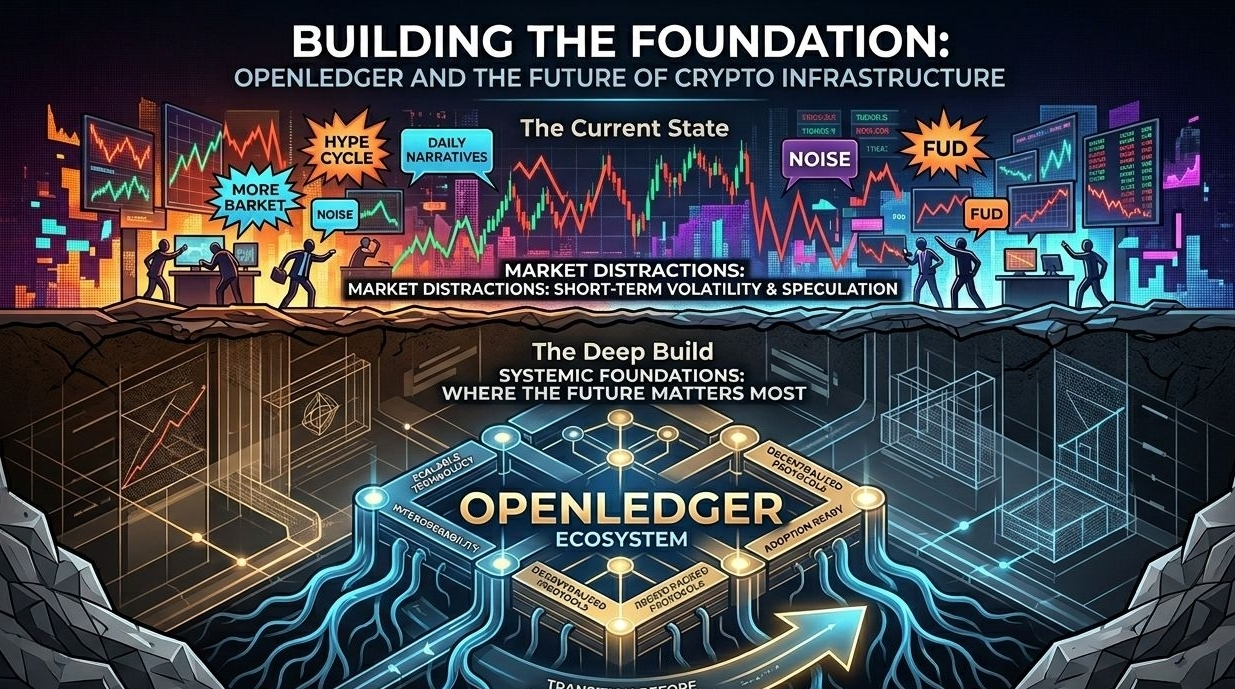
Right now, most of the market remains distracted by short-term volatility, daily narratives, and constant speculation. But beneath all of that noise, the foundation for the next phase of crypto infrastructure is quietly being built. Historically, the projects improving how systems function underneath the surface often become the ones that matter most once adoption catches up with the technology itself. And in my opinion, OpenLedger may already be positioning itself directly inside that transition before the majority of the market fully understands how important infrastructure-focused ecosystems could eventually become.