
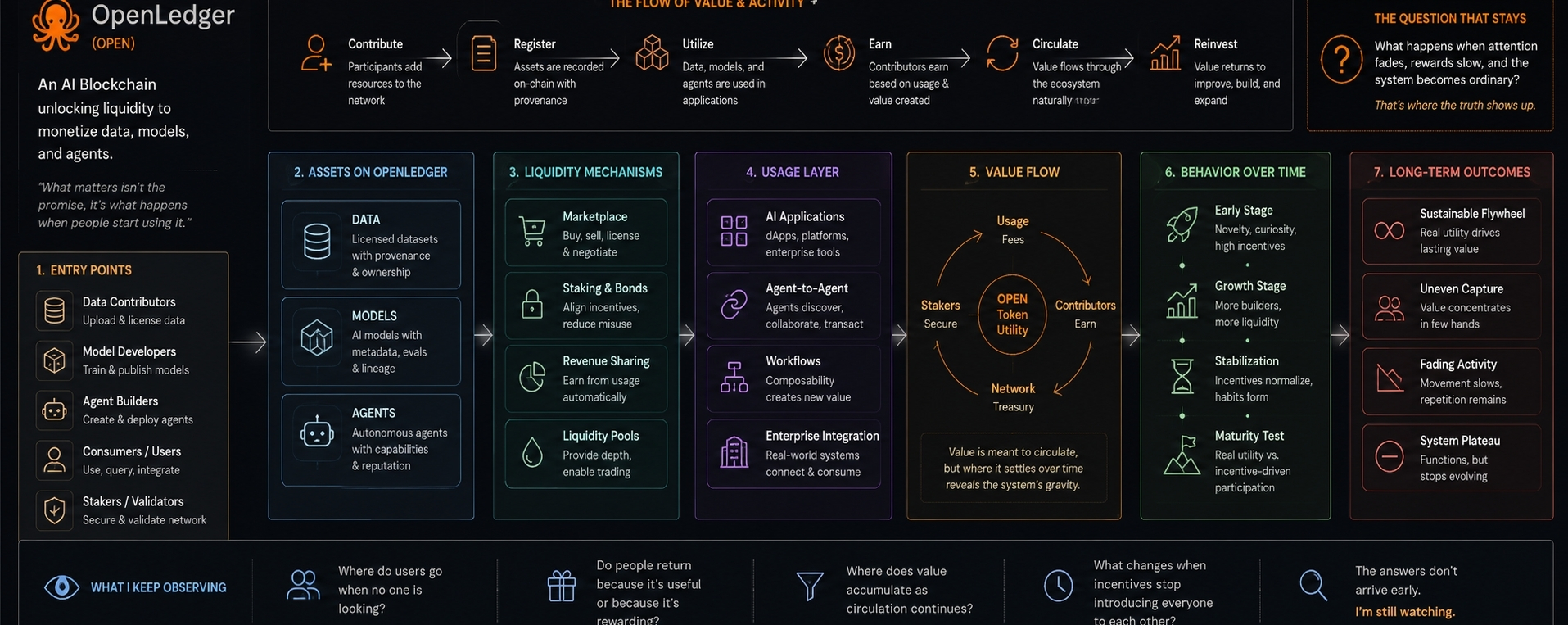
I’m watching and I’m waiting and I’m looking a little closer than I usually do because I’ve been paying attention to the smaller things that tend to disappear behind announcements and narratives and carefully chosen words, and I focus on small details because those details usually move before larger patterns become visible. I keep watching how people enter, how they stay, how they move between systems, how attention behaves when nobody is actively directing it. OpenLedger sits in front of me with this idea of turning data and models and agents into something liquid, something that can circulate, something that can be monetized rather than simply consumed, and I keep staring at that because I’m less interested in what it sounds like and more interested in what it eventually becomes once people begin touching it in ordinary ways.
I keep noticing that projects built around infrastructure often create a strange distance between the story and the behavior underneath it. The story usually arrives first. The movement comes later. What matters is not whether activity exists but what kind of activity survives after the first wave passes through. I find myself looking for friction. I look for hesitation. I look for moments where users stop moving automatically and start making choices. Those moments usually reveal more than metrics ever do.
What stands out to me starts feeling less like the technology itself and more like the direction of incentives moving underneath it. Data becomes an asset, models become assets, agents become assets, and eventually I start wondering where value actually settles after enough time passes. Does value stay near the people creating something, or does it slowly collect around systems designed to organize and distribute it? There is usually a difference between participation and ownership even when they appear close together.
I keep coming back to the idea of circulation because circulation can sometimes create the appearance of life even when the movement underneath is repetitive. Activity is easy to see. Genuine dependency is harder to find. People can interact with a system because rewards exist, because attention exists, because curiosity exists, but those reasons behave differently over time. Curiosity fades first. Attention shifts after that. Rewards eventually slow down. Then something quieter starts happening.
That’s where it gets interesting.
Because beneath all of this I keep asking myself whether behavior changes once the system stops introducing itself and starts becoming ordinary. I wonder what users are doing when nobody is watching them anymore. I wonder if people continue returning because they found something necessary or because movement itself became a habit. I wonder whether agents and models become useful objects or simply become things moving between people because movement itself creates signals.
This is where most projects fail without needing anyone to say they failed. Nothing dramatic happens. Everything just becomes quieter. Transactions still exist. Numbers still move. The machine still functions. But something underneath loses tension. You stop seeing discovery and start seeing repetition.
And maybe that question stays sitting in front of me more than anything else. OpenLedger talks about unlocking something that already exists beneath the surface, and maybe that is true, but I keep finding myself looking beyond the unlocking part and staring at what happens afterward. I keep watching where people settle once movement becomes slower and attention becomes harder to hold. I keep watching who remains after incentives stop introducing everyone to each other.
I’m still watching that part. That always seems to arrive later.
