

A lot of people still think AI productivity breaks because models are not smart enough yet.
Spend enough time around AI tools and that idea starts feeling normal. Better reasoning models arrive. Context windows get larger. Agents become more capable. Every few weeks something faster appears. Something that writes better. Plans better. Understands more.
For a while I looked at it the same way.
The more time I spent digging into OpenLedger and especially OctoClaw, the more I felt the bottleneck was sitting somewhere else.
Workflow fragmentation.
That sounds smaller than model intelligence.
I do not think it is.
Most AI workflows today still break in a very human place. Not reasoning. Execution.
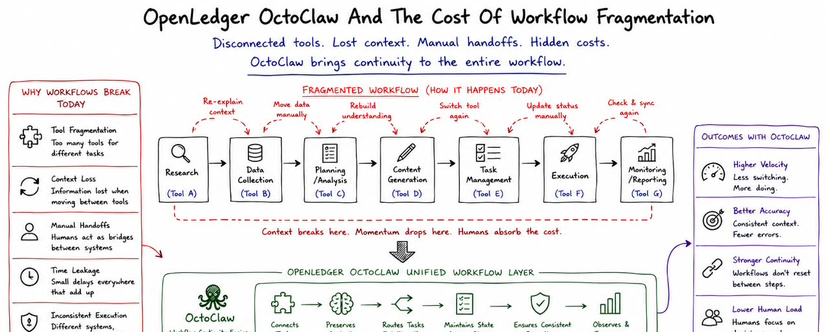
Research happens somewhere.
Writing happens somewhere else.
Data gets pulled from another place.
Tasks move into another system.
Approvals sit elsewhere.
Execution finally happens after multiple manual steps.
The strange thing is most people do not notice how much friction exists because we got used to carrying it ourselves.
Open tabs everywhere.
Copy information manually.
Move outputs between tools.
Rewrite context.
Re-explain objectives.
Reconnect pieces that should already understand each other.
The workflow technically works.
Efficiency quietly leaks.
The more I sat with OpenLedger's OctoClaw direction, the more that friction started feeling like infrastructure debt.
Not intelligence debt.
Infrastructure debt.
That distinction stayed with me.
People usually judge AI systems by output quality.
OctoClaw pulled me toward another question.
What happens after output?
That part feels underestimated.
A research agent finding information is useful.
A generation system creating content is useful.
Automation is useful.
The handoff between those layers becomes the problem.
Context breaks.
Momentum breaks.
Execution slows.
Humans become coordination infrastructure.
That last part kept staying in my head while looking deeper into OpenLedger.
Humans keep carrying operational burden between systems that should already communicate naturally.
The framework around OctoClaw feels designed around reducing that burden.
Not by adding more complexity.
By reducing how many times workflows lose continuity.
That changes how agents behave.
Most AI systems today still operate like isolated specialists.
Research here.
Generation there.
Execution somewhere else.
OpenLedger increasingly feels focused on keeping those layers connected.
That matters because context carries value.
An agent researching market information already learned something.
An execution system should not need humans rebuilding that understanding manually.
A workflow system should not lose memory every time tasks move between stages.
Context loss quietly becomes operational friction.
Operational friction becomes inefficiency.
The more systems scale, the larger that problem becomes.
One thing I kept thinking about while studying OctoClaw was how much AI infrastructure still assumes humans will keep acting as bridges between disconnected systems.
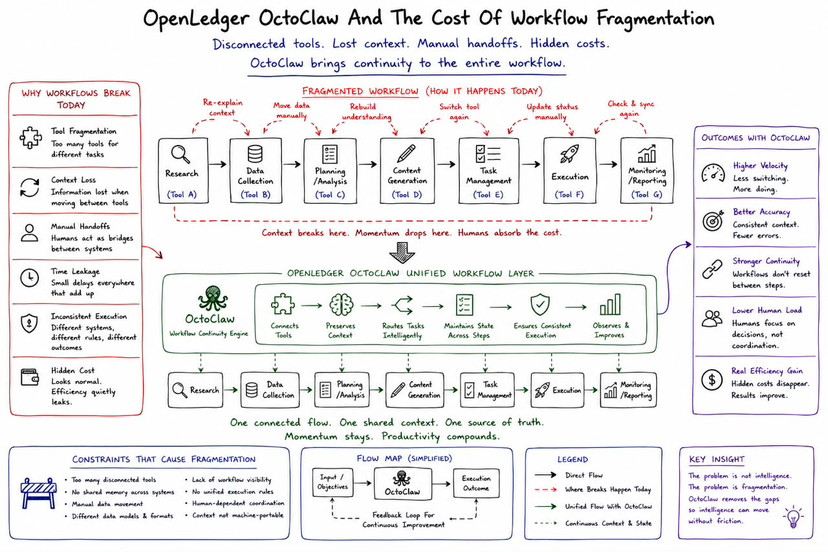
Move information.
Move context.
Move execution.
Move decisions.
People do not usually notice how much work sits there because we normalized it.
The system feels efficient.
The user quietly absorbs fragmentation costs.
That becomes harder as autonomous systems expand.
An agent operating continuously cannot depend on humans constantly stitching workflow pieces back together.
Research quality matters.
Execution quality matters.
Continuity matters too.
That feels like the layer OpenLedger keeps pushing toward.
Not isolated intelligence.
Operational continuity.
The interesting thing is workflow fragmentation rarely looks dramatic.
Nobody notices ten seconds lost here.
Two minutes lost there.
Extra verification somewhere else.
Repeated context rebuilding.
Small inefficiencies compound.
Teams feel slower.
Systems feel heavier.
Automation feels weaker than expected.
The infrastructure technically exists.
The workflow still feels broken.
The longer I looked into OctoClaw, the less I thought about agent capability.
I kept coming back to workflow continuity.
Because future autonomous systems probably do not fail because intelligence becomes unavailable.
They fail because fragmented systems quietly destroy momentum underneath execution.
OpenLedger kept pulling me back toward that problem.
Not because OctoClaw makes agents smarter.
Because reducing fragmentation changes how intelligence moves through systems in the first place.
That feels bigger than people realize right now.