For the last few years, I’ve noticed how quickly people confuse momentum with meaning. Every cycle feels louder than the one before it, but somehow less convincing. The same ideas keep returning with slightly different language wrapped around them, and eventually the narratives start collapsing into each other until none of them really say anything anymore. That’s probably why OpenLedger keeps sitting in the back of my mind lately. Not because I think it has all the answers, but because it seems aware of a problem most people still treat like background noise.
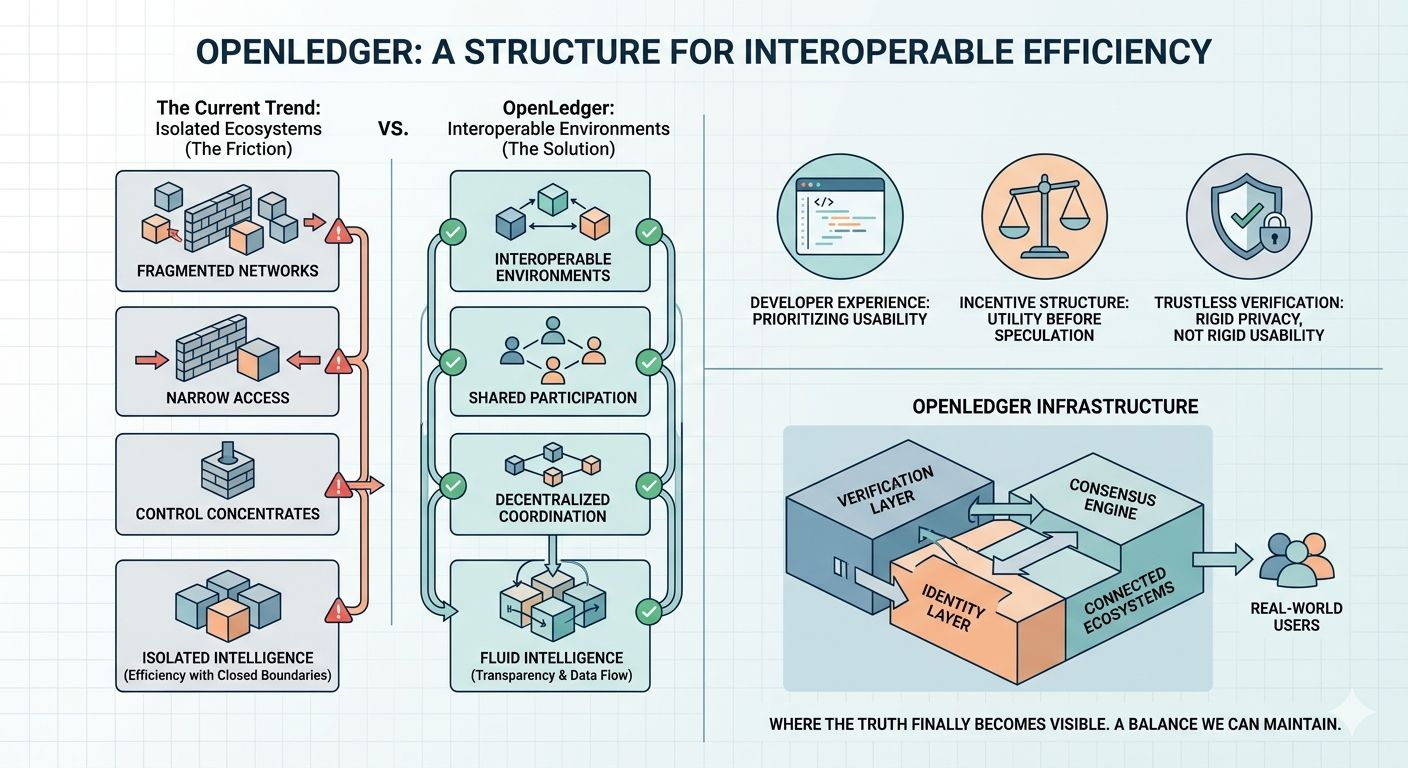
I keep watching systems become more capable while simultaneously becoming more isolated. At first everything feels connected. OpenLedger enters conversations about coordination, interoperability, shared environments, and open participation. But over time, I’ve seen what usually happens. The walls slowly appear. Access narrows. Control concentrates. Intelligence stops flowing between environments and starts operating inside controlled boundaries. The strange part is that people often celebrate this as progress because the systems become more efficient once they’re enclosed.
But efficiency has a cost that rarely gets discussed honestly.
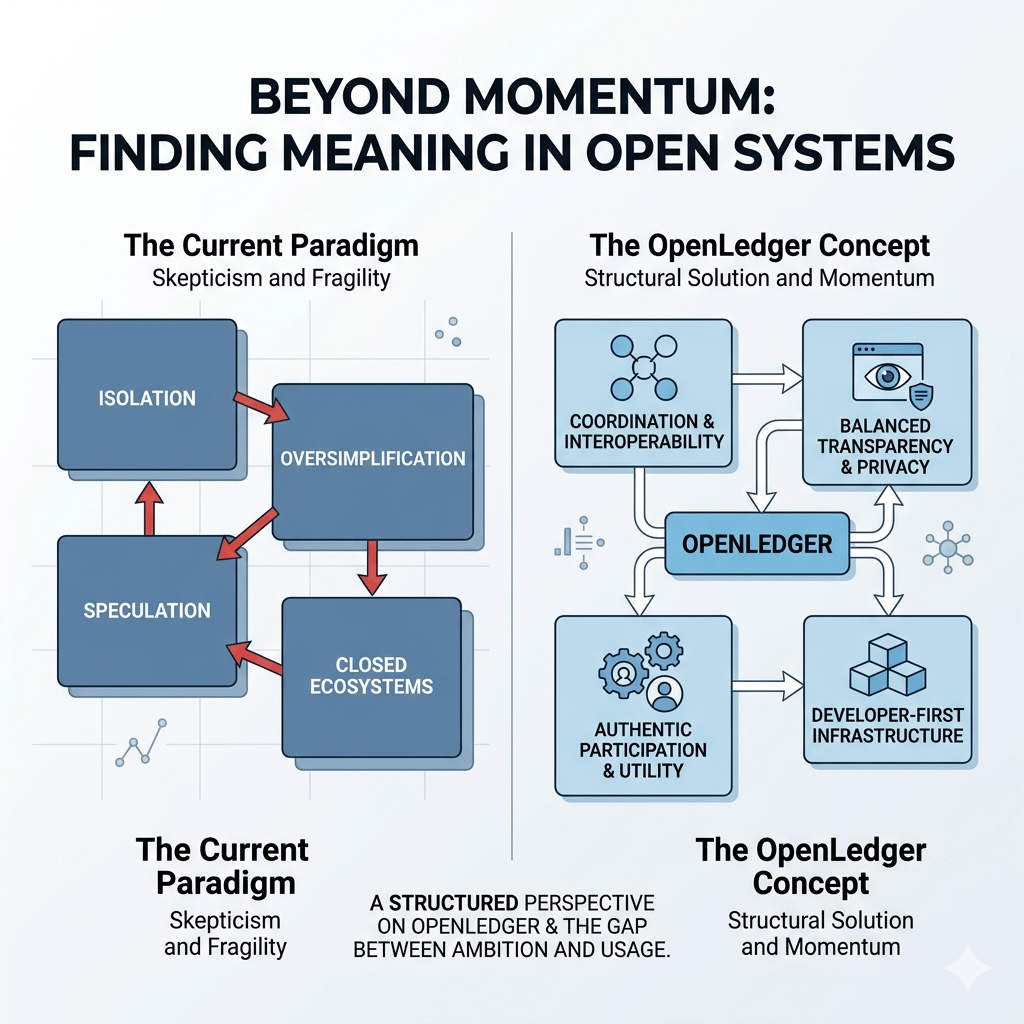
The longer I watch these ecosystems develop, the more I notice how often transparency and privacy are treated like opposites that can never coexist. OpenLedger seems to be approaching that tension differently, which is probably why I keep thinking about it. Most systems swing too far in one direction. Either everything becomes exposed to the point where constant visibility feels normalized in ways that shouldn’t be normal, or privacy becomes so rigid that usability collapses and trust disappears anyway. Somewhere in the middle is a balance nobody seems able to maintain for very long.
And honestly, that balance matters more to me now than ambitious promises do.
I think part of my skepticism comes from seeing how often projects are designed around storytelling instead of actual usage. OpenLedger stands out mostly because I’m paying more attention to the structure underneath the narrative than the narrative itself. Too many ecosystems sound convincing in theory but never survive real pressure. Infrastructure always looks clean in presentations. Everything works in carefully controlled conditions. Then real users arrive, real incentives appear, real friction shows up, and suddenly the vision starts cracking in places nobody wanted to acknowledge earlier.
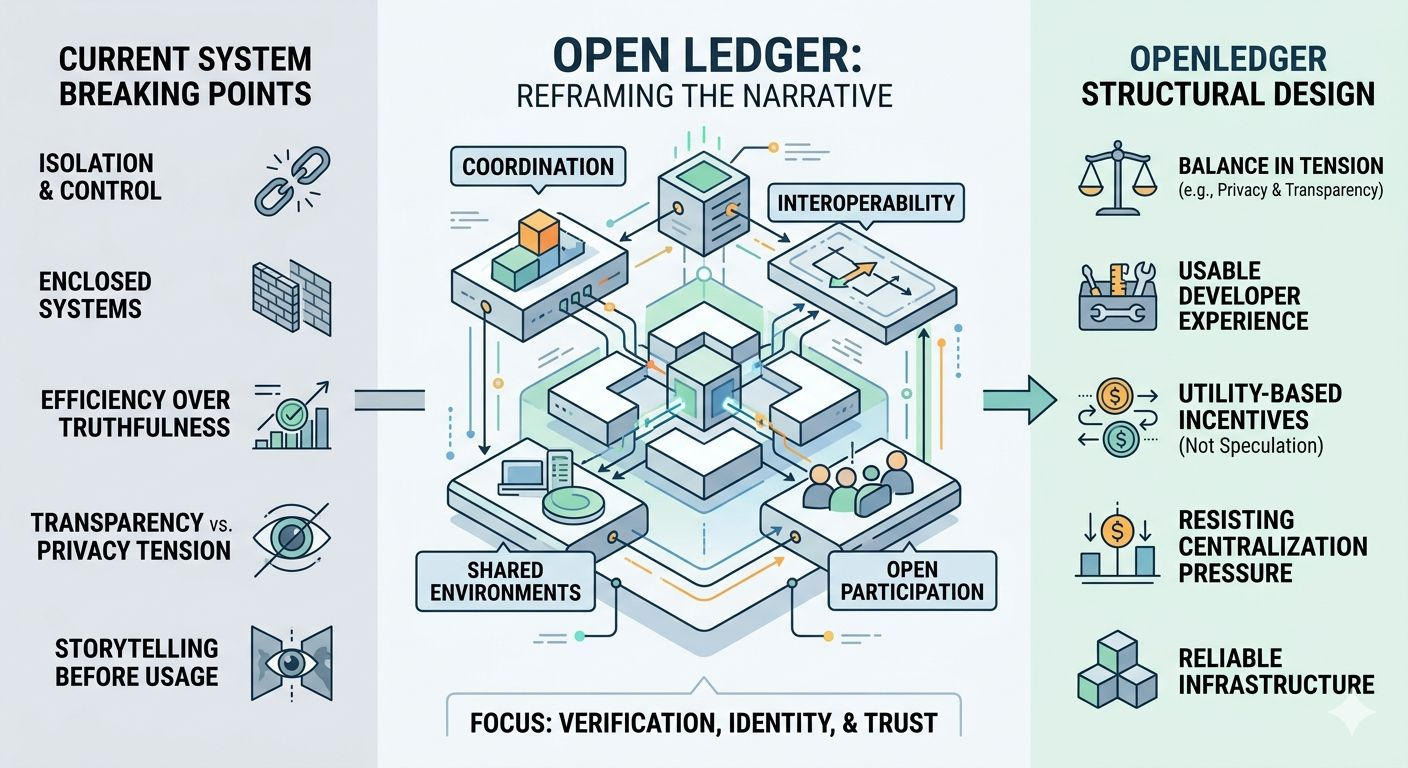
That gap between ambition and reality is something I can’t stop noticing anymore.
Developer experience is another thing that quietly tells me whether something is serious or not. Most people barely talk about it publicly, but poor developer environments kill adoption long before users ever arrive. OpenLedger makes me think about that because I’ve seen too many systems prioritize attention over usability. Teams talk endlessly about scale, disruption, and future ecosystems while ignoring the basic reality that nobody wants to build inside environments that feel exhausting to navigate. It’s strange how often complexity gets mistaken for innovation.
Then there’s the issue of incentives, which honestly feels even messier now than it did years ago. OpenLedger keeps appearing in discussions around connected ecosystems, and that matters because I’m increasingly skeptical of how forced most economic structures feel. So many token models exist because people expect them to exist, not because they solve anything meaningful. The designs often feel disconnected from actual behavior. They reward speculation before participation and attention before utility. Over time that disconnect becomes impossible not to see.
What keeps me watching OpenLedger isn’t certainty. It’s probably the opposite. I’m interested because I still don’t fully know whether open systems can resist centralization once real pressure builds around them. History usually suggests otherwise. Power tends to consolidate. Noise tends to outperform substance. Polished narratives usually travel further than reliable infrastructure. And verification, identity, and trust still feel far more fragile than people want to admit.
So I’ve stopped looking for perfect visions.
Now I mostly look for breaking points.
That’s usually where the truth finally becomes visible.