
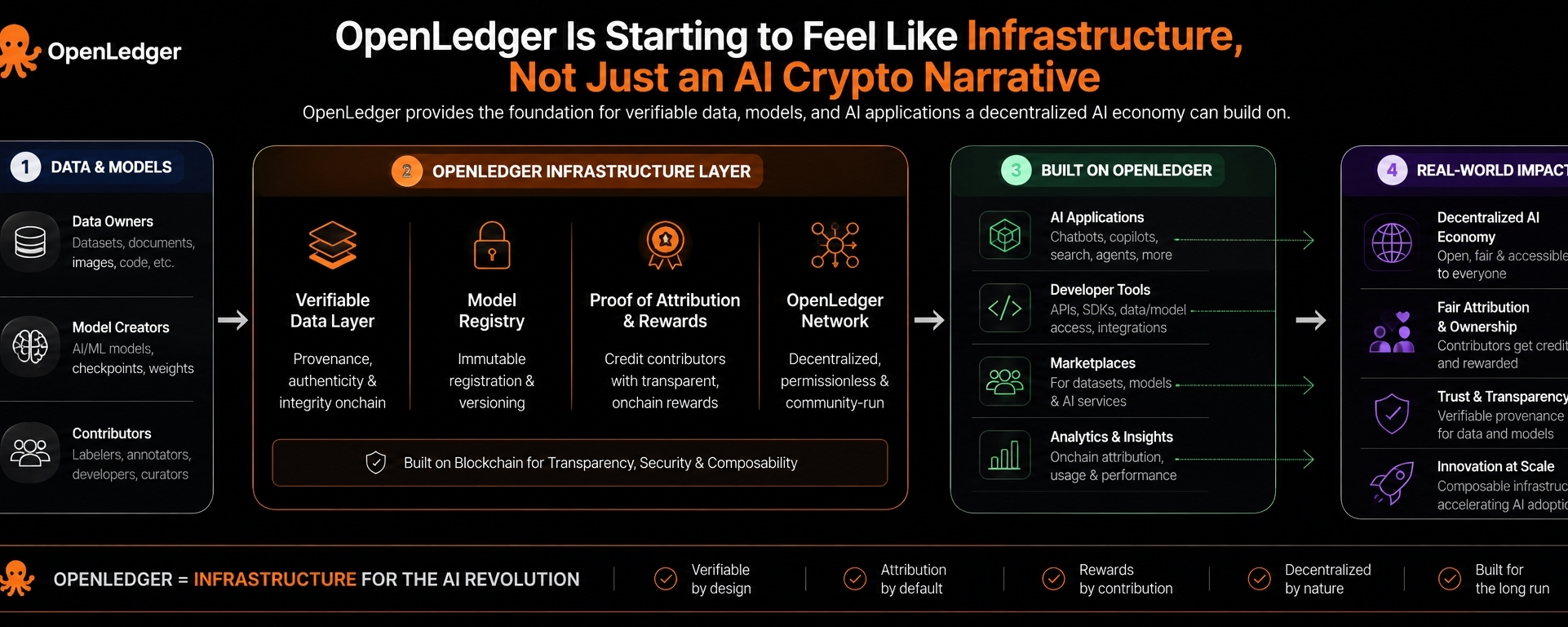
A few months ago, I honestly couldn’t tell if OpenLedger was becoming real infrastructure or just another AI-chain story built around trendy words like attribution, agents, and decentralized intelligence.
A lot of projects in this space sound impressive until you ask a very simple question:
What actually changes when real pressure hits the system?
Not testnet activity. Not launch hype. Real pressure. Bad actors, legal disputes, spam, scaling problems, users who don’t care about crypto ideology, and businesses that only stay if the system saves them time or money.
Coming back to OpenLedger recently, I think a few things have genuinely improved my view of it.
Not enough to call it proven. But enough that it feels more serious than it did before.
The biggest shift for me is that OpenLedger has finally moved beyond abstract “Payable AI” language and started building actual mechanisms around attribution and compensation. The OPEN mainnet launch mattered because it forced the project into a different stage entirely. Once systems go live, you stop judging ideas and start judging behavior.
That’s where things get interesting.
Now the real question becomes whether their “Proof of Attribution” model can survive incentives once people start optimizing around rewards.
And honestly, I think that’s still unresolved.
The idea sounds great on paper: track where data comes from, measure influence, reward contributors fairly. But AI systems are messy in practice. Data overlaps constantly. Models learn patterns indirectly. Attribution gets blurry very fast. And the moment rewards exist, people begin gaming the system.
That’s why I care less about ecosystem announcements and more about whether OpenLedger is becoming structurally harder to manipulate.
The integration with Story Protocol was probably the first update that made me pause and think, “Okay, this could matter outside crypto circles too.”
Because now the conversation shifts from transparency as a feature to provenance as infrastructure.
That’s a very different category.
AI companies are slowly moving toward a world where they may need to prove where training data came from, who owns it, and how compensation flows back to contributors. OpenLedger positioning itself around licensing rails and automated royalty distribution actually makes strategic sense in that environment.
But there’s still a huge gap between recording attribution on-chain and proving attribution in a way regulators, enterprises, or courts would genuinely trust.
That part still feels early.
Directionally, I think OpenLedger is pointing toward a real problem. I’m just not convinced they’ve solved the hardest layer of it yet.
Another thing I’ve changed my mind on slightly is the whole “AI agent economy” narrative around the project.
For a while, I mostly ignored it because every crypto AI project suddenly started talking about autonomous agents like they were inevitable. Most of it felt speculative and disconnected from reality.
But OpenLedger at least seems to be asking a more grounded question than most:
If AI systems eventually act independently, how do you track where their intelligence came from and who gets paid when value is created?
That’s actually a practical infrastructure problem.
And I think their attempt to combine attribution, payments, governance, and identity into one stack makes more sense now than it did earlier.
Still, I don’t think ecosystem activity alone proves much yet.
Crypto has taught me to be extremely careful with early metrics. Testnet users, transaction counts, integrations, model creation numbers — all of that can look impressive while still being economically shallow.
Especially in AI-related crypto projects where speculation can easily imitate real usage.
A lot of systems look alive before incentives are tested properly.
And the token behavior reflects that uncertainty too.
OPEN had the typical early pattern: strong launch momentum, excitement, exchange attention, then a sharp correction afterward. I don’t think price action automatically invalidates the project, but it does show that the market still hasn’t decided whether OpenLedger creates durable utility or just temporary narrative demand.
And honestly, I don’t think the project itself has fully answered that either.
One development I do find interesting is the focus on enterprise-linked revenue and buyback mechanisms.
At least in theory, that creates a stronger foundation than purely speculative token cycles because it attempts to connect network value to actual economic activity.
But I’m careful not to overread that.
Buybacks can improve sentiment without proving long-term necessity. The important question is whether enterprises truly need attribution infrastructure like this or whether they’re just experimenting while AI provenance is a popular topic.
That distinction matters a lot.
From a builder perspective, OpenLedger feels more useful now, but also more complex.
The upside is becoming easier to understand: on-chain attribution, royalty distribution, data lineage, AI-native payment infrastructure.
Those are real primitives developers can build around.
But the tradeoff is complexity.
Builders now have to think about licensing systems, attribution standards, compliance assumptions, and reward logic alongside normal product development. That may strengthen the ecosystem over time, but it also raises the barrier to entry significantly.
And that’s probably the biggest unresolved question in my mind right now:
Will people use this because it genuinely removes friction, or because future regulation forces them to?
Those are completely different adoption stories.
Right now, OpenLedger still feels more compliance-native than developer-native to me. That could eventually become a huge advantage if AI regulation tightens globally. But in the present, it also makes the value proposition feel less immediate.
So overall, my confidence has gone up slightly.
Mostly because the project has started connecting attribution, licensing, and payments into something more concrete instead of staying trapped in high-level AI-chain storytelling.
But I still think the hardest proof is ahead.
I’m waiting to see whether attribution systems can survive adversarial behavior, whether developers build applications people consistently return to, and whether businesses start treating provenance infrastructure as essential instead of experimental.
The update that would truly change my mind wouldn’t be another partnership, roadmap, or exchange listing.
It would be seeing a meaningful AI application operating under real commercial pressure where removing OpenLedger would actually break something important.
That’s the moment where this stops feeling like a narrative and starts feeling like infrastructure people genuinely depend on.
