
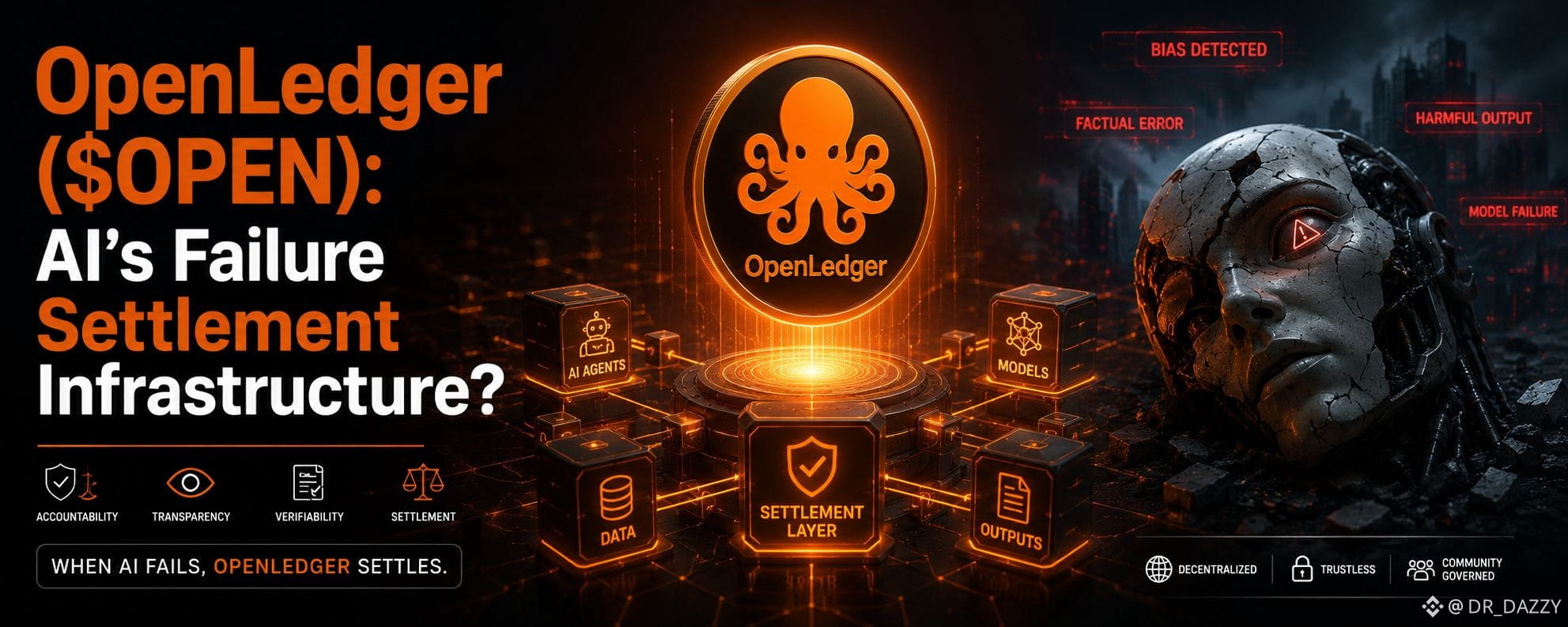
OpenLedger ($OPEN) Could Quietly Become AI’s Infrastructure For Unresolved Accountability
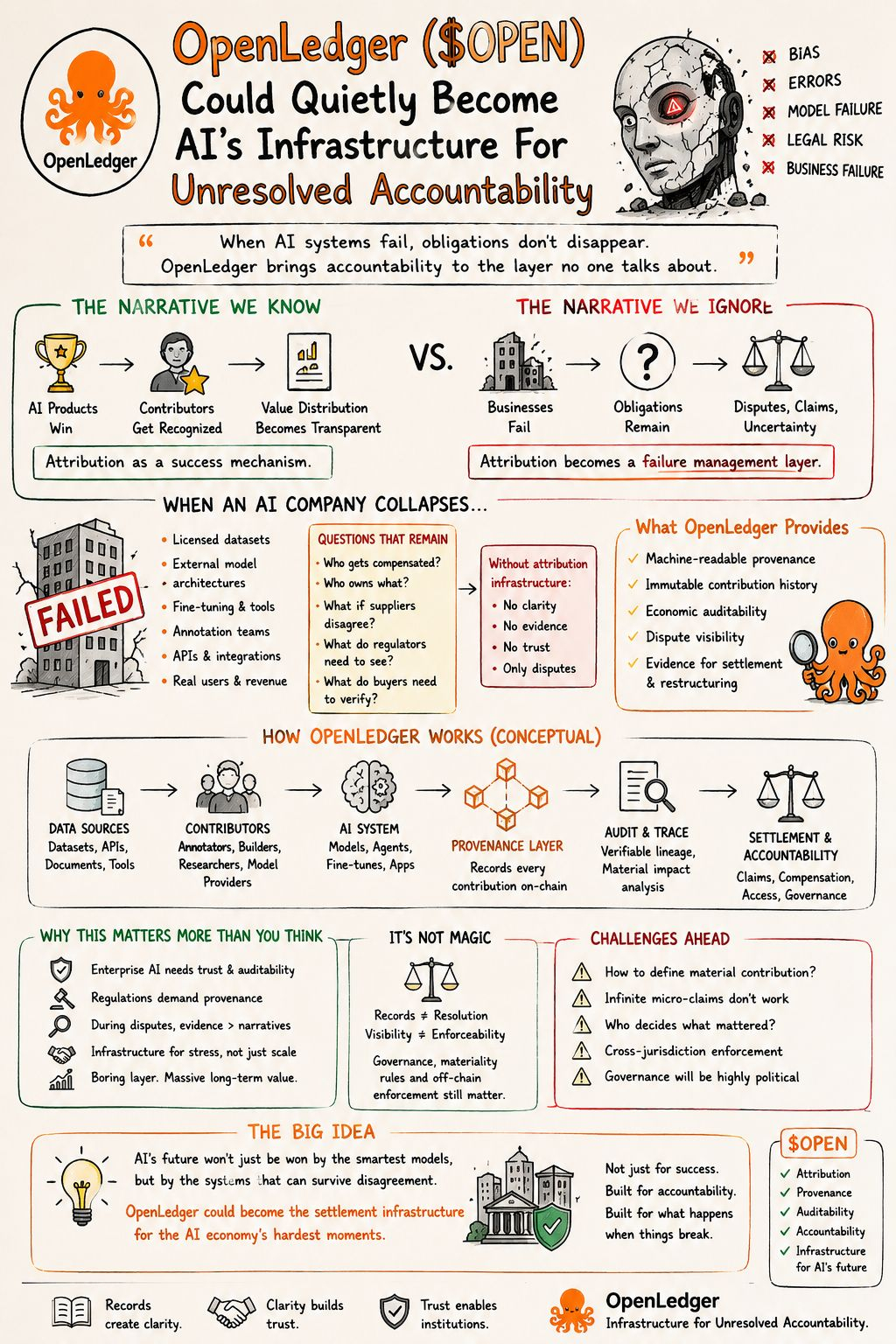
For a long time, I viewed attribution infrastructure mainly as a success mechanism.
AI products win. Contributors get recognized. Data sources become economically traceable. Value distribution becomes more transparent than today’s opaque systems.
Simple narrative.
Recently, I’m not convinced that’s the most important layer.
Most AI infrastructure conversations feel unusually optimistic. Scale, autonomous agents, monetization, machine economies, execution speed.
Very little discussion about what happens when the underlying business collapses.
Because businesses fail constantly.
A company raises capital, integrates multiple datasets, licenses external models, hires annotation teams, launches an AI product, gains traction — then a year later everything unravels.
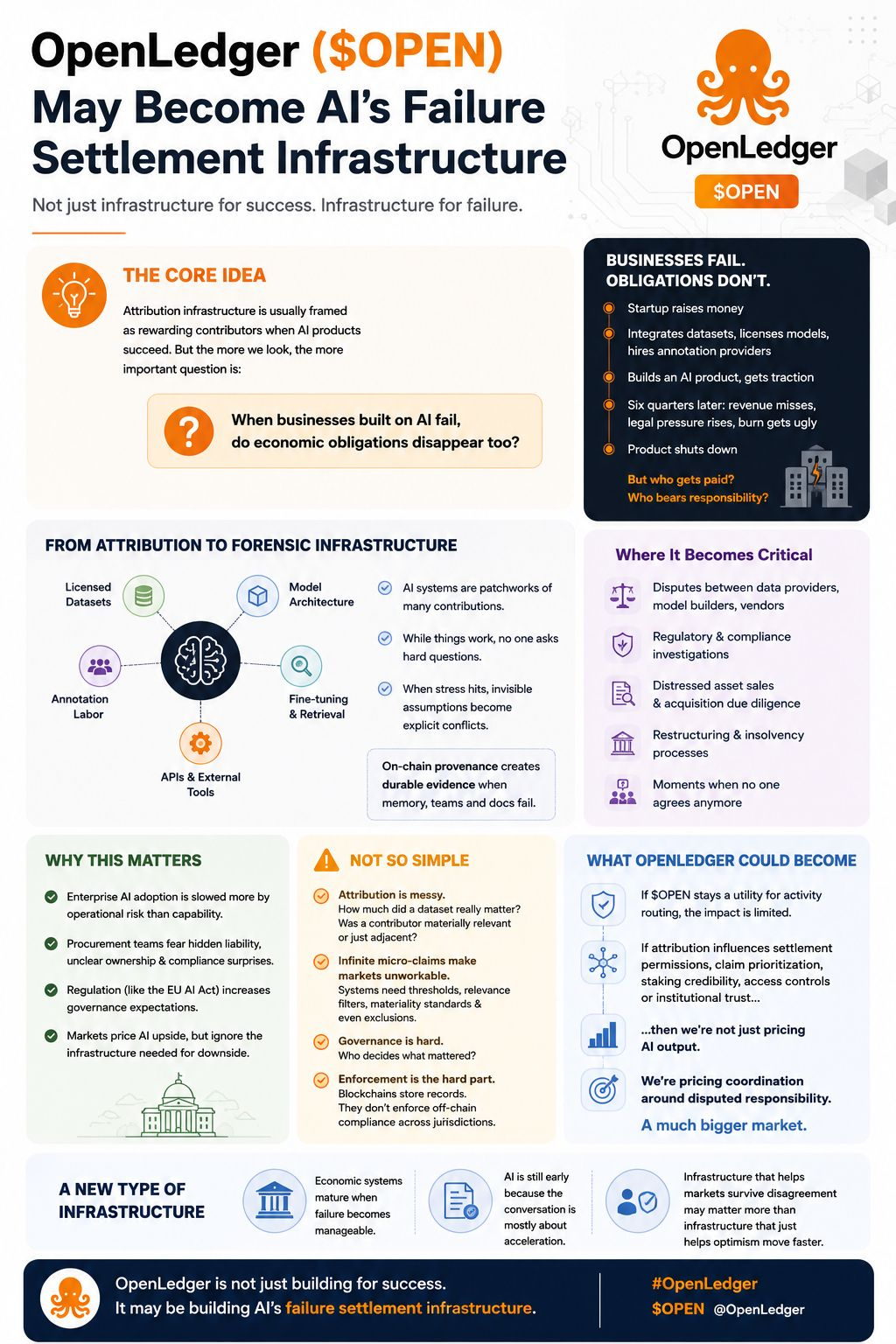
Revenue weakens. Legal friction rises. Cash runway disappears. Operations shut down.
People assume the AI story ends there.
But do the economic obligations disappear too?
That question kept resurfacing while thinking about OpenLedger.
The project is typically described as attribution infrastructure. Contributors receive recognition. Provenance becomes visible. Data participation gains economic identity.
Fair description.
But another interpretation feels increasingly important to me.
Maybe this isn’t only infrastructure built for successful AI economies.
Maybe it’s infrastructure designed for system failure.
Not in a dramatic sense.
In mature economic systems, unresolved obligations require institutional mechanisms. Finance has settlement rails. Corporations have bankruptcy frameworks. Supply chains rely on dispute resolution. Software licensing depends on auditability because memory becomes unreliable once incentives shift.
AI still behaves as if that layer can be ignored.
That feels premature.
Imagine a healthcare AI company operating on licensed medical datasets, external model architecture, proprietary fine-tuning, outsourced annotation labor, and live retrieval integrations.
Entirely realistic.
Now imagine the company fails.
Nothing extraordinary. Just ordinary commercial failure.
Who gets compensated when contracts were imprecise? What happens when a data supplier argues their contribution materially influenced commercial outcomes? What if regulators request provenance visibility? What if distressed asset buyers need clarity around ownership exposure?
At that point, attribution stops looking like creator-economy branding.
It starts looking like forensic infrastructure.
And that is where OpenLedger becomes more compelling to me.
Not because it magically resolves disputes.
It doesn’t.
But machine-readable provenance changes how economic disagreement operates.
That matters.
Modern AI systems depend on tangled dependency structures. Multiple datasets. Inherited architectures. Fine-tunes built on previous layers. Agents calling external tools. APIs stacked across APIs.
Externally, the product appears unified.
Internally, it’s fragmented composition.
As long as incentives remain healthy, those complexities stay manageable.
Pressure changes everything.
The crypto ecosystem already understands this pattern. During expansion cycles, assumptions remain invisible. The moment incentives tighten, buried expectations become open conflict.
We’ve seen it in governance breakdowns, validator incentives, treasury disputes.
AI will not escape that reality.
Conceptually, OpenLedger appears to be building a framework where contribution history becomes economically auditable instead of socially remembered.
That difference is larger than it sounds.
Social memory deteriorates. Documentation becomes selective. Teams disperse. Infrastructure disappears. Narratives shift when incentives change.
On-chain provenance doesn’t manufacture truth.
But it creates durable evidence.
Different concept.
Still insufficient by itself.
This is where crypto narratives often oversimplify.
“On-chain” does not automatically mean “resolved.”
Records alone don’t solve disputes unless systems understand how to operationalize them.
If $OPEN remains limited to utility coordination, the thesis becomes narrower.
Interesting, yes.
Transformational, maybe not.
But if attribution begins influencing settlement logic, claim hierarchy, staking reputation, permission structures, institutional trust models, or access governance, then the economic implications become significantly heavier.
Because now the market is not pricing AI output alone.
It is pricing coordination around contested responsibility.
Entirely different category.
Potentially larger than many expect.
Enterprise AI adoption carries a trust challenge that retail narratives consistently underestimate.
Not intelligence capability.
Operational exposure.
Procurement teams worry about hidden liability, ownership ambiguity, compliance surprises, contaminated data lineage.
Less exciting than agent narratives.
Still very real.
Regulatory expectations continue tightening. Governance requirements expand. Data protection frameworks remain relevant regardless of model sophistication. Commercial agreements still care about attribution boundaries even when technical systems blur them.
Markets continue pricing AI upside while underpricing institutional risk infrastructure.
Which is odd.
Historically, boring infrastructure often captures more durable value than speculative narratives.
Of course, attribution introduces its own complications.
How much did a dataset actually contribute? Which participants were economically material versus merely adjacent? If thousands of micro contributions exist, do claims become perpetual?
That logic becomes unworkable quickly.
No viable market can survive infinite administrative overhead.
Any functioning model needs thresholds, filtering, relevance standards, materiality rules perhaps intentional exclusion mechanisms.
Which immediately creates governance questions.
Who determines what mattered?
That becomes political very fast.
And enforcement remains the uncomfortable unresolved layer.
Blockchains preserve records exceptionally well.
They do not automatically enforce off-chain compliance across jurisdictions, insolvency systems, or fragmented legal agreements.
Visibility and enforceability are not interchangeable.
Still, I keep returning to the idea that attribution infrastructure becomes economically essential not during expansion — but during institutional stress.
During disputes.
During restructuring.
During acquisitions.
During diligence reviews.
During moments when alignment disappears.
That’s when systems reveal whether they were genuine architecture or simply narrative packaging.
So when I describe OpenLedger as something resembling an AI bankruptcy layer, I’m not talking about literal courts or tokenized litigation.
The point is simpler.
Economic systems mature when failure becomes manageable.
AI still feels early stage because most conversations revolve around acceleration.
Infrastructure that helps markets survive disagreement may ultimately matter more than infrastructure that only accelerates optimism.
Less exciting thesis.
Possibly the important one.