

Most AI platforms today feel like giant open fields. Everyone throws data in, models consume it, and nobody really asks whether the information itself has any structure, value, or accountability behind it.
What caught my attention about OpenLedger is that it’s trying to approach this from a completely different angle.
At first, the system honestly feels restrictive.
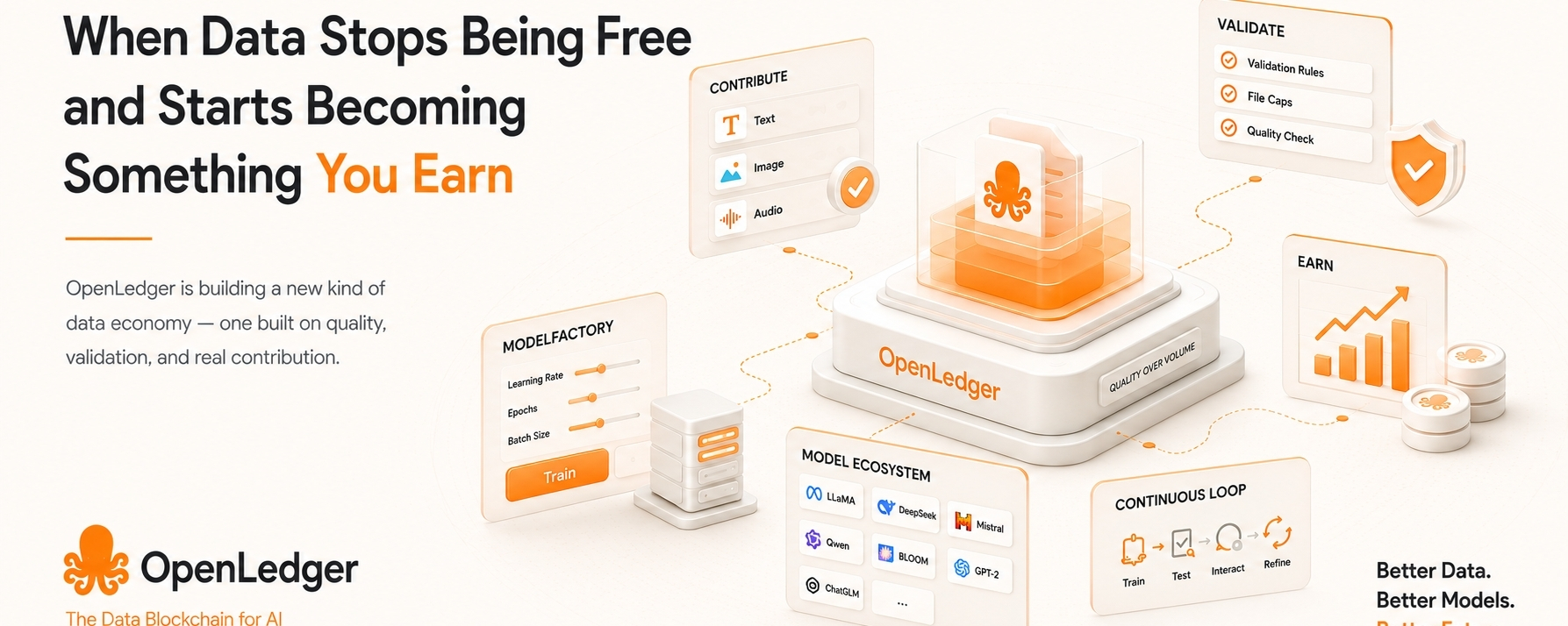
There are contribution limits. File caps. Validation rules. Separate categories for text, image, and audio. You can’t just dump random content into the pipeline and expect rewards.
Normally in Web3, people hear “restrictions” and immediately assume something is wrong. Because the culture has always leaned toward unlimited participation.
But after reading deeper into how OpenLedger works, I don’t think the goal here is control for the sake of control. I think they’re trying to solve a bigger problem:
How do you stop data economies from turning into noise economies?
That’s where the contribution system becomes interesting.
The platform doesn’t seem to reward volume as much as it rewards usable input. Uploading more files doesn’t automatically push someone higher. Acceptance rate matters more. That changes contributor behavior completely.
And honestly, one detail stood out to me:
Rejected submissions don’t destroy your ranking.
That sounds small, but psychologically it changes everything. It encourages experimentation without making people afraid to participate. Most systems punish mistakes immediately. This one seems more focused on filtering quality over time.
Then there’s the ModelFactory side, which feels like the bigger ambition underneath all of this.
Instead of keeping AI fine-tuning locked behind research workflows and terminal-heavy setups, OpenLedger is trying to make the process visual and accessible. Learning rates, epochs, batch sizes — all adjustable through a GUI instead of forcing every user into pure engineering workflows.
That might sound like a convenience feature, but I think it’s actually part of a much larger direction: making AI development usable by more people without turning the process into complete chaos.
The support for LoRA and QLoRA also feels very intentional. Full model fine-tuning is expensive and unrealistic for most builders now. Lightweight adaptation is becoming the practical route, and OpenLedger seems aligned with that reality.
What I also like is that the workflow doesn’t end after training.
The whole structure feels continuous:
train → test → interact → refine.
That loop matters because models are rarely “finished.” They evolve through feedback, usage, and iteration.
Even the supported model ecosystem tells a story.
LLaMA, DeepSeek, Mistral, Qwen, BLOOM, GPT-2, ChatGLM — it’s broad coverage instead of narrow exclusivity. And that probably matters more long term than people realize. Wide compatibility creates a larger experimentation environment.
One funny comparison kept coming into my head while reading all this
The system feels like a very disciplined kitchen.
You can’t just throw random ingredients everywhere. There are rules, measurements, and checks before anything reaches the table. But once the final product is ready, everyone can evaluate it.
No vibes-only cooking allowed here.
And honestly, maybe that’s necessary if data is ever going to become a real asset class instead of an endless flood of low-quality content.
Because when you zoom out, OpenLedger seems to sit right in the middle of two completely different ideas:
open contribution
vs
structured validation
Usually platforms choose one side. OpenLedger is trying to combine both.
I don’t know yet whether that balance fully works. Maybe nobody does right now.
But I do think the experiment itself is worth paying attention to.
Because the future AI economy probably won’t belong to whoever has the most data.
It’ll belong to whoever figures out how to make data trustworthy, usable, and valuable at scale.