I think a lot of people are underestimating how weird the next few years are going to get.
Right now AI still feels like a tool to most users. Something you open in another tab to write emails faster, summarize articles, fix code, generate images, maybe help with homework or research. Helpful. Impressive sometimes. But still just software sitting on top of the internet.
I don’t think it stays that simple for long.
Because AI is slowly turning into infrastructure. Economic infrastructure. And honestly that changes the entire conversation.
The industry keeps pretending the main story is which company has the smartest chatbot, but I don’t think that’s the real battle anymore. The real battle is about ownership, data, incentives, and who controls the systems underneath machine intelligence once AI starts operating everywhere all the time.
That’s where OpenLedger starts looking more interesting than most of the AI hype flooding crypto right now.
Most projects in this space feel shallow honestly. Same recycled promises. “AI-powered ecosystem.” “Autonomous future.” “Revolutionary decentralized agents.” Half the time it sounds like people smashed random buzzwords together and launched a token before figuring out whether the idea even solves a real problem.
OpenLedger at least seems focused on something deeper.
The uncomfortable truth underneath AI itself.
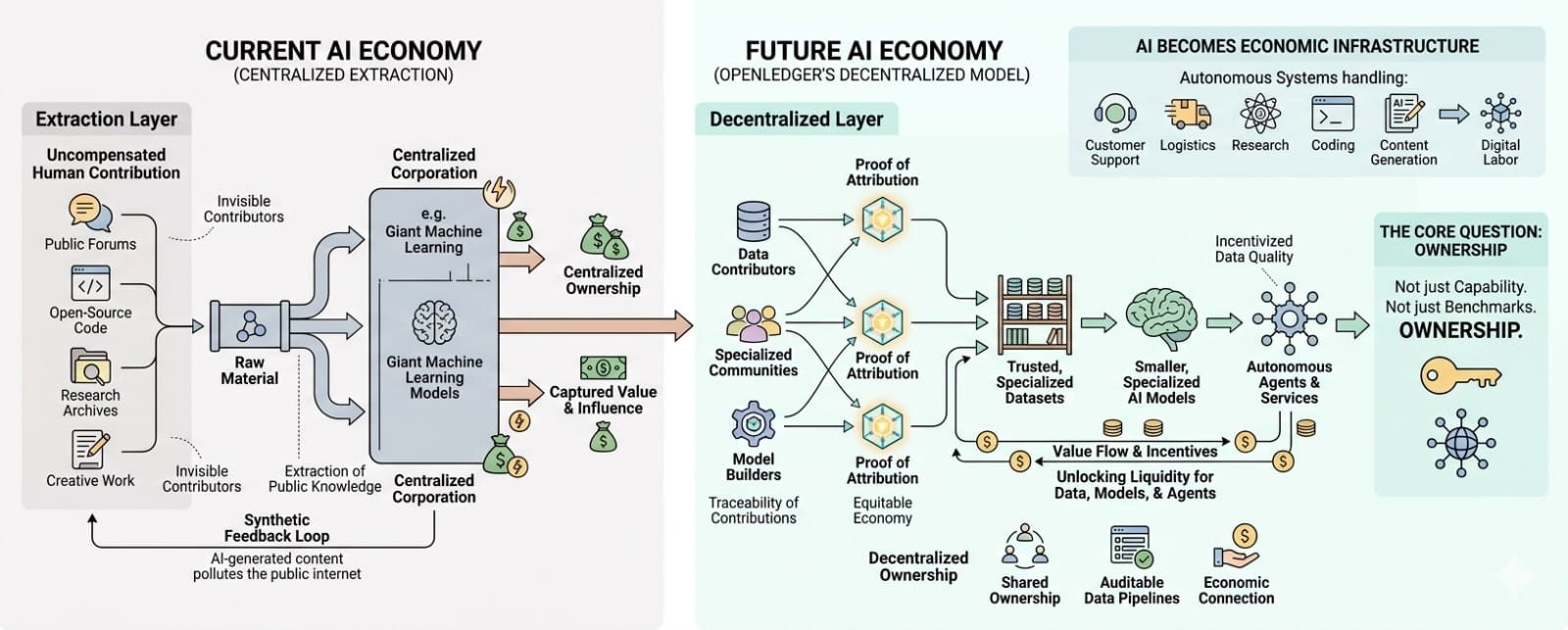
Because right now the entire AI economy is built on top of human contribution that mostly goes uncompensated. The internet trained these systems. Human conversations trained these systems. Public forums, open-source code, tutorials, blogs, research archives, creative work, community discussions… all of that became raw material feeding giant machine-learning models owned mostly by centralized corporations with enough money to dominate compute infrastructure.
And somehow people accepted this surprisingly fast.
Probably because the products are useful enough to distract everyone from the economics underneath them.
But eventually those economics matter.
They always do.
The internet already went through this once with social media. Users created endless value while platforms captured most of the money and influence. AI feels like the same pattern again except now the extraction layer runs even deeper because this time companies aren’t just monetizing attention. They’re monetizing intelligence built partly from public human knowledge itself.
That’s why OpenLedger’s whole “unlocking liquidity for data, models, and agents” idea actually matters more than it sounds at first.
They’re basically trying to create an economy where contributors inside AI systems don’t remain invisible forever.
Which honestly feels necessary long term.
Because once AI agents become normal, things get very strange very quickly. Imagine autonomous systems handling customer support, market analysis, logistics, research, scheduling, coding, trading, negotiations, content generation, maybe even managing businesses nonstop without human supervision.
At that point AI stops being software and starts behaving more like digital labor.
And once machine intelligence becomes labor infrastructure, ownership becomes one of the biggest economic questions on earth.
Who owns the agents?
Who owns the models?
Who gets paid when AI systems generate value?
Who controls the data pipelines feeding those systems?
Right now the answer mostly points toward giant centralized corporations.
OpenLedger is basically betting that eventually people reject that structure before it becomes permanent.
That’s where their Proof of Attribution system comes in. The idea is trying to create traceability around AI contributions instead of allowing value to disappear invisibly into giant black-box systems nobody can properly audit. Data contributors, specialized communities, model builders, and participants become economically connected rather than functioning like unpaid fuel powering centralized infrastructure.
At least that’s the theory.
And honestly I think the theory makes sense because the current AI economy already feels unstable underneath the hype. The internet itself is getting flooded with synthetic content at absurd speed now. AI-generated articles. AI-generated replies. AI-generated videos. Entire websites generated automatically for search traffic. Machine-written garbage everywhere feeding algorithms and ad systems.
The internet slowly turning into a giant synthetic feedback loop.
That creates problems most companies don’t seem eager to talk about because the race for scale and dominance is moving too fast. Future AI systems depend heavily on training data quality, but the public internet itself is becoming increasingly polluted by AI-generated noise.
Which means trustworthy data probably becomes incredibly valuable later.
That’s another reason OpenLedger’s focus on specialized datasets and attribution keeps sticking in my head. Future AI systems might not be won purely through model size. They might be won through cleaner information ecosystems, trusted communities, and transparent contribution systems.
Smaller specialized models trained on reliable data could become more useful than giant generalized systems trying to absorb the entire internet forever.
Honestly that future sounds more realistic to me than endless scaling.
Because bigger models alone don’t automatically solve structural problems. Hallucinations still happen. Data quality issues still happen. Ownership issues definitely still happen. Giant centralized systems still create dependency risks no matter how impressive the outputs become.
And people are already starting to feel uncomfortable with how much power a handful of AI companies accumulated so quickly.
That discomfort probably grows over time.
Still, I’m not pretending decentralized AI automatically wins either. Crypto communities romanticize decentralization constantly while ignoring how brutally efficient centralized systems can be in practice. OpenAI, Google, Meta, Anthropic… these companies have absurd advantages. Money. Engineers. GPUs. Infrastructure. Distribution.
Competing against that is incredibly hard.
Most decentralized AI projects probably fail honestly.
But centralized AI creates massive long-term risks too. Too much power concentrated into too few entities controlling systems that increasingly shape information, communication, labor, and economic activity itself.
That’s why OpenLedger’s broader narrative feels important to me beyond just the token or the hype cycle. They seem to understand that AI is becoming more than software. It’s becoming infrastructure underneath society itself.
And once intelligence becomes infrastructure, ownership becomes the real story eventually.
Not just capability.
Not just benchmarks.
Ownership.
#OpenLedger $OPEN @OpenLedger