
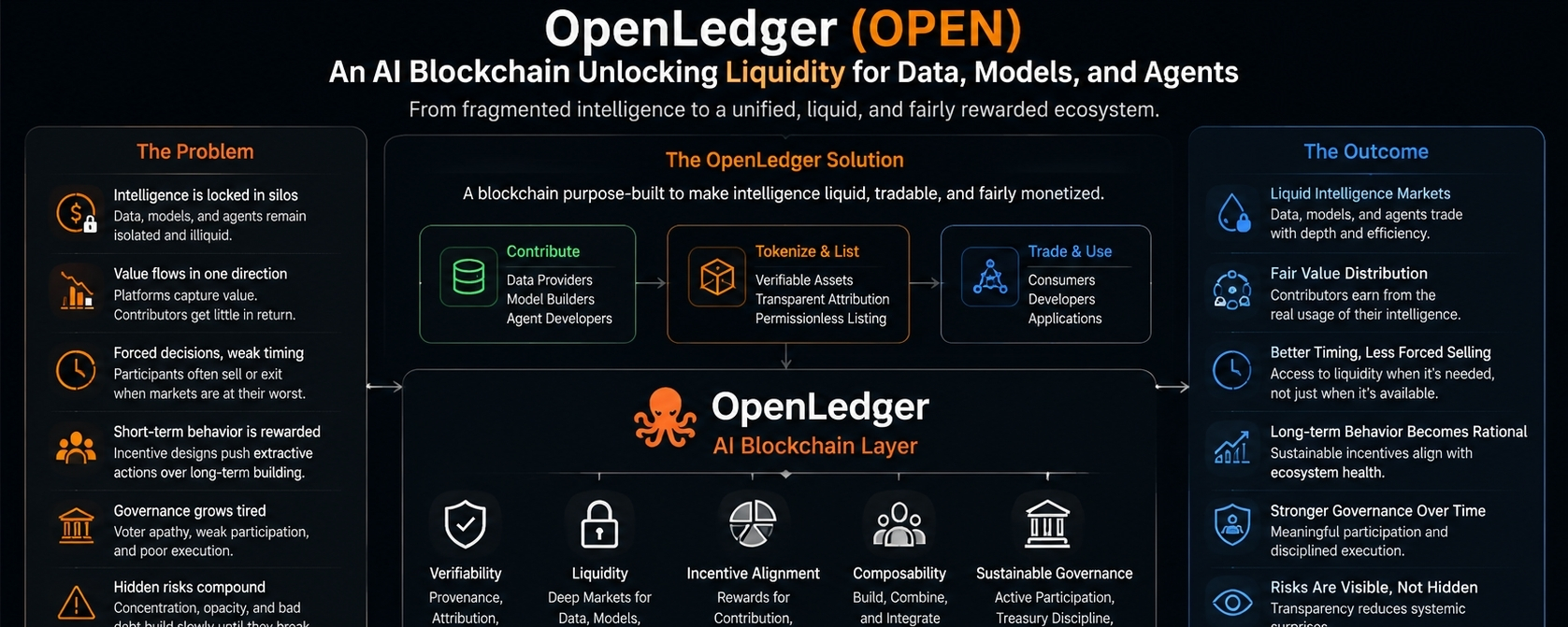
I’ve spent enough time watching crypto markets to notice that most systems eventually drift toward the same behavior. Capital starts moving faster than real value. Liquidity looks healthy until pressure arrives. Governance sounds decentralized until difficult decisions have to be made. Then the cracks appear all at once.
What interests me about OpenLedger is not the AI narrative itself. I think the market already has more than enough AI branding attached to blockchains. The deeper question is why a protocol like this would need to exist in the first place.
From where I stand, the answer has less to do with technology and more to do with ownership.
I think modern digital markets have become extremely efficient at extracting value from data while remaining surprisingly poor at distributing value back to the people creating it. Models improve because users continuously feed systems with behavior, patterns, and information, yet the economic structure around that process remains heavily concentrated. Most participants contribute intelligence without ever gaining meaningful exposure to the upside generated from it.
Crypto solved part of this problem for finance by making ownership transferable on-chain. But I don’t think the industry has fully solved it for data, models, or autonomous systems. In many cases, intelligence still behaves like an illiquid asset trapped inside closed environments.
That is where OpenLedger becomes more interesting to me.
I don’t see the protocol simply as another place to launch AI products. I see it as an attempt to create liquidity around intelligence itself. That may sound abstract at first, but the market inefficiency behind it is very real.
I’ve noticed that valuable datasets often remain isolated because there is no efficient economic structure connecting contributors, builders, and users. Smaller AI models struggle to sustain themselves because distribution naturally gravitates toward larger centralized players. Autonomous agents appear briefly during bullish periods, attract attention, and then disappear because their economic incentives were never durable enough to survive changing conditions.
The market keeps producing intelligence, but the market still struggles to price intelligence correctly.
That creates another problem I rarely see discussed honestly. Most crypto systems eventually train participants to prioritize extraction over patience. Traders are pushed toward short-term positioning because liquidity conditions remain unstable. Builders start optimizing for attention because attention converts into survival. Governance slowly turns performative because serious long-term coordination becomes emotionally exhausting during volatile cycles.
I’ve watched many projects fail quietly this way. Not through dramatic collapses, but through slow erosion. Treasury decisions become reactive. Communities lose conviction. Liquidity providers leave the moment incentives weaken. Everything still looks functional on dashboards while the foundation underneath becomes increasingly fragile.
I think OpenLedger is attempting to respond to that exact environment.
What stands out to me is that the protocol seems built around the assumption that intelligence production should behave like an active economic layer rather than a passive resource owned by a small number of dominant entities. That changes how value can circulate through a network.
If contributors, models, and agents can interact inside a shared liquidity framework, then value no longer depends entirely on speculative trading activity. Instead, utility itself starts participating in the economic flow. I’m not saying this removes risk or guarantees sustainability. Markets are never that simple. But I do think it changes where durability might come from.
And honestly, I think durability matters more now than aggressive growth metrics.
I’ve seen too many ecosystems expand quickly while quietly building structural weaknesses underneath. High emissions attract temporary capital. Incentive programs create artificial participation. Governance frameworks look impressive until actual stress arrives. Then everyone discovers that growth on paper does not automatically translate into resilience in real markets.
OpenLedger appears more aware of this tension than many protocols I’ve studied recently.
The AI sector already carries deep centralization pressure because compute, infrastructure, and data ownership naturally consolidate over time. Efficiency usually rewards scale. That means decentralized systems entering this space face a difficult challenge from the beginning. They cannot survive purely through ideology. They need economic coordination strong enough to compete against centralized convenience.
I think that is the real test ahead for OpenLedger.
Not whether it can attract short-term excitement, but whether it can maintain productive alignment between participants after speculative momentum fades. Most protocols look strongest during expansion phases. Very few remain coherent when liquidity tightens and user behavior becomes defensive.
That is why I pay closer attention to structural design than market narratives now.
The projects that survive long-term are usually the ones solving recurring friction that markets continue experiencing cycle after cycle. Wasted capital. Misaligned incentives. Shallow governance. Hidden dependency on constant growth. These problems rarely dominate headlines during bullish periods, but they quietly shape which systems endure and which disappear.
I think OpenLedger matters because it is trying to engage with those deeper inefficiencies instead of simply building another financial wrapper around AI excitement.
To me, the protocol feels less focused on creating another speculative layer and more focused on organizing intelligence as an economic resource that can move, earn, and compound on-chain in a more sustainable way.
That does not guarantee success. Markets are too unpredictable for certainty.
But after watching multiple cycles unfold, I’ve learned that the most important projects are not always the loudest ones. Sometimes the protocols that matter most are the ones trying to solve structural problems before the broader market fully realizes those problems exist.
I think OpenLedger is attempting to do exactly that
