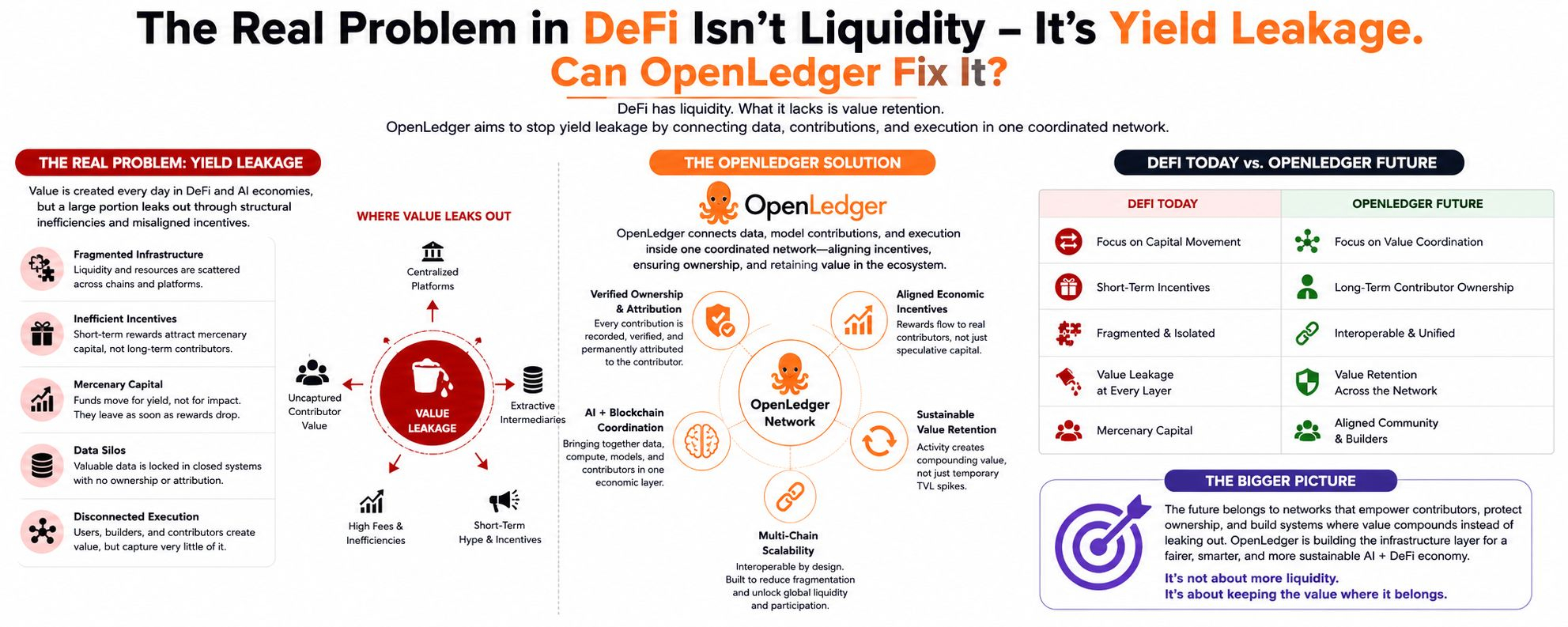

For a long time, I believed the biggest challenge in DeFi was liquidity.
Every cycle seemed to repeat the same conversation. Projects competed to attract more capital, protocols launched higher incentives, and users moved funds from one platform to another searching for the best APY. On the surface, it looked like liquidity was the engine powering everything.
But after spending more time studying how decentralized finance actually functions behind the scenes, I started noticing a different problem that rarely gets enough attention. The issue is not simply how much liquidity exists. The deeper problem is how much value quietly leaks out of the system every single day.
That leakage happens in many forms. It appears through fragmented infrastructure, inefficient routing, temporary incentive farming, mercenary capital, data silos, and disconnected execution layers that fail to reward the people creating real value. In many DeFi ecosystems, users, contributors, and even developers help generate activity, but only a small portion of that value flows back to them in a sustainable way.
This is where OpenLedger started becoming interesting to me.
At first, I honestly assumed OpenLedger was just another AI narrative attached to crypto because the market has already seen hundreds of projects trying to combine artificial intelligence and blockchain without solving meaningful infrastructure problems. But the more I explored OpenLedger’s architecture, research, and ecosystem vision, the more I realized the project is approaching something much larger than simple hype.
What caught my attention most is the idea that data, model contributions, and execution itself can become economically connected inside one coordinated network.
Traditional DeFi systems are often designed around capital movement alone. OpenLedger appears to focus on value coordination. That difference matters more than people realize.
The current AI economy already depends on massive amounts of user-generated data, distributed compute, community participation, and model refinement. Yet most contributors remain disconnected from the long-term economic upside created by their activity. Platforms collect value, while contributors receive only temporary compensation or no ownership exposure at all.
OpenLedger seems to recognize this imbalance directly.
Instead of treating data as an invisible resource flowing into closed systems, the network attempts to create verifiable ownership and attribution layers around contributions. That means participants are not only interacting with applications but potentially becoming part of the economic structure powering those applications.
From my perspective, this is where the “yield leakage” conversation becomes important.
In DeFi today, a huge amount of economic energy escapes the ecosystem because incentives are often short-term and disconnected from actual productivity. Liquidity mining campaigns may temporarily increase TVL, but once rewards slow down, capital usually leaves. The system keeps paying for growth without always creating durable value retention.
OpenLedger’s model appears designed to reduce this dependency on purely speculative participation. By connecting AI infrastructure, contributor verification, decentralized coordination, and economic incentives together, the network tries to build an environment where activity itself becomes more sustainable.
Another aspect I found interesting is the project’s multi-chain scalability approach. OpenLedger does not seem focused on remaining isolated within a single blockchain environment. The ecosystem vision surrounding interoperability across many chains could help reduce fragmentation, which has been one of the biggest hidden inefficiencies in both DeFi and AI coordination.
Fragmentation creates invisible costs. Liquidity gets scattered. Developers duplicate infrastructure. Communities split across ecosystems. Users experience unnecessary complexity. Over time, all of that becomes another form of value leakage.
If OpenLedger succeeds in simplifying coordination across ecosystems while also aligning incentives around verified contributions, it could create a stronger foundation than many existing DeFi models currently offer.
I also think the timing matters.
The industry is entering a phase where users are becoming more skeptical of unsustainable tokenomics and short-lived hype cycles. People increasingly want infrastructure that produces real utility, measurable participation, and transparent economic logic. AI is growing rapidly, but questions around data ownership, attribution, and monetization are also becoming more serious.
OpenLedger seems positioned at the intersection of those conversations.
What makes the project stand out to me is that it does not only ask how AI can improve blockchain. It also asks how blockchain can create fairer economic coordination for AI itself.
That is a much bigger discussion than many people realize.
If decentralized systems are going to power future digital economies, then contributor ownership will likely become one of the most important infrastructure layers of all. The networks that successfully align incentives between builders, users, data contributors, and applications may ultimately outperform systems designed only around speculative liquidity flows.
Of course, execution will decide everything. Many ambitious ideas in crypto sound powerful in theory but struggle under real adoption conditions. OpenLedger still has to prove that its infrastructure, scalability, and coordination mechanisms can function effectively at larger scale.
But conceptually, I think the project is addressing a very real issue that DeFi has quietly ignored for years.
The future may not belong to the protocols offering the highest temporary yield. It may belong to the networks that prevent value from leaking out of the ecosystem in the first place.
And that is exactly why OpenLedger has started attracting my attention.