
Most people see AI the way people see electricity.
You flip a switch, something happens, and you stop thinking about what is happening behind the walls.
But behind every AI model is an ocean of human work.
Someone wrote the articles.
Someone labeled the images.
Someone answered the forums.
Someone spent years becoming an expert at something, only for that knowledge to quietly end up inside a machine that now speaks with synthetic confidence.
That is the uncomfortable truth OpenLedger is trying to face head-on.
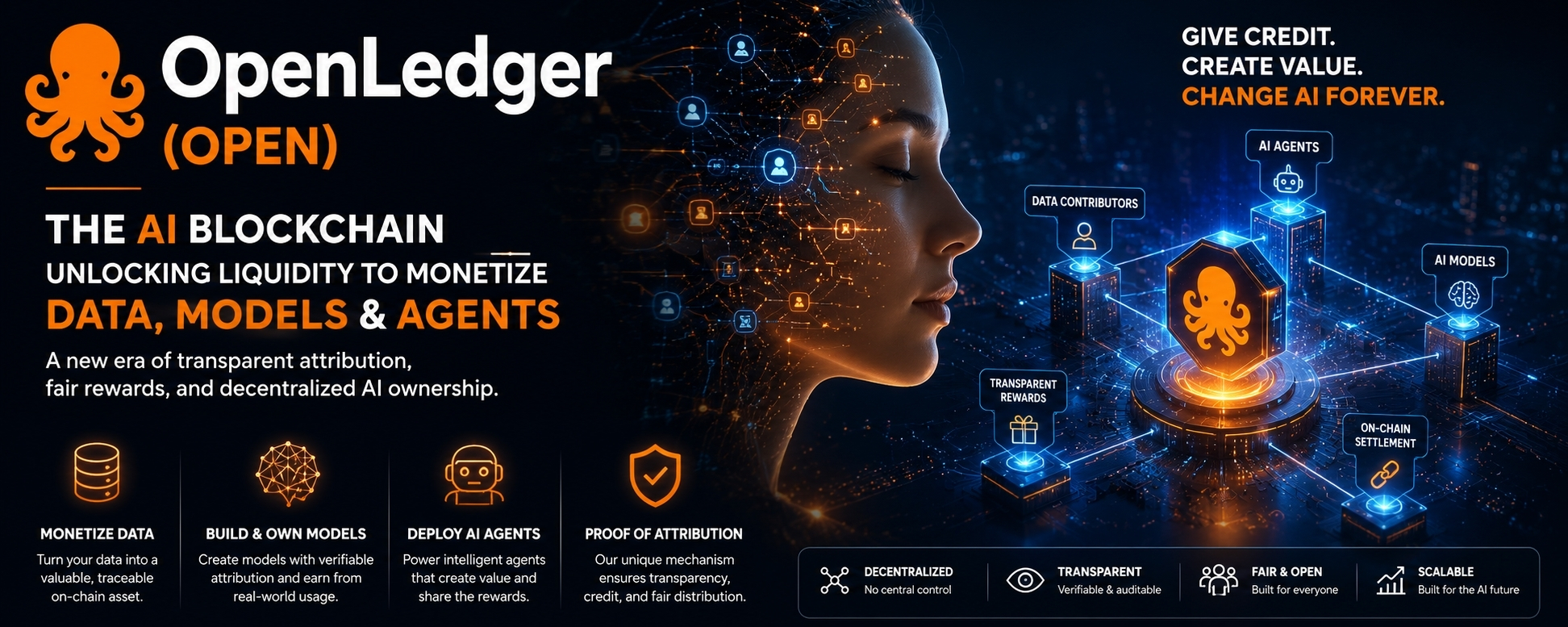
OpenLedger calls itself an AI blockchain focused on monetizing data, models, and agents. On paper, that sounds like another futuristic crypto slogan. But underneath the branding is a much more human idea: people who help create intelligence should not disappear from the story once the machine becomes successful.
And honestly, that hits a nerve because the internet has spent years training us to accept invisible labor.
We scroll through feeds without thinking about the creators behind the posts. We use apps without thinking about the workers moderating them. Now AI has taken that invisibility problem and stretched it even further. Data goes in. Billions are made. The original contributors rarely see anything come back.
OpenLedger is trying to build a system where the trail does not vanish.
Its core idea, Proof of Attribution, is basically an attempt to answer a simple question that turns extremely complicated once AI enters the room:
“Who actually helped create this intelligence?”
Not in a philosophical sense. In a measurable sense.
If a dataset helped shape a model, and that model later creates value, OpenLedger wants the contributors behind that dataset to have a visible connection to the outcome. Instead of data being swallowed into a black hole forever, it becomes something traceable. Something with memory.
That changes the emotional texture of AI completely.
Right now, most AI systems feel like giant anonymous cities. You walk through them, use them, benefit from them, but you have no idea who laid the bricks. OpenLedger is trying to put street signs back up. It wants AI to remember where pieces of itself came from.
And maybe that is why the idea feels bigger than blockchain.
Because this is really about ownership in the age of machine intelligence.
For years, tech platforms built economies around attention. Whoever controlled traffic controlled money. AI is creating a new kind of economy where intelligence itself becomes the product. OpenLedger is betting that the next major fight will not just be about who owns the models, but about who owns the value flowing through them.
That is where the project becomes genuinely interesting.
It imagines a world where datasets are not dead files sitting in storage, but living economic assets. Where niche communities with specialized knowledge can contribute information and continue benefiting when that knowledge gets used. Where AI agents are not isolated bots but participants in an open financial ecosystem.
In theory, it sounds fairer. More balanced. Less extractive.
But theory is the easy part.
Reality is where things get messy.
Because attribution inside AI is incredibly difficult. Human learning itself is blurry. Ask ten musicians where their style came from and you will get ten incomplete answers. AI is even harder. Models absorb patterns from massive amounts of information at once. Tracing influence cleanly is not like following footprints in snow. It is more like trying to trace one drop of rain after it hits the ocean.
That is the mountain OpenLedger has chosen to climb.
And then there is privacy.
The same system designed to track contribution could easily become dangerous if handled carelessly. People like transparency until transparency starts exposing them. Blockchain systems are excellent at remembering things permanently, but human beings are messy creatures who sometimes need deletion, nuance, or forgiveness. Building an attribution economy without turning people into permanently exposed data points is going to be one of the hardest balancing acts in this entire space.
Still, there is something undeniably compelling about the direction.
Because AI right now often feels emotionally disconnected from humanity. It consumes human culture while pretending to stand above it. OpenLedger is trying to rebuild the connection between creation and reward. It is trying to remind people that intelligence does not appear magically from silicon. It comes from millions of human fingerprints layered on top of one another.
In a strange way, the project feels less like finance and more like archaeology.
It wants to preserve the lineage of intelligence.
Not just the output. The origins.
And maybe that is why the idea stays with people. Deep down, nobody likes feeling replaceable. Nobody likes watching systems grow richer from collective human effort while the actual contributors fade into the background like ghosts.
OpenLedger is built around the opposite instinct.
It says contribution matters.
Memory matters.
Origins matter.
Whether the project fully succeeds is another question entirely. The technical challenges are brutal. The governance problems are real. The economics will probably get chaotic at times because every system involving money eventually attracts speculation.
But even with all that uncertainty, the core idea still feels important.
AI should not become a machine that forgets the humans who built it.
And right now, OpenLedger is one of the few projects seriously trying to solve that problem instead of pretending it does not exist.
