What happens when the people who trained AI finally realize they were never part of the deal?
That’s really the uncomfortable thing sitting underneath all this AI hype right now.
Because if you strip away the marketing and billionaire interviews and endless “future of humanity” speeches, modern AI was built on top of human knowledge collected from the internet at absurd scale. Forums. Articles. Open-source code. Tutorials. Research papers. Public conversations. Creative work. Communities spending years building information ecosystems online without realizing giant machine-learning systems would eventually absorb all of it into commercial products.
And somehow that became normal incredibly fast.
People just accepted that public human knowledge could quietly become raw material feeding trillion-dollar AI industries controlled mostly by centralized corporations with enough money to dominate compute and infrastructure.
Honestly that still feels insane when you think about it too long.
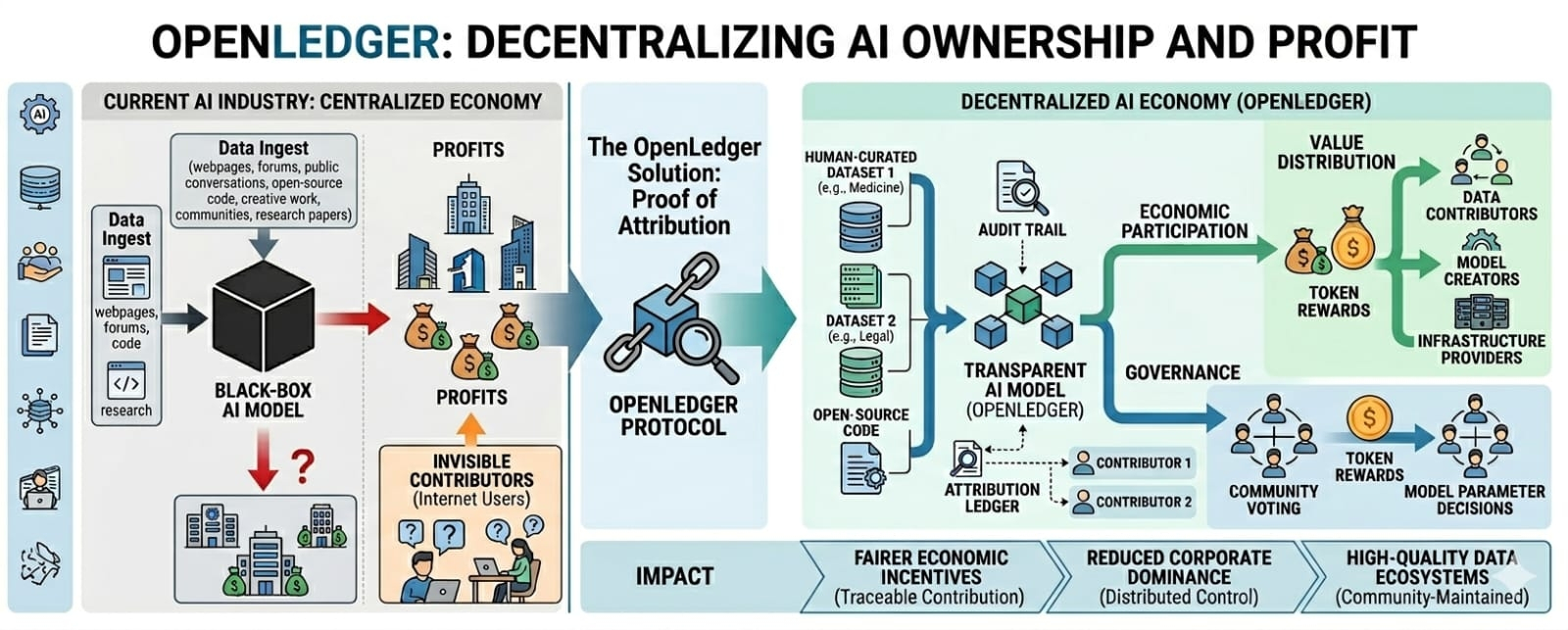
Because the current AI economy is weirdly one-sided. Millions contribute value indirectly every day while ownership and profit concentrate upward into a handful of companies building black-box systems nobody outside their organizations can properly inspect.
That imbalance is probably why projects like OpenLedger even exist now.
Not because blockchain magically fixes AI. Most of the time crypto overcomplicates things honestly. But OpenLedger is at least trying to attack a real structural issue instead of launching another fake AI token pretending a chatbot with token rewards somehow changes civilization.
The issue is contribution without ownership.
Right now AI systems depend heavily on distributed public knowledge while economic participation stays heavily centralized. The internet trained the models. The companies own the models. Everyone else rents access back through subscriptions and APIs.
That model works for now because the technology still feels exciting enough to distract people from the economics underneath it.
But eventually the excitement fades and ownership becomes the real story.
It always does.
Same thing happened with social media. Early internet culture felt open and decentralized until eventually a few giant platforms captured enormous amounts of value and influence from user-generated activity. People didn’t really notice the imbalance until dependency became unavoidable.
AI feels like a much bigger version of that cycle starting all over again.
Because this time companies aren’t just monetizing attention. They’re monetizing intelligence itself.
That’s why OpenLedger’s whole “unlocking liquidity for data, models, and agents” idea actually matters more than the typical crypto buzzwords surrounding it. They’re basically trying to build economic rails where contributors inside AI systems don’t remain invisible forever.
And honestly that feels necessary long term.
Because future AI economies probably become extremely dependent on high-quality specialized datasets maintained by real communities and experts. The internet itself is already getting flooded with AI-generated junk. Articles written by machines. Replies written by machines. Entire websites generated automatically for search traffic. Synthetic content feeding algorithms nonstop.
The web slowly turning into a giant feedback loop where machines train on outputs created by other machines.
That sounds unstable as hell honestly.
Which means trustworthy human-curated data probably becomes incredibly valuable over time. Not just random internet scale. Clean information. Specialized information. Verified information. Community-maintained information.
That’s where OpenLedger’s Proof of Attribution model becomes interesting. The project is basically trying to create infrastructure where contribution remains traceable instead of disappearing into giant opaque systems nobody can audit properly.
Because right now most AI operates like a black box.
Data goes in.
Models train.
Outputs come out.
Money flows upward.
Nobody really knows who deserves what.
That setup becomes harder to justify once AI starts generating larger portions of economic activity itself.
And honestly we’re already moving toward that world faster than people realize. AI systems now write code, generate content, automate support, analyze markets, summarize research, manage workflows, assist legal tasks, help diagnose medical issues, and handle growing sections of digital labor.
The next phase is autonomous agents operating continuously across online economies.
That’s where things get really weird.
Because once AI agents become economically active, ownership questions explode. If agents generate revenue using community-trained models and public datasets, who gets rewarded? The infrastructure company? The model creators? The data contributors? The users operating the systems?
Nobody has clean answers yet.
OpenLedger seems to be betting that transparent attribution systems become necessary before AI economies scale too far into centralized control.
And honestly I think they might be right about that part.
Because centralized AI already creates uncomfortable dependencies. A handful of corporations controlling increasingly important intelligence infrastructure feels risky no matter how impressive the technology becomes. Search, communication, education, software, research, customer service, even parts of creative work are already becoming dependent on systems controlled by a tiny number of companies.
That concentration probably gets worse before it gets better too.
Especially because centralized systems move faster. That’s the reality crypto people hate admitting. Corporations dominate because coordination is easier when a few entities control everything internally. More money. Faster decisions. Better infrastructure. Better engineering talent.
Decentralized systems sound better philosophically but execution becomes messy fast.
Which is why projects like OpenLedger are still extremely risky obviously.
The vision makes sense.
Actually building it at scale is the brutal part.
Most crypto AI projects probably disappear eventually because the market is overloaded with hype and very little real infrastructure. But OpenLedger feels different mostly because it’s focused on a problem that probably gets bigger over time instead of smaller.
The ownership problem.
The attribution problem.
The question of whether contributors inside AI economies remain invisible forever while centralized infrastructure captures all the value.
Because honestly I don’t think society stays comfortable with that imbalance indefinitely once AI moves deeper into everyday economic life.
At some point people stop being impressed by the magic trick and start asking who owns the machine.#OpenLedger $OPEN @OpenLedger