
I think one of the strangest things about this AI boom is how quickly people accepted the idea that human knowledge could become infrastructure without anyone really stopping to ask what that means long term.
Maybe that sounds dramatic, but I’ve been watching crypto long enough to recognize when an industry moves too fast past an uncomfortable question. It usually happens during the phase where everyone is distracted by growth, funding, narratives, and the feeling that something massive is happening. Ethics becomes background noise until the consequences become impossible to ignore.
That’s kind of where I feel we are with AI right now.
Every week there’s another model, another launch, another company promising smarter agents, faster automation, better reasoning, more personalization. The pace is exhausting. And underneath all of it sits this enormous invisible layer of human contribution that people barely talk about anymore.
Forums. Articles. Art. Conversations. Research. Comments. Tutorials. Open-source work. Millions of people feeding the internet for years without realizing their words and ideas would eventually become training material for systems owned by a handful of companies.
I keep thinking about that.
Not in a paranoid way. More in the sense that something about it feels unfinished, like society skipped an important conversation because the technology moved faster than people’s ability to process it.
That’s partly why OpenLedger caught my attention.
Normally I ignore most AI + crypto projects because they all start sounding the same after a while. Decentralized this. Ownership that. Fair incentives. Community-driven infrastructure. I’ve heard every version of the pitch already. Crypto has a habit of wrapping complicated human problems inside clean technical language and pretending the architecture alone changes reality.
Most of the time it doesn’t.
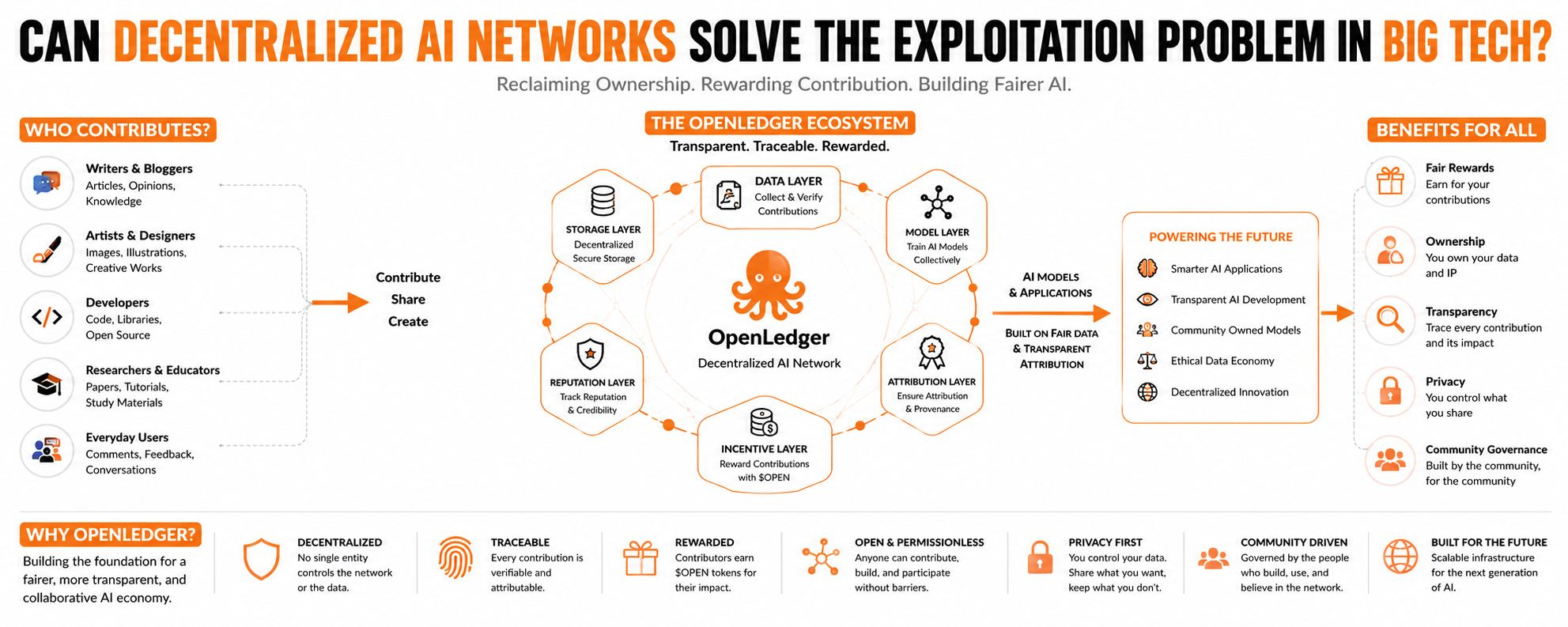
But OpenLedger seems to be focusing on something more specific — the idea that data, models, and contributors inside AI networks should actually be traceable and rewarded instead of disappearing into black-box systems where value only flows upward.
And honestly, I understand why people find that appealing.
Because right now the AI economy feels incredibly one-sided.
The public creates the raw material. Platforms collect it. Companies train systems on top of it. Investors celebrate trillion-dollar opportunities. Meanwhile the average person contributing to the data layer usually gets nothing except more uncertainty about whether their own work is being absorbed into systems they don’t control.
That imbalance feels real to me. Probably more real than most crypto narratives I’ve watched over the years.
Still, I’m careful about sounding too optimistic about decentralized AI networks fixing the problem. I’ve seen too many cycles already. Every cycle arrives with this belief that a new structure will somehow remove human greed, power concentration, manipulation, or exploitation. Then eventually the same incentives creep back in through different doors.
Crypto never fully escaped that pattern either.
People forget how many projects originally started with genuinely idealistic ideas. Open systems. Shared ownership. Redistribution of value. Transparency. Then speculation arrived, incentives warped behavior, and suddenly communities built around principles became ecosystems built around extraction.
That memory stays with you after enough years in this space.
So when people ask whether decentralized AI can solve exploitation in Big Tech, I honestly don’t think the answer is simple. Technology alone usually doesn’t solve exploitation because exploitation is rarely just technical. It’s economic. It’s behavioral. It’s cultural. It follows incentives wherever incentives go.
And incentives have a way of corrupting almost everything eventually.
At the same time, I also don’t think the current AI model feels stable forever. There’s growing tension underneath it now. Lawsuits around training data. Creators questioning ownership. Workers realizing invisible labor still powers supposedly automated systems. Ordinary users becoming uncomfortable with how much information large companies quietly absorb.
You can feel trust starting to thin out around the edges.
That’s why projects like OpenLedger even have room to exist in the first place. They’re responding to a real discomfort people are starting to feel about AI becoming centralized infrastructure controlled by very few entities.
Maybe decentralized networks can at least introduce accountability where there currently isn’t much. Maybe attribution systems can create better visibility around contribution. Maybe contributors gain leverage they never had before. Even small shifts like that matter.
But I also know how messy reality becomes once money touches systems like these.
People game rewards. Low-quality contributions flood networks. Reputation systems become political. Governance gets captured by insiders. Speculators arrive before builders finish the foundation. The original mission slowly turns into another market.
I’ve seen that movie too many times to ignore it now.
So I guess where I’ve landed is somewhere in the middle. I don’t think decentralized AI networks are some grand solution waiting to replace Big Tech. But I also don’t think the current model is healthy enough to avoid pushback forever.
Maybe these systems become alternatives.
Maybe they become pressure mechanisms.
Maybe they fail completely.
Maybe they evolve into something quieter and more useful than the original vision.
I’m not sure yet.
What I do know is that the conversation around AI ownership feels more serious than a lot of the artificial narratives crypto has pushed in the past. There’s an actual fracture underneath it. Real tension. Real imbalance. Real uncertainty about who benefits from all this in the long run.
And after watching years of empty hype cycles come and go, I’ve learned to pay closer attention whenever a problem feels real before the solution even exists.
