
Every time I explore OpenLedger, I end up thinking about one uncomfortable reality inside both DeFi and AI:
The problem is no longer access to information.
It’s execution.
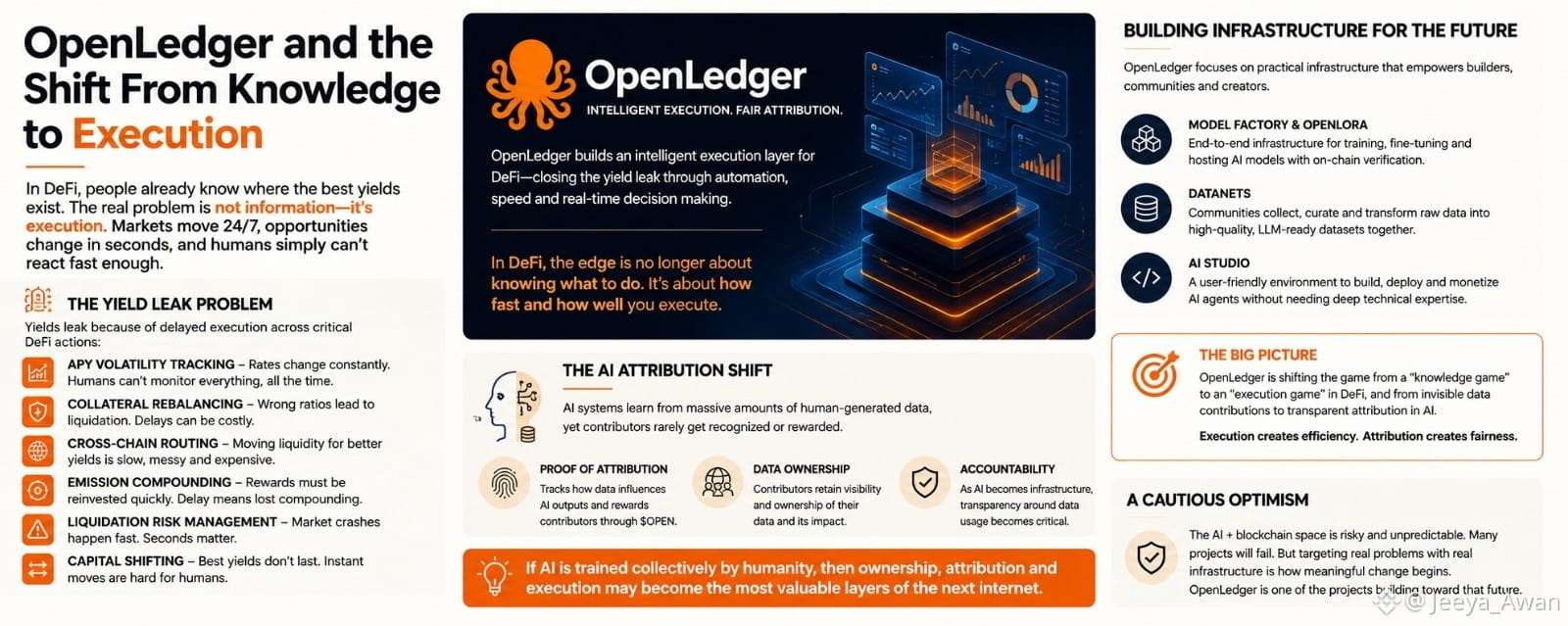
In DeFi, people already know where the best yields exist. APYs, liquidity pools, incentives, and trading opportunities are visible to everyone within seconds. But the market moves faster than humans can react. Rates change while people sleep, collateral positions become risky in minutes, and liquidity constantly shifts across chains. That’s where “yield leak” actually begins, not from lack of knowledge, but from delayed execution.
This is the part of OpenLedger that caught my attention.
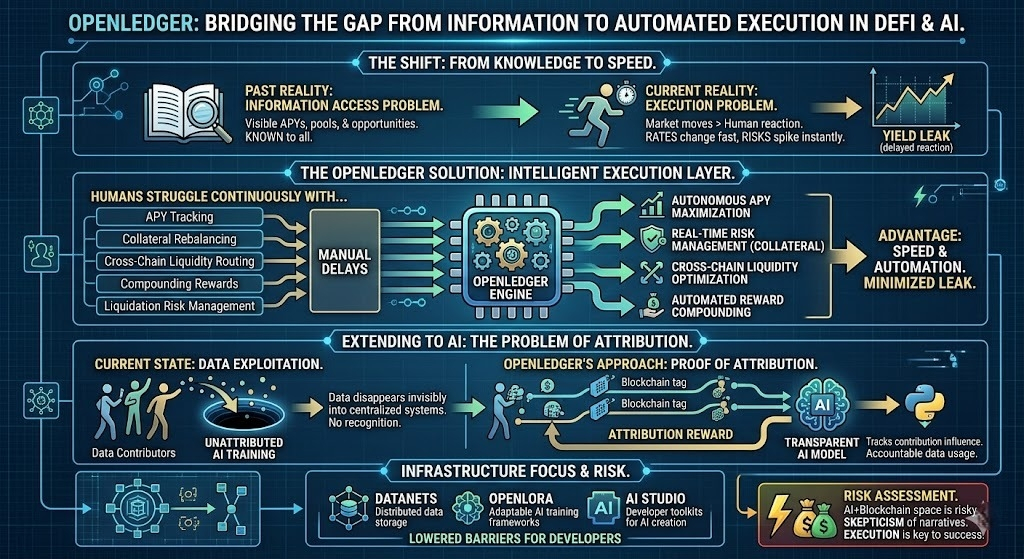
The project seems focused on building an intelligent execution layer capable of handling things humans struggle to manage continuously: APY tracking, collateral rebalancing, cross-chain liquidity routing, compounding rewards, and liquidation risk management.
The idea is simple but important:
In modern DeFi, knowing what to do is no longer enough. Speed and automation may become the real advantage.
And honestly, that shift feels inevitable.
But what interested me even more is OpenLedger’s direction around AI attribution.
Right now, AI systems are trained using massive amounts of human-generated data, yet the people contributing that data rarely receive ownership or recognition once models become valuable. Human behavior has quietly become raw material for machine intelligence.
OpenLedger’s Proof of Attribution approach tries to change that by tracking how contributions influence AI outputs instead of allowing data to disappear invisibly into centralized systems.
That matters because AI is no longer just chatbots or image tools. It’s becoming infrastructure for finance, automation, communication, and decision-making. Once AI reaches that level, accountability around data usage becomes far more important.
Another reason OpenLedger stands out to me is that it focuses on infrastructure instead of pure hype. Systems like Datanets, OpenLoRA, and AI Studio seem designed to lower barriers for developers and communities instead of keeping AI locked behind technical complexity.
Of course, none of this guarantees success.
AI + blockchain is still a risky space filled with noise, speculation, and unfinished ideas. A strong narrative alone means nothing if execution fails.
But I think OpenLedger is at least targeting a real problem:
If AI is trained collectively by human activity, then ownership, attribution, and execution may become the most valuable layers of the next internet.
