
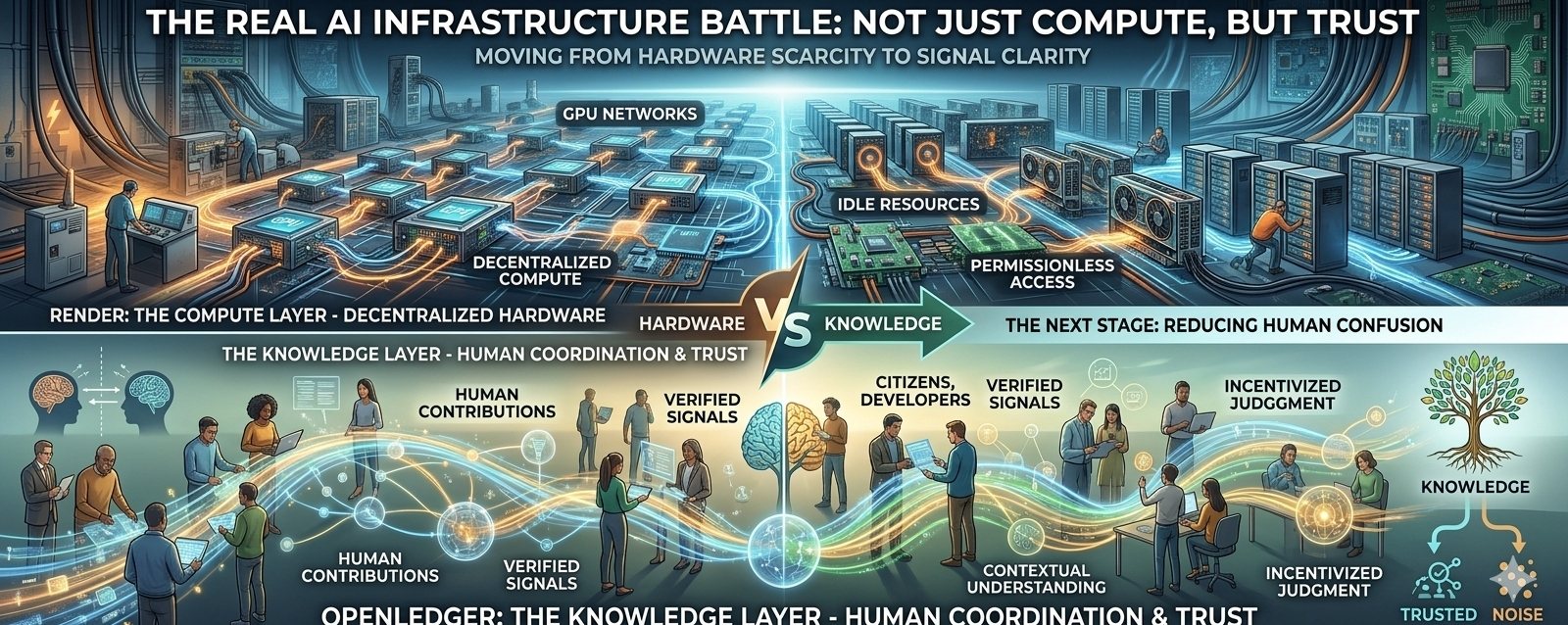
The AI infrastructure conversation keeps getting framed in a very predictable way. People usually ask which network has more compute, which platform can offer cheaper GPUs, which model can run faster, or which decentralized system can challenge the dominance of Big Tech. Those questions are not wrong, but I think they only capture the surface of what is actually happening. The deeper I look at OpenLedger and Render, the more I feel this is not simply a battle over machines, hardware, or processing power. It feels more like a battle over how humans will organize themselves around AI. Render represents one side of the story very clearly. It comes from a logic that crypto has understood for years: unused resources can be turned into productive infrastructure if enough people are connected through the right network. Idle GPUs, distributed compute, decentralized marketplaces, and permissionless access all make sense inside that framework. It is a strong narrative because it gives people the feeling that infrastructure is being pulled away from centralized giants and placed back into the hands of a wider network. But the more AI grows, the more I question whether compute is really the hardest part of the problem.
What seems harder now is attention. People are not suffering from a lack of tools anymore. In many cases, they are overwhelmed by too many tools, too many dashboards, too many models, too many outputs, and too many promises. Every new AI product claims to make life easier, yet many users still do not stay with these products for long. They try them, they feel impressed for a moment, and then they slowly stop using them because the product still demands too much thinking. This is something the market often underestimates. Users do not always want more power. They want less friction. They want fewer decisions. They want systems that understand context without forcing them to constantly manage prompts, workflows, and information. That is where OpenLedger feels different to me. It does not seem to treat AI infrastructure only as a compute problem. It appears to approach it more like a knowledge and coordination problem, where data, human contribution, context, and trust become just as important as the hardware that runs the system.
This difference may look subtle at first, but it points toward two very different visions of the AI economy. Render is closer to the compute layer. It focuses on the physical and technical resources AI needs in order to function. OpenLedger seems to be thinking about the layer above that, the layer where useful signals are created, organized, verified, and turned into something AI can actually learn from. One side is asking how we make processing power more accessible. The other side is asking what kind of information AI should rely on, who creates that information, and how people can be motivated to keep contributing quality knowledge. A few years ago, most of the AI conversation was about model performance. Everyone wanted to know which model was smarter, faster, or more capable. But now the question is shifting. The market is slowly realizing that intelligence is only as useful as the data and context behind it. A powerful model trained on weak signals can still create confusion. A less flashy system built around better signals may end up being more valuable than people expect.
The internet already has more information than any human can consume, but it does not have enough clarity. There is content everywhere, but meaning is harder to find. People are reacting faster, posting faster, and consuming faster, yet real understanding often feels slower. Everything online has been optimized for engagement, but very little has been optimized for judgment. AI makes this even more complicated. As automation improves, the cost of producing content, analysis, code, images, and summaries keeps falling. That sounds exciting, but it also means noise grows at the same time. When everything can be generated instantly, trust becomes more valuable. The real question becomes less about who can produce the most output and more about who can help people identify what is actually useful, original, and reliable. This is why I think the next stage of AI infrastructure may not only be about GPU farms or decentralized compute nodes. It may be about systems that shape how humans filter information, how they contribute knowledge, and how they decide what to believe.
Render and OpenLedger may not be direct competitors in a traditional sense, but they represent two very different priorities. Render belongs to the stage where the biggest concern is compute availability. OpenLedger feels closer to the stage where the concern becomes knowledge quality and human coordination. Both are important, but they solve different kinds of scarcity. Render is solving for scarce processing resources. OpenLedger seems to be solving for scarce trusted signals. And as AI becomes more common, I think the second form of scarcity may become more visible. Compute can scale, hardware can improve, and marketplaces can become more efficient. But trust is not that easy to scale. Human context is not that easy to manufacture. Meaningful knowledge does not appear just because a network has more capacity. It needs incentives, structure, and a system that makes people want to contribute something better than recycled noise.
That is why this comparison feels bigger than a normal infrastructure debate. The future of AI may depend on both compute and trust, but the market may slowly start rewarding the layer that reduces human confusion the most. In the early phase of any technology cycle, people focus on raw capability. Later, the winning systems are usually the ones that change behavior naturally. The internet did not become valuable only because it stored information. It became valuable because it changed how people searched, shared, learned, and trusted. Social networks did not win only because they gave people profiles. They won because they reshaped attention and behavior. AI infrastructure may follow the same pattern. The most important platform may not simply be the one that provides more machine power, but the one that helps humans think with less noise around them.
I am still not completely sure whether OpenLedger can fully execute on this vision, and I do not think Render should be underestimated. Compute is still a foundation of AI, and decentralized GPU networks can play a serious role in the future stack. But the longer I watch this market, the more I feel the conversation is moving away from hardware alone. The real infrastructure battle may be shifting toward trust, knowledge, and human behavior. Render shows what happens when decentralized networks organize machines. OpenLedger points toward what happens when networks try to organize intelligence, contribution, and context. And if AI keeps flooding the world with more output, the biggest winner may not be the system that helps us generate more. It may be the system that helps us understand better.
