
I’ve been around crypto long enough to know when something is just another shiny wrapper around the same old noise. Most of the time, the pattern is obvious. A project shows up, says a few confident things about the future, throws in some words like “decentralized,” “liquidity,” “ownership,” and “AI,” and suddenly everyone acts like the world changed overnight.
Most of it doesn’t last.
That’s why I keep coming back to OpenLedger with a slightly different feeling. Not trust, exactly. Not excitement either. More like a pause. A small one. The kind you get when something sounds familiar, but not completely fake.
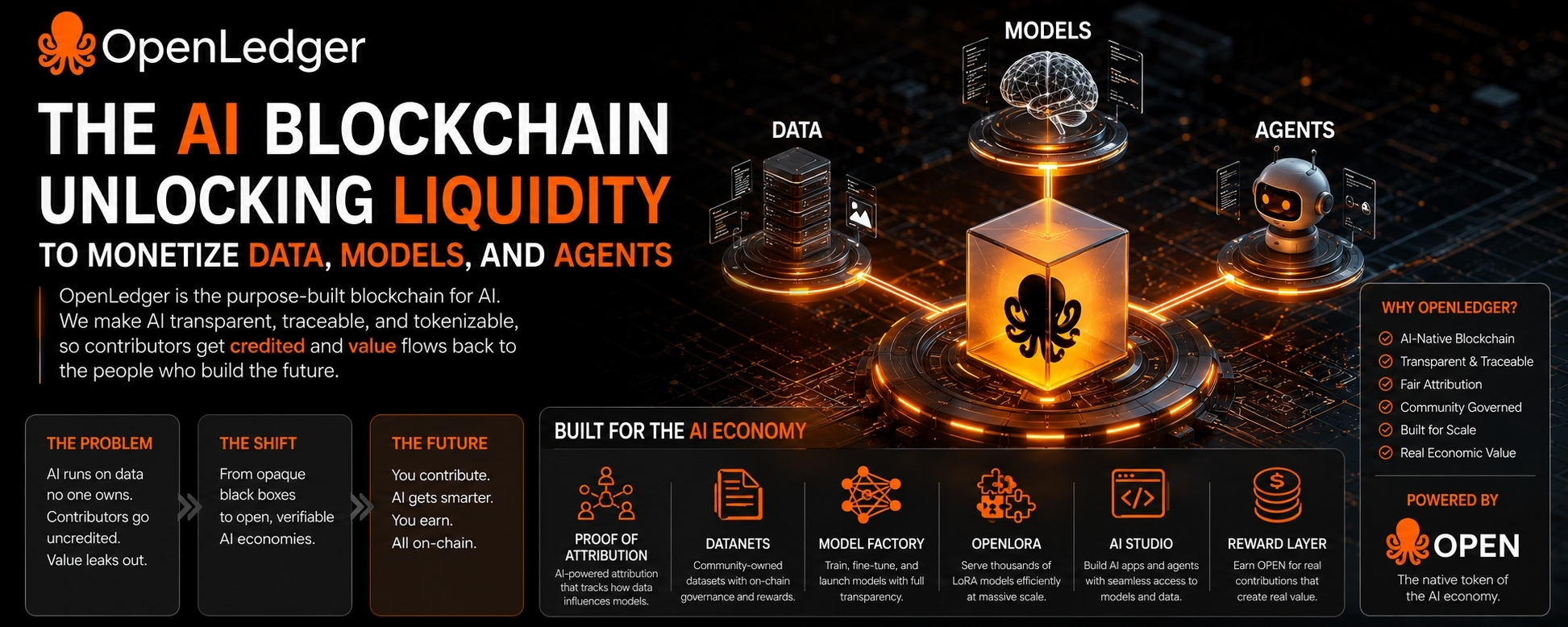
What it seems to be reaching for is bigger than just another chain with an AI label slapped on top. It’s trying to turn data, models, and agents into things that can actually move value, not just consume it. And that sounds clean on paper, but the real world is never that clean. It never is in crypto, and it definitely isn’t when AI gets involved.
That’s the part I keep thinking about. Everyone loves to talk about AI like it appears out of nowhere, fully formed, almost magical. But that’s not how it works. These systems are built on layers of human input, borrowed language, scraped behavior, patterns from places nobody remembers and contributions nobody credits. There’s a kind of quiet theft in that, or at least a quiet forgetting. OpenLedger seems to be circling that problem instead of pretending it doesn’t exist.
I don’t know if that makes it better yet. But it makes it more interesting.
The thing I respect, even while staying skeptical, is that it feels like the project is trying to deal with the ugly parts instead of just decorating them. The hard part is never the pitch. The hard part is the plumbing. How do you actually track who contributed what? How do you make sure value flows back to the people who added something real? How do you do that without turning the whole thing into a maze no one wants to use?
That’s where most of these ideas fall apart. Not in the headline. In the friction.
And crypto has a terrible habit of underestimating friction. It loves clean stories. It loves technical elegance. It loves anything that looks great in a thread and terrible in practice. I’ve seen that cycle too many times. A project looks thoughtful for a while, people start projecting a future onto it, and then the messy parts show up. Adoption is slower than expected. Incentives drift. Users don’t behave the way the whitepaper imagined. The whole thing starts to feel heavier than it looked at launch.
OpenLedger feels aware of that possibility, at least. That’s part of why it stands out.
It seems to be saying that if AI is going to become a real economic layer, then the people feeding it shouldn’t stay invisible. That’s not a wild idea. It’s actually a pretty reasonable one. The weird part is that it still feels fresh, probably because so much of crypto has trained us to expect hollow language instead of real questions.
I keep noticing that the most convincing projects usually don’t sound like they’re trying too hard. They don’t shout. They don’t over-explain their importance. They just point at a problem and keep working on it. OpenLedger feels closer to that than most things wearing the AI badge right now.
Still, I’m not romantic about it.
I’ve seen enough cycles to know that a project can have a solid idea and still get swallowed by the market’s appetite for spectacle. Sometimes the market doesn’t reward the thing that matters. Sometimes it rewards the thing that is easiest to trade. Sometimes the story becomes the product, and the product becomes background noise.
That’s the risk here too.
OpenLedger might be trying to build something useful, but usefulness is a slow burn. It rarely gets the same attention as hype. Hype is loud, fast, and exhausting. Utility is quieter. It takes longer to prove itself. It asks people to care after the dopamine wears off, and that’s usually where projects start losing the room.
So I’m left in that familiar place crypto keeps putting me in. Not convinced. Not dismissive. Just watching.
And maybe that’s the most honest thing I can say about OpenLedger right now. It doesn’t feel like one of those projects I can file away immediately as nonsense. It also doesn’t feel like something I’d blindly cheer for. It sits in that uncomfortable middle space where the ideas are serious enough to deserve attention, but the outcome is still completely unresolved.
That’s the part that feels human to me, actually.
Not certainty. Not confidence. Just the uneasy sense that something in the project is trying to answer a real problem, even if the answer is still incomplete.
That kind of thing matters more to me now than polished narratives ever did.