
The funny thing about AI right now is that almost everybody sounds the same.
Every project claims it’s building the future. Every startup says it’s revolutionary. Every token suddenly became “AI-powered” overnight because that’s where attention moved. Half the market feels like people just glued the letters A and I onto random crypto ideas hoping nobody would ask deeper questions.
And honestly most of it feels disposable.
Not because AI itself is fake. AI is obviously real. The shift happening right now is massive. But hype markets always create noise faster than substance. Especially in crypto. People chase narratives before infrastructure even exists. Everybody talks about the future while quietly ignoring whether the foundations underneath that future actually make sense.
That’s why OpenLedger feels different to me.
Not because it promises magic solutions. Most serious projects don’t. It stands out because it seems focused on what happens after the excitement fades and the real structural problems start becoming impossible to ignore.
Because eventually the market stops caring about flashy demos.
Eventually people start caring about ownership.
About trust.
About where the data came from.
About who controls the infrastructure.
About who actually benefits economically from AI systems built using public human knowledge.
Those questions always arrive later in technology cycles. Early on people only care about convenience and novelty. Same thing happened with social media. Nobody thought deeply about platform ownership in the beginning because the products themselves felt exciting enough. Years later everybody realized a few giant corporations had quietly centralized huge sections of communication, culture, and online attention.
AI feels like that pattern repeating at much larger scale.
Because now we’re talking about intelligence infrastructure itself.
And right now that infrastructure is becoming centralized extremely fast.
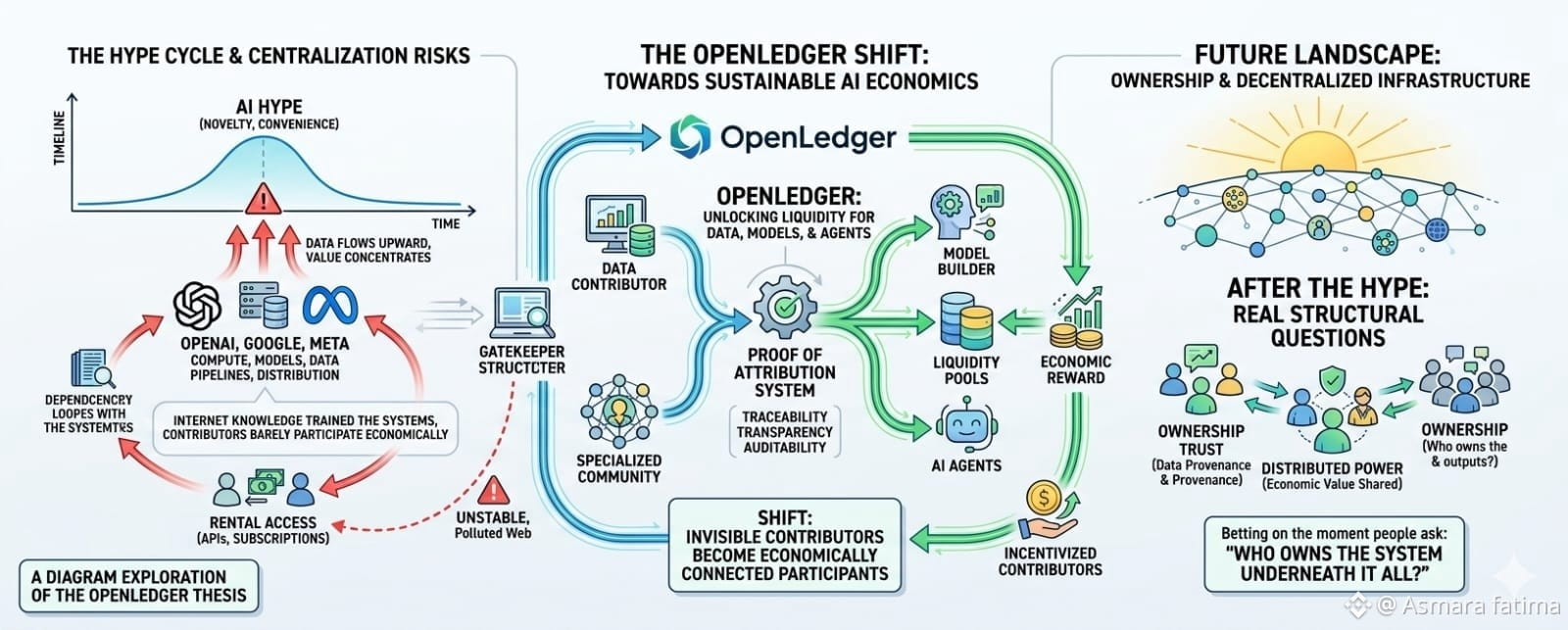
A handful of corporations already dominate compute, models, training pipelines, and distribution. OpenAI, Google, Meta, Anthropic… they aren’t just building products anymore. They’re becoming gatekeepers for machine intelligence systems millions of people increasingly depend on daily.
That concentration should probably worry more people than it does.
Especially because the internet itself trained these systems in the first place.
Human communities created the knowledge. Public forums created the discussions. Developers built open-source ecosystems. Writers published articles. Researchers shared work publicly. Entire generations of internet activity became raw material feeding giant AI systems now controlled mostly by centralized companies.
And somehow contributors barely participate economically in any meaningful way.
That imbalance already feels unstable.
OpenLedger’s entire thesis seems built around that tension.
Their whole “unlocking liquidity for data, models, and agents” thing basically comes down to one idea: contributors inside AI economies shouldn’t remain invisible forever.
Which honestly sounds obvious once you phrase it directly.
But the current system operates almost entirely in the opposite direction. Human knowledge flows upward into centralized infrastructure. Models get monetized. Economic value concentrates. Everyone else rents access back through subscriptions and APIs.
That setup works for now because AI still feels exciting enough to distract people from the economics underneath it.
But eventually ownership becomes the real conversation.
It always does.
Especially once AI agents start becoming more autonomous. And honestly I think people still underestimate how weird that future gets. Autonomous systems handling workflows, customer support, scheduling, research, coding, negotiations, trading, maybe even entire online businesses eventually.
At that point AI stops feeling like software and starts feeling like labor infrastructure.
And once intelligence becomes labor infrastructure, ownership becomes one of the biggest economic questions in the world.
Who owns the agents?
Who owns the outputs?
Who owns the data pipelines feeding the systems?
Who gets paid when machine intelligence generates economic value nonstop?
Right now the answer mostly points toward centralized corporations.
OpenLedger is basically betting that society eventually pushes back against that before the structure becomes permanent.
That’s where their Proof of Attribution system matters too. The goal seems to be creating traceability inside AI economies instead of letting contributions disappear invisibly into giant opaque systems nobody can audit properly. Data contributors, specialized communities, model builders, and AI agents become economically connected rather than functioning like invisible fuel powering centralized machine-learning companies forever.
At least that’s the vision.
And honestly I think the vision makes more sense than a lot of the shallow AI hype dominating crypto right now.
Because the internet itself is already changing in dangerous ways. AI-generated content floods platforms everywhere now. Machine-written articles. Synthetic replies. Fake expertise. Entire websites publishing AI sludge optimized only for algorithms and ad revenue. The web slowly turning into this polluted feedback loop where machines increasingly train on outputs created by other machines.
That’s not sustainable forever.
Which means clean data, trustworthy communities, and transparent attribution systems probably become much more valuable later than they look today.
OpenLedger seems designed around exactly that assumption.
Not endless hype.
Not endless scaling.
But the idea that future AI systems eventually need better economic structures underneath them or the internet itself becomes unstable.
Still risky obviously.
Very risky.
Crypto people always underestimate how hard infrastructure battles actually are. Centralized companies dominate for real reasons. Faster coordination. More money. Better compute access. Better engineering resources. Better distribution.
OpenLedger isn’t competing in an easy environment.
Most decentralized AI projects probably fail honestly.
But centralized AI has weaknesses too. Trust problems. Ownership problems. Data provenance problems. Increasing dependency risks. Public discomfort around concentrated power. The deeper AI moves into everyday life, the more those structural issues start mattering.
That’s why I think OpenLedger’s broader narrative is more important than just another market cycle story.
They aren’t really betting on today’s AI excitement.
They’re betting on the moment people stop being distracted by the excitement and start asking who owns the system underneath it all.
#OpenLedger $OPEN @OpenLedger