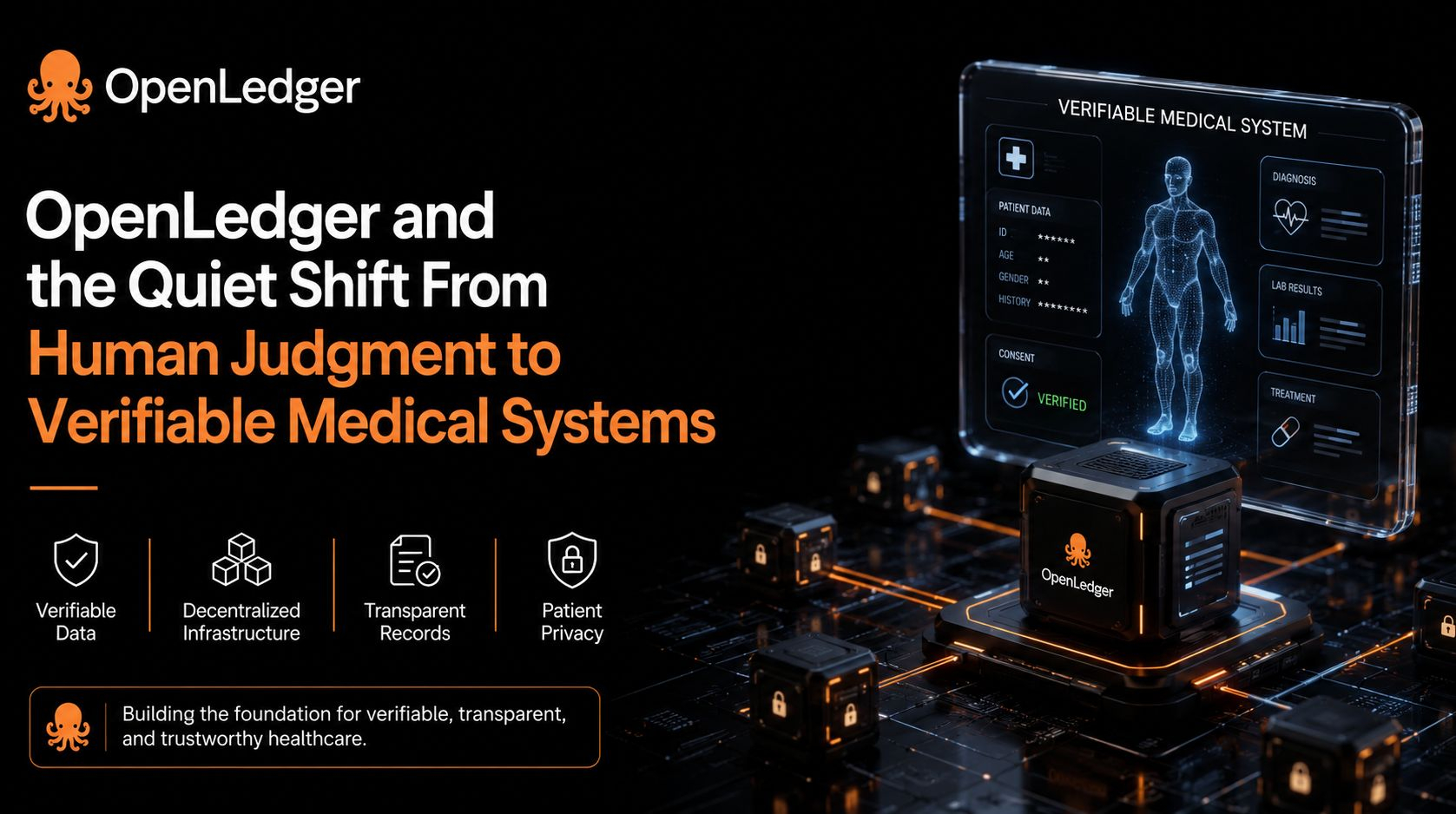

I kept coming back to the word diagnosis.
Not AI. Not blockchain. Not data ownership. Diagnosis.
It is such a heavy word for something that often begins in uncertainty. A doctor narrowing possibilities. A patient trying to stay calm. A family pretending not to search symptoms online. A scan opened on a screen. A pause before someone speaks.
That pause matters.
Because once a diagnosis is spoken, even softly, life starts rearranging itself around it. Calendars change. Money becomes a question. Sleep becomes thinner. People begin using new words for their own bodies.
So when I think about OpenLedger and AI diagnostics in healthcare, I do not imagine some clean future where machines simply make medicine smarter. I imagine a hospital room at 2 a.m., someone waiting for an answer, and a system somewhere in the background helping shape what that answer might be.
That is where the whole thing becomes uncomfortable.
AI diagnostics needs data, and healthcare data is never just data. It is someone’s bad morning. Someone’s scan after weeks of fear. Someone’s blood test. Someone’s rare condition that took years to name. Someone’s private history, cleaned and formatted until it can travel through a model.
OpenLedger seems to exist inside that problem. It tries to make the movement of data and intelligence more visible, so contribution does not disappear into a black box. That sounds reasonable. Maybe even necessary. If people, hospitals, researchers, and contributors help build diagnostic systems, there should be some memory of that work.
But memory is not the same as care.
A ledger can show where something came from. It can record who contributed. It can make systems harder to hide behind. But it cannot feel the weight of a wrong result. It cannot sit with a patient after a false alarm. It cannot explain to a family why the model missed something that a human might have noticed.
And that is the part I keep circling.
We are building systems to make trust more technical because human trust has become too fragile, too slow, too expensive, too uneven. Hospitals do not fully trust vendors. Patients do not fully trust institutions. Researchers do not fully trust closed models. Everyone wants proof now. Logs. Records. Attribution. Verification.
Maybe that is progress.
Maybe it is also a sign of how little we trust each other.
The strange thing is that AI diagnostics could genuinely help. It might catch patterns tired doctors miss. It might give smaller clinics access to better tools. It might make rare diseases less invisible. It might reduce some of the waiting that makes illness even harder to bear.
But help is never simple once incentives enter the room.
If medical data becomes valuable, people begin behaving around that value. Hospitals clean records not only for patients, but for systems. Contributors learn what kinds of data matter. Researchers follow what gets rewarded. Slowly, healthcare becomes not only a place of care, but a place where human suffering produces machine intelligence.
That sentence feels harsh, but I do not think it is false.
A patient never gets sick in order to improve a model. Yet their illness may become useful to one. Their scan may help train something. Their history may become part of a future diagnostic loop. Their fear becomes signal.
There is something generous in that.
There is also something deeply uneasy.
What worries me most is not that machines will replace doctors overnight. It is that everyone will slowly adapt to the machine without noticing. Doctors will write notes in ways systems understand better. Patients will learn to describe themselves through risk scores. Hospitals will protect themselves with audit trails. Trust will become less about a person looking another person in the eye, and more about whether the process can be verified afterward.
That may be safer in some ways.
It may also make medicine colder in ways we only notice later.
Because healthcare is not only the search for the right answer. It is also the way that answer is carried. Who says it. How they say it. Who takes responsibility when the answer is wrong. Who stays in the room afterward.
OpenLedger can help with provenance. It can help show how data moved, who contributed, what shaped a model. That matters. But responsibility is harder than provenance. A system can trace a mistake without anyone truly holding it.
That is the quiet danger.
When everything is distributed, blame becomes distributed too. The model suggested. The doctor approved. The hospital adopted. The data came from elsewhere. The network recorded it. The validator checked it. Everyone touched the decision, but no one feels fully inside it.
And healthcare cannot live only on traceability. It needs someone to answer.
I do not know where that leaves me. I do not want to dismiss these systems, because the current system already fails too many people. Delayed diagnoses are real. Bias is real. Burnout is real. Data silos are real. Closed AI systems extracting value without accountability are real.
Maybe OpenLedger is trying to solve one of the right problems.
But even right problems can produce strange solutions.
The more medicine becomes data-driven, the more people may reshape themselves to fit what data systems can see. The messy parts of illness may become harder to express. The uncertainty, the fear, the intuition, the small detail a patient mentions at the end of an appointment because they were embarrassed to say it earlier. These things matter, even when they are difficult to measure.
A system may not erase them.
It may simply fail to notice them.
And over time, what systems fail to notice can become what institutions stop valuing.
That is what stays with me. Not a dramatic fear of AI doctors. Not some clean argument for or against OpenLedger. Just the feeling that healthcare is entering a new kind of bargain. We may get faster diagnostics, clearer data histories, better attribution, maybe even fairer participation in the creation of medical AI.
But beneath that, something else may be changing.
Care may become more visible to machines and less recognizable to people.
And maybe that is the question we should sit with longer than the technology itself.
#OpenLedger @OpenLedger #OpenLedger # $OPEN