I’ve been watching crypto bolt “AI” onto literally everything for almost two years now and honestly, most of it feels disposable.
Same cycle every time. Fancy website. Big claims about autonomous agents. Some vague diagram showing data flowing through arrows into a token. Retail gets excited because people think saying “AI infrastructure” automatically means trillion-dollar opportunity.
Half these projects barely have a product. Some are basically chatbot wrappers with staking mechanics.
So when I first looked at OpenLedger, I expected the same thing. Another AI coin pretending to reinvent the internet.
But after digging through it for a while, I think there’s actually a real idea underneath the marketing. Doesn’t mean it’ll work. Big difference.
The part that caught my attention wasn’t the blockchain itself. Nobody needs another generic chain. We already have too many chains with zero activity except farming and fake volume.
The interesting part is the project’s obsession with attribution.
Who contributed the data.
Who trained the models.
Who gets paid when those models are used.
That’s the actual conversation here.
Because AI right now runs on a weird contradiction nobody in Silicon Valley really wants to acknowledge publicly. The entire industry depends on human-created information, but the economics are insanely centralized.
People create the raw material.
Companies capture the upside.
That’s basically the entire AI economy in one sentence.
Every model was trained on somebody’s work. Articles, research papers, forum posts, open-source code, niche communities, support tickets, documentation, conversations. The models didn’t invent that knowledge out of nowhere. Humans spent years producing it.
And now we’ve got trillion-dollar companies building businesses on top of that pile while the contributors mostly get… nothing.
Or worse, they eventually compete against systems trained on their own work.
That tension is only going to get uglier from here. Especially once AI moves deeper into specialized industries where the useful data isn’t freely available online anymore.
That’s where OpenLedger is placing its bet.
Not on “decentralized AGI” or whatever buzzword crypto Twitter is screaming about this week. Their bet is simpler:
Future AI systems will need valuable proprietary data, and the owners of that data are eventually going to want economic participation.
Makes sense to me honestly.
The first generation of AI models got fat off scraping the open web. That era is fading. The next layer is more niche. Legal data. Medical workflows. Enterprise knowledge bases. Financial research. Regional languages. Industry-specific behavior.
Smaller datasets. More valuable.
And companies are not going to hand those over for free forever.
OpenLedger is trying to build a system where those datasets can actually earn ongoing revenue instead of being swallowed into a black box permanently.
That’s the theory anyway.
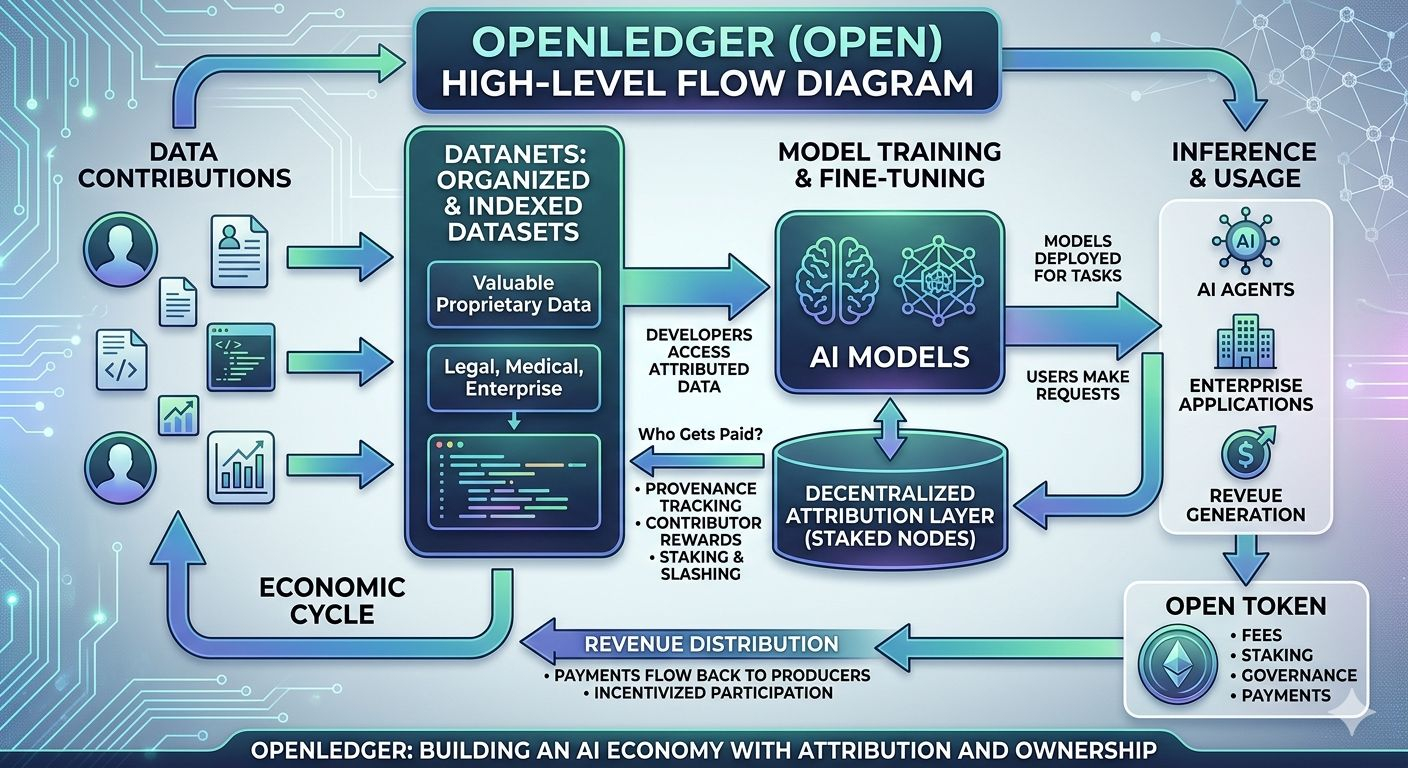
They call these things Datanets. Basically organized datasets that developers can use to train or fine-tune AI models. Then when those models get used — inference requests, agent activity, whatever — payments flow back through the system.
In practice, OpenLedger wants AI data to behave more like an asset than a one-time resource.
Which is interesting because crypto has mostly ignored this layer until recently. Everybody focused on compute. GPU marketplaces everywhere. Decentralized cloud narratives. Tokenized compute grids.
I get why. Compute is easier to understand.
But compute alone probably isn’t the long-term moat. Access to useful data matters more over time. Especially exclusive data.
That’s the thing crypto people sometimes miss while chasing narratives. OpenAI didn’t become dominant because of decentralization debates. They became dominant because they accumulated distribution, talent, compute, and insane amounts of training data before everybody else.
OpenLedger seems to understand that the next fight in AI may revolve around ownership and coordination rather than just model size.
Still, there are parts of this that feel very unresolved.
The attribution layer is the obvious one.
The project talks heavily about rewarding contributors whose data influences model outputs. Sounds great conceptually. But technically? That gets messy very fast.
Neural networks aren’t spreadsheets.
You can’t cleanly isolate value creation inside these systems. Once data gets absorbed into training weights, figuring out what influenced what becomes blurry. Sometimes impossible.
And I think some crypto projects underestimate how hard this problem actually is because “on-chain attribution” sounds cleaner in theory than it probably works in reality.
If OpenLedger can’t solve that convincingly, a lot of the economic model weakens.
Because then you’re back to trust assumptions and fuzzy accounting. Which crypto people usually hate. Unless number goes up.
Another thing.
The project leans hard into AI agents too, which I have mixed feelings about. Not because AI agents are fake — eventually they’ll matter a lot — but because the current agent market is flooded with garbage.
Most “AI agents” today are basically automated social accounts with tokens attached to them. Endless loops of agents interacting with other agents generating meaningless activity so dashboards look alive.
Feels like watching bots perform theater for venture capitalists.
OpenLedger at least tries to add economic accountability into the mix. Agents may need staking, collateral, slashing conditions. That part I actually like. If autonomous systems are going to operate financially, there probably should be consequences for bad behavior.
Crazy idea apparently.
The OPEN token itself is pretty standard infrastructure stuff. Payments, staking, governance, fees. Nothing magical there.
And honestly, that’s fine.
Crypto projects get into trouble when they pretend token design alone is innovation. Most tokenomics are just variations of inflation schedules and incentive games anyway.
The bigger issue is whether the network ever gets real demand.
Not Twitter engagement.
Not Discord members.
Not “community growth.”
Not testnet wallets inflated by airdrop hunters.
Actual usage.
That’s where nearly every AI crypto project eventually runs into a wall.
People in this industry love confusing speculative attention with adoption. Happens every cycle. If users show up because they expect free tokens later, those aren’t real users yet. They’re tourists.
OpenLedger still sits in that danger zone for me.
There’s definitely interest around the project. Funding helped. AI narratives help even more because the market throws attention at anything remotely connected to machine learning right now. But attention is cheap.
The hard part comes later when incentives fade and the system has to survive on utility instead of speculation.
Can OpenLedger onboard real enterprise datasets?
Can developers build useful models there instead of using centralized providers?
Can the attribution system function well enough that contributors actually trust it?
Can inference demand become sustainable?
Those are the questions that matter.
Not whether some influencer calls it “the future of decentralized AI” on Twitter.
Competition isn’t exactly forgiving either.
Bittensor already owns a huge chunk of mindshare around decentralized intelligence markets. Render dominates decentralized GPU conversations. Sahara AI is attacking similar territory around collaborative AI ownership.
And then there’s the obvious reality nobody likes admitting in crypto:
Centralized AI companies are still massively ahead.
Like… massively.
The gap in capital alone is absurd. OpenAI burns through more money in months than entire crypto sectors combined. Google, Microsoft, Anthropic — these aren’t startups fighting for survival on token incentives.
So OpenLedger doesn’t win just by being on-chain.
That’s not enough anymore.
It has to offer something materially better:
better economic alignment,
better access to specialized data,
better incentives for contributors,
something.
Otherwise most serious companies will stay with centralized AI stacks because they’re easier and more mature.
Still. I think OpenLedger is pointing at a real pressure point in the AI industry, and that’s more than I can say for most projects in this category.
Because the current direction of AI feels increasingly extractive.
Users generate value.
Platforms absorb value.
Contributors lose visibility once their data enters the machine.
Same internet model again. Just bigger this time.
Crypto, at its best, usually emerges where coordination problems exist. And there probably is a real coordination problem forming around AI data ownership.
Whether blockchain is the right solution… honestly, I’m still undecided on that.
But I do think the market is underestimating how important data rights and attribution become once AI systems move deeper into professional industries and proprietary information.
That’s where things get serious.
That’s where the free-data era ends.
And if OpenLedger manages to position itself there before the rest of the market catches up, then yeah, it could become much bigger than people expect right now.
Big “if” though.
A lot of crypto projects sound smart before reality shows up.