
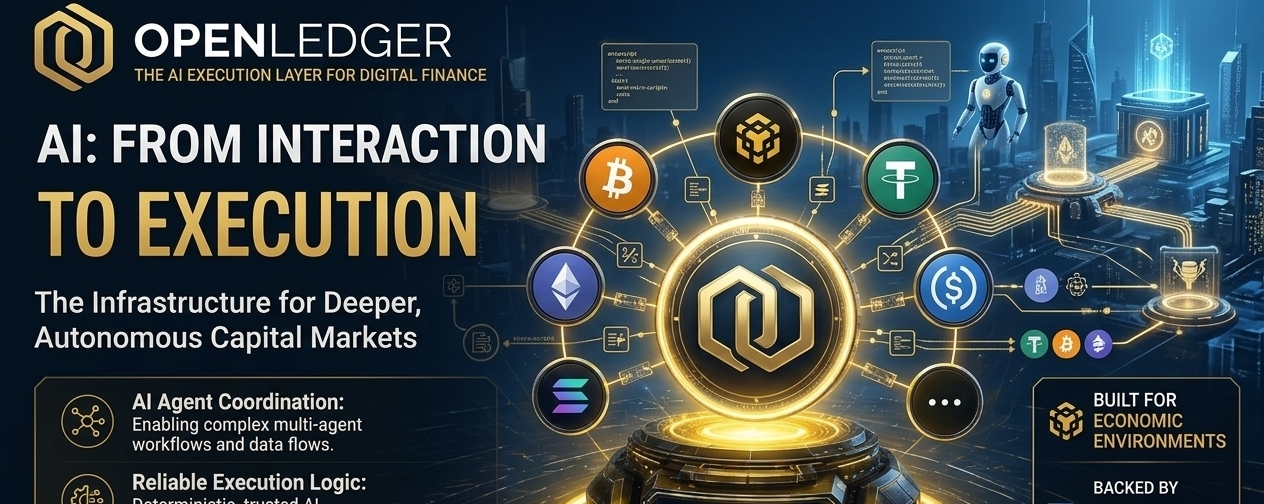
For a long time, most people have understood AI through interaction.
We ask a question, it gives an answer. We give a prompt, it creates text, images, summaries, code, or automation. That version of AI is useful, but it still feels like a tool sitting in front of us. The human stays at the center, while AI responds from the outside.
What makes @OpenLedger interesting to me is that it points toward a different phase.
The next phase of AI may not be about who builds the most impressive chatbot. It may be about who builds the infrastructure that allows AI agents to operate, coordinate, execute, and prove value inside real economic systems.
That is a much bigger shift.
In financial environments, AI cannot just be entertaining or convenient. It has to be reliable. It has to understand data flows, execution logic, attribution, incentives, and trust. When AI moves closer to markets, trading agents, liquidity systems, and autonomous decision-making, the standard becomes much higher.
This is where the OpenLedger thesis feels important.
@OpenLedger is not only about AI as a visible feature. It is connected to the idea of AI becoming part of the operational layer underneath digital finance. Instead of simply helping users interact with platforms, AI may start helping systems execute tasks, coordinate activity, and create measurable outcomes.
That is why $OPEN stands out to me.
The market still talks about AI like it is mainly a content machine. But the real value may come when AI becomes infrastructure: something that runs quietly in the background, supports agents, manages workflows, and helps financial systems become more intelligent and autonomous.
To me, #OpenLedger represents that deeper direction.
AI is moving from interaction to execution.
And the projects building for that shift early may become far more important than the ones only chasing surface-level attention.