
I once noticed something while using different crypto applications that stayed in my mind longer than I expected.
A basic transaction that usually completes in seconds stayed pending for longer than normal. Nothing showed an error. Nothing looked broken. It just did not move. Later, I saw a similar situation in another app during a busy period. That is when it stopped feeling like a random delay and started feeling like something structural in how these systems behave under pressure.
What I realized is that crypto systems rarely fail in obvious ways. Most of the time, they become uneven. When activity is low, everything feels smo0th and predictable. But when usage increases, the experience changes. Some requests go through instantly while others slow down without a clear explanation from the user side.
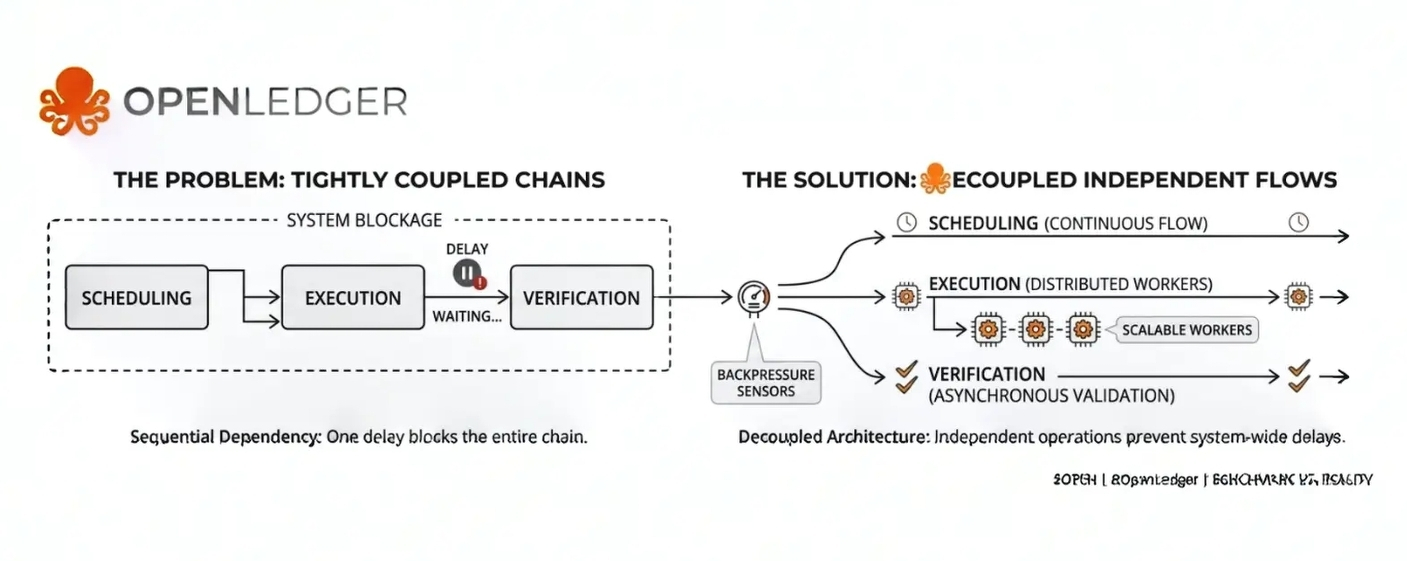
from a system perspective, this usually comes down to coordination, not raw performance. There are multiple layers working together like execution, verification, and scheduling. when these layers are tightly connected, a delay in one part affects everything else. The system d0es not break, but it becomes inconsistent, and that inconsistency is what users actually feel.
I often think of it like a busy bus terminal.
When traffic is light, everything runs on time. Buses arrive, passengers board, and movement feels simple. But when the terminal gets crowded, the issue is no longer speed. It becomes about managing flow. If too many routes depend on the same platform or timing system, delays start to build even if nothing has technically failed.
When I look at how @OpenLedger approaches this, what stood out to me is the focus on structure rather than just performance. The idea seems to be that complex workloads, especially AI-related ones, need to be organized in a way that avoids unnecessary dependency between parts of the system.
What matters in practice is how scheduling, execution, and verification are separated. In many systems, these are linked too closely. That means one delay can hold everything else back. Scheduling waits for execution. Execution waits for verification. And the whole process becomes one long chain instead of separate flows that can move independently.
What interests me more is how separation changes behavior under load. If scheduling can continue without waiting on execution, and verification can run without blocking everything behind it, the system does not rely on a single point of movement. It becomes more flexible when demand is uneven.
Backpressure is another part that feels important. In real systems, overload does not usually appear suddenly. It builds up quietly. Backpressure allows the system to slow down before that buildup turns into instability. It is not about limiting performance. It is about keeping the system stable when demand is higher than expected.
Worker scaling also depends on how well work is distributed. Adding more capacity only helps if tasks are spread properly. If everything still funnels through the same bottleneck, scaling just shifts the pressure instead of removing it. What matters is whether the system can balance load across different parts instead of concentrating it in one place.
there is also a tradeoff between ordering and parallelism. Strict ordering is easier to understand but can slow everything down. Parallel execution improves speed but requires careful control to avoid confusion or inconsistency. Most real systems end up balancing both depending on what the task actually needs.
From what I have seen in different networks, the real test of infrastructure is not how it performs in ideal conditions. It is how it behaves when conditions are uneven. When demand spikes. When multiple processes compete at the same time. When one part slows down and starts affecting others.
What stands out in systems like OpenLedger is not a single feature, but the attempt to design around that reality. Not assuming perfect flow, but building for uneven pressure.
A system does not need to feel fast when everything is calm. It needs to stay steady when things are not.
Good infrastructure is rarely something you notice directly. It is something that continues working quietly, even when everything around it becomes busy.