
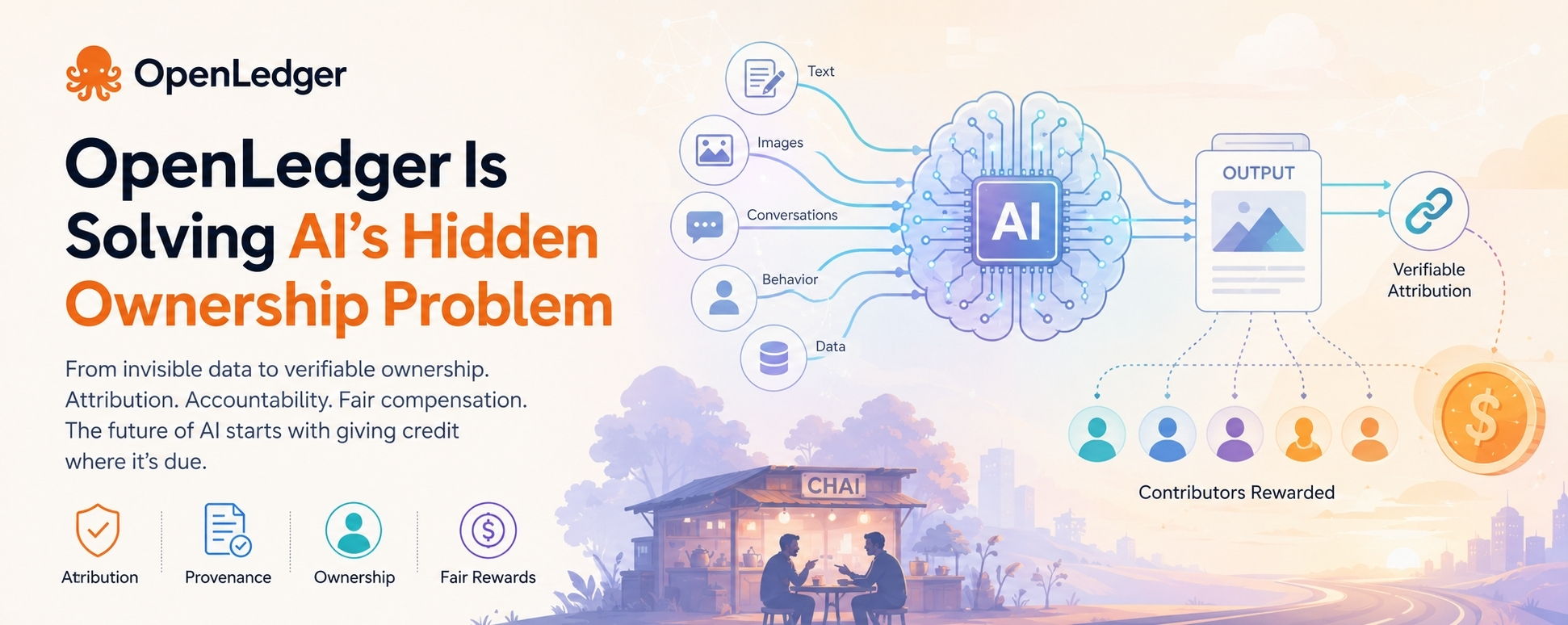
I was sitting in a roadside chai shop yesterday evening while two shopkeepers argued over an old notebook full of unpaid balances. One kept turning pages trying to prove he had already cleared the amount. The other pointed at missing entries and said half the deliveries were never recorded properly in the first place.
The strange thing was that nobody was confused about the products themselves.
The argument was about records.
Who contributed. Who deserved payment. What could actually be verified afterward.
That stayed in my head later while I was reading through OpenLedger again.
Because the deeper I looked into the architecture, the more I realized the project is not really trying to solve a compute problem.
It is trying to solve an ownership problem the internet quietly ignored for years.
I originally started paying attention to OpenLedger because one question kept bothering me:
Why would Polychain Capital back this project?
This is the same fund that understood Ethereum early when most people still dismissed it completely. They usually do not chase temporary AI hype or fast-moving narratives. Most of their larger bets target infrastructure layers that could become structurally important later if the market evolves in a certain direction.
And honestly, once I stopped looking at OpenLedger like “another AI chain,” the project started making a lot more sense.
Most people still describe it very simply: upload data, train models, earn rewards.
But I think that framing misses the real point entirely.
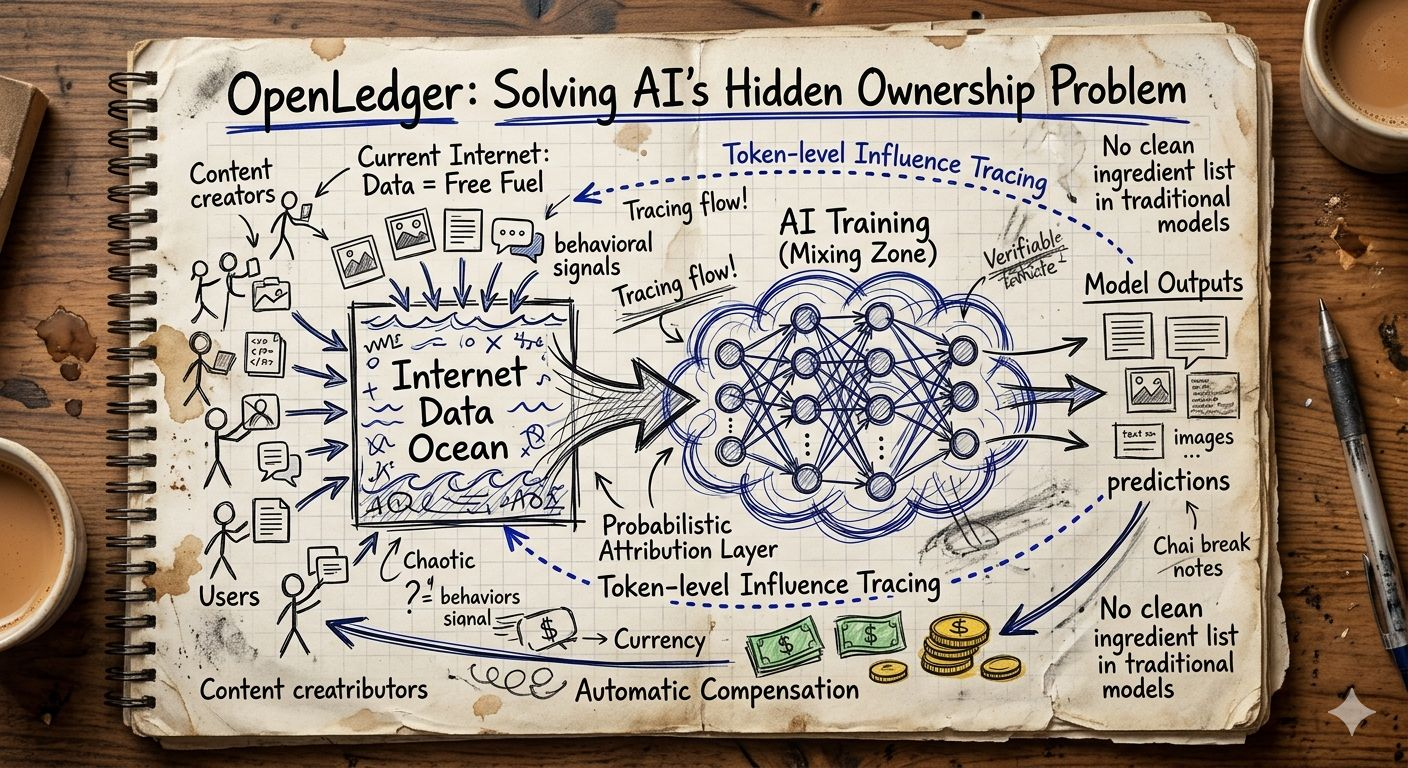
For almost twenty years, the internet has operated on an invisible exchange.
People create content. People generate behavior. People produce signals, conversations, images, preferences and knowledge every single day.
Platforms collect all of it. AI systems train on top of it. Companies monetize the intelligence extracted from it.
And almost nobody contributing value gets compensated directly.
Not because the data lacks value.
Mostly because there was never a clean system capable of tracing contribution clearly enough to create economic accountability afterward.
That seems to be the real thing OpenLedger is trying to build.
Not just decentralized storage.
Not just AI infrastructure.
An attribution system where model outputs can be linked back toward the data sources influencing them and where compensation can move automatically through that trail afterward.
Honestly, that is a much more difficult problem than most people realize at first.
AI models do not naturally preserve clean ingredient lists internally.
Training data gets mixed together constantly. Information becomes compressed. Signals overlap. Patterns transform through multiple stages before outputs ever appear.
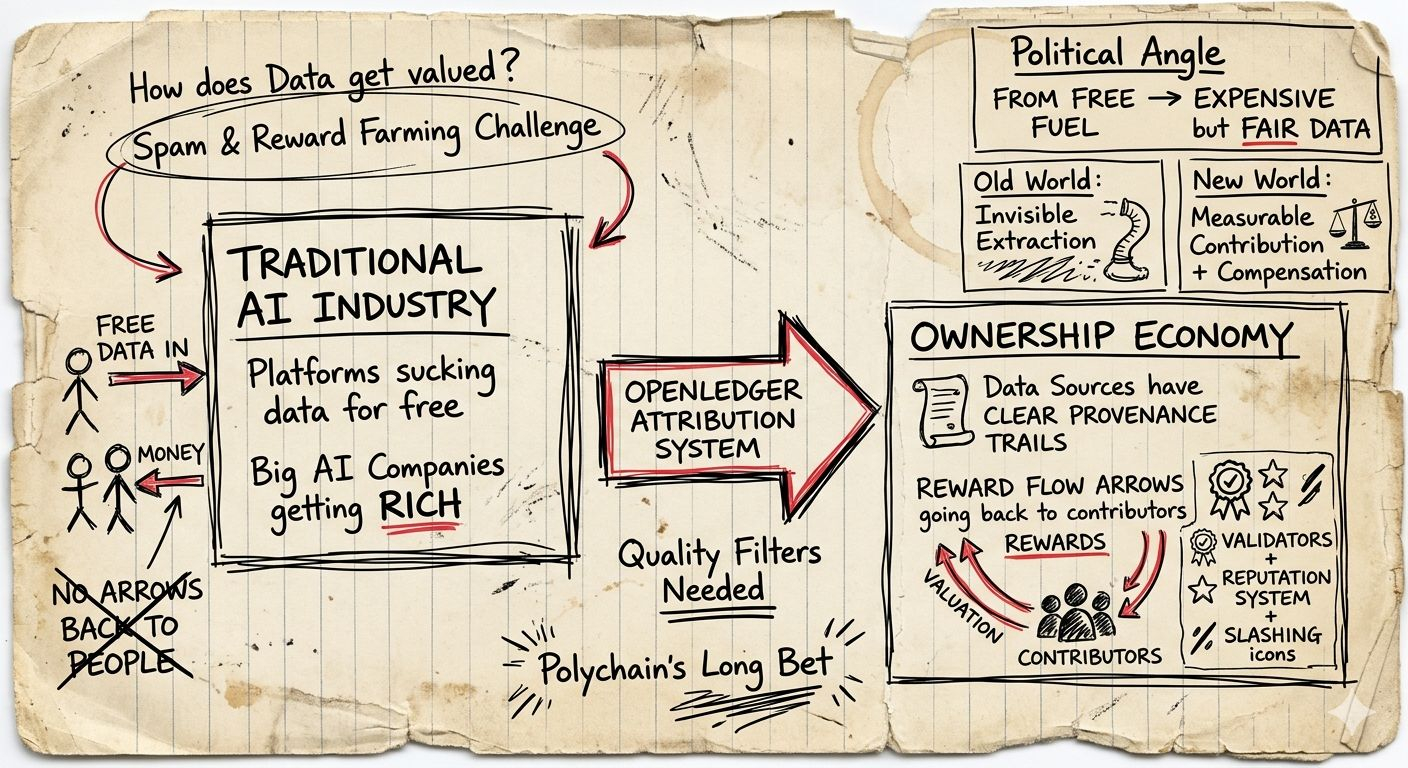
By the time a model generates something useful, tracing influence cleanly becomes extremely messy.
And that is exactly why most companies avoid touching this problem seriously.
OpenLedger is trying to build around it anyway.
The technical side becomes complicated quickly.
Smaller models can estimate influence through mathematical attribution methods. Larger language models require broader token-level pattern tracing systems to connect outputs back toward training sources probabilistically.
Most normal users honestly will never care about the technical mechanics themselves.
But the economic implication underneath them matters a lot.
Because the moment attribution becomes reliable enough, internet data stops behaving like free raw material.
It starts behaving like property.
And that changes the economics of AI completely.
The more I thought about it, the more I realized this is not only a technical challenge.
It is also political.
The current AI industry grew partly because internet-scale data was effectively treated as free fuel for model training.
If attribution systems eventually become standard practice, the economics shift dramatically.
Training AI becomes more expensive. Data provenance becomes important. Licensing matters. Ownership matters.
At first that sounds inefficient.
But historically, industries mature the moment invisible extraction finally becomes measurable.
Factories became more expensive once environmental damage carried real costs. Financial systems slowed down once compliance became mandatory. Food supply chains changed once provenance standards mattered commercially.
AI may eventually face the same transition.
And honestly, I think this is the timeline Polychain is probably betting on.
Not short-term hype cycles.
Structural pressure building slowly underneath the AI economy itself.
That also explains why I think many people misunderstand the current $OPEN market situation completely.
Retail crypto usually wants immediate validation.
Three months. Six months. Quick momentum. Fast narratives.
But OpenLedger feels more like infrastructure positioned around a problem that becomes important gradually once regulation, legal pressure and industry incentives begin aligning together later.
Especially as governments start focusing more heavily on AI accountability and data provenance standards.
Still, I do not think the risks here are small.
Actually, the biggest threat to OpenLedger may come from the same incentives powering the network.
The moment contributors can earn rewards from data, spam pressure appears almost immediately.
Duplicate datasets. Low-quality labeling. Synthetic garbage uploads. Reward farming disguised as participation.
Every open incentive system eventually encounters this problem.
And honestly, maintaining quality inside decentralized networks is much harder than most whitepapers make it sound.
OpenLedger talks about validators, contributor reputation systems, slashing mechanisms and quality filters.
Those ideas make sense conceptually.
But enforcing standards globally across millions of participants with completely different incentives is extremely difficult operationally.
Open systems always carry the same tension:
the easier participation becomes, the harder quality becomes to protect.
Still, I think OpenLedger is addressing a deeper issue than most AI crypto projects are even willing to acknowledge yet.
Most projects are trying to monetize intelligence itself.
OpenLedger is trying to monetize attribution around intelligence.
And those are two completely different markets.
The internet spent two decades teaching people their data was free because nobody had a practical system capable of accounting for its value properly.
AI may become the industry that finally proves it never was.