
I kept thinking about airport chains while reading deeper into how AI systems are starting to organize themselves.
Not the planes, not the passengers. The terminals.
Because if you’ve ever been to different airports in different countries, there’s this quiet familiarity that almost feels intentional. The layout changes slightly, the scale changes, but the logic remains the same. You don’t need to relearn everything each time. You already know where things are going to be, even before you see the signs.
That kind of repetition is not accidental. It is designed stability.
And the strange thing is, AI infrastructure seems to be drifting toward something similar, just less visible on the surface.
Most people still talk about AI like it’s a product race. Better models, sharper outputs, faster reasoning. But what started standing out to me is that performance is no longer the only pressure point. Once systems leave controlled environments and start interacting with real users, real data, and real incentives at scale, something else becomes heavier than intelligence itself.
Consistency.
The ability to behave the same way under repeated stress, across different environments, with different actors touching it at the same time.
That’s where things start shifting quietly.
Because intelligence without coordination doesn’t scale cleanly. It fragments. It becomes impressive in isolated moments but unstable when embedded into systems that depend on continuity.
And continuity is where real economies live.
That reminded me again of franchises. Not in a romantic sense, but in a structural one. A franchise is not built on uniqueness. It is built on replication that holds its shape even when stretched across geography, people, and time. The deeper value is not in creativity at each node, but in the fact that deviation is controlled.
Over time, that pressure compounds.
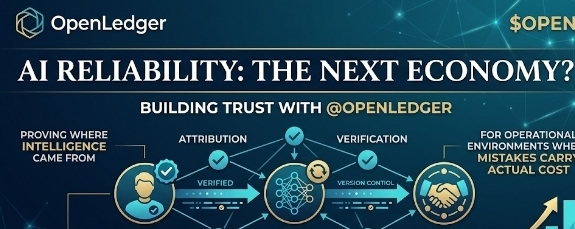
Now when I look at projects like @OpenLedger, I don’t immediately see the surface narrative of decentralized AI infrastructure. That explanation feels too clean for what is actually being attempted.
What feels more accurate is something closer to coordination architecture.
A system where AI behavior is not just generated, but tracked, attributed, and stabilized across multiple participants who don’t fully trust each other by default.
The difficult part is no longer building models that can think.
The difficult part is making sure those models behave predictably when they are no longer inside a single boundary.
And that introduces problems most AI discussions quietly avoid. Attribution becomes messy. Data contribution becomes contested. Reliability becomes uneven across different environments. Even failure becomes harder to locate. Not because the system is broken, but because responsibility is distributed.
That’s a different kind of complexity.
It feels less like software engineering and more like building an economic rail system where every train is slightly autonomous and every station is independently operated, yet the timing still has to make sense globally.
What started standing out to me about $OPEN in this context is not the idea of intelligence creation itself, but the idea of persistence layers around intelligence.
Once systems become persistent, they stop being evaluated moment to moment. They start being assumed. And that assumption is where infrastructure power quietly forms.
Nobody evaluates electricity when they flip a switch. They only notice it when it fails. AI is slowly moving toward that same expectation curve, even if most of the industry still treats it like a tool you actively engage with.
The transition from tool to infrastructure is never loud. It happens through repetition, through dependency, through small integrations that accumulate until removal becomes more expensive than continuation.
That’s usually the point where systems stop being seen as products.
And start behaving more like networks that must remain stable no matter how many independent actors are pushing against them.
I don’t think we are fully there yet with AI. But I do think the direction is visible if you stop focusing only on model improvements and start paying attention to operational pressure.
Because the real question is no longer what AI can do in isolation.
It is what AI can reliably do when nobody is coordinating the whole system from a single center.
That’s a very different problem.
And it’s not clear yet who solves it, or what the final shape even looks like when it is solved.
But the direction feels less like software evolution now, and more like infrastructure quietly learning how to standardize itself under load.