

OpenLedgerI was sitting in a small tea stall last evening while rain kept falling in that slow, stubborn way that makes the whole street feel heavier than usual. People were standing close to the counter, half-watching the road, half-watching their phones. A delivery guy kept refreshing his app, not angry, just quietly stuck in that familiar waiting loop where nothing is wrong—but nothing is moving either.
That moment made me think about how most systems only look “fine” until real pressure shows up. When demand increases, when timing matters, when everyone tries to move at once, that’s when small gaps suddenly feel big.
That’s the kind of space where something like OpenLedger fits into the conversation.
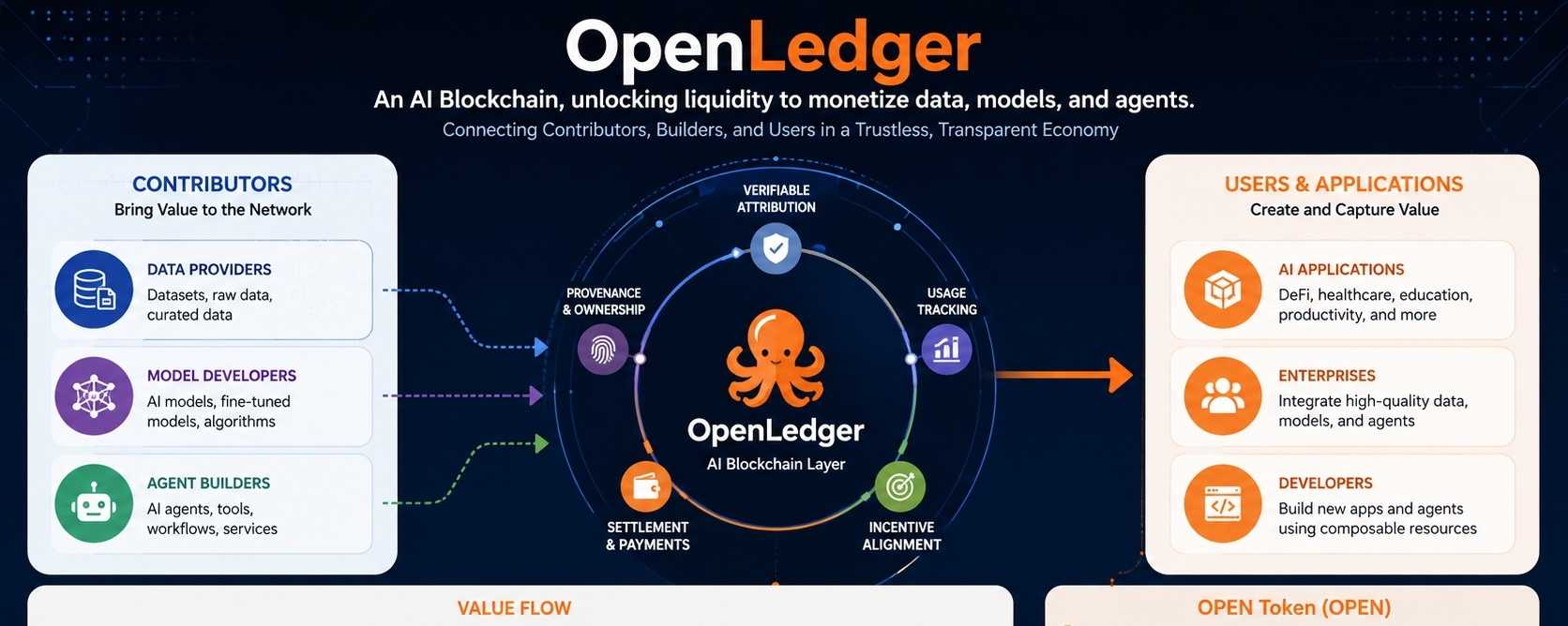
On the surface, OpenLedger is about AI, data, and models being connected through a blockchain-based system where value can actually follow usage. But when I step back from the technical language, what it’s really pointing toward is something more basic: in today’s digital world, everything is scattered.
Your data is in one place, your tools are in another, your models somewhere else, and the value created from all of it often disappears into separate platforms that don’t talk to each other properly.
And honestly, this separation only feels harmless until things get busy.
I’ve seen this happen in simple ways too. Like when a small shop suddenly gets a rush of customers. The system that worked fine for two people at a time starts struggling when ten people arrive together. Not because anything is “broken,” but because coordination was never designed for pressure.
OpenLedger is trying to solve a similar kind of problem, just at a digital level where the “rush hour” is made of data requests, AI model usage, and automated agents interacting all at once.
The idea is to make data and AI models more “liquid,” meaning they can move between users and applications without losing track of where they came from or who contributed to them. In simple terms, if your data helps train or improve something, the system should remember that contribution and reflect it in value.
That sounds fair in theory. But fairness is where things start getting complicated in real systems.
Because the moment you attach value to usage, you also introduce pressure. People start asking: what counts as contribution? Who decides what is useful? What happens when thousands of interactions happen at the same time and everything becomes messy instead of clean?
This is where systems usually stop behaving like neat ideas and start behaving like crowded streets.
I often think of traffic in rain when I think about these kinds of networks. Everyone knows where they want to go, but nobody has perfect visibility. Small hesitations turn into delays. One slow movement affects five others. And somehow, the system still works—but not in a smooth or predictable way.
Digital systems under load behave very similarly.
OpenLedger’s direction is basically an attempt to create a shared coordination layer so that AI models, data sources, and agents don’t drift into disconnected silos. Instead, their usage, contribution, and value can be tracked in one place, using blockchain as the underlying record system.
But here’s the part that often gets ignored in hype discussions: recording things is easier than making them meaningful.
A system can track everything perfectly and still struggle with how people behave inside it.
For example, when rewards are involved, people naturally start optimizing for rewards. Not always in bad ways, but in ways that can shift the system away from its original intention. Some try to game it, some overuse it, some avoid contributing unless there’s clear benefit. Over time, the system starts adjusting to human behavior instead of the other way around.
That’s the real stress test.
And I think OpenLedger is still sitting in that early stage where the idea is clearer than the long-term behavior. Like many infrastructure projects in AI and blockchain, the real challenge won’t be the design—it will be how it behaves when thousands or millions of interactions start happening at once, all slightly imperfect, all slightly delayed.
I don’t say that as criticism. It’s just how systems tend to evolve.
Even something as simple as water pipes in an old building can tell you this story. On paper, the layout is fine. But when pressure increases, leaks appear in places nobody expected. Not because the design was wrong, but because real-world conditions are never as clean as diagrams.
That’s what scaling does. It reveals hidden assumptions.
What I find interesting about OpenLedger is not that it promises to solve everything, but that it is trying to bring structure to something that is already messy—how data, AI, and automated systems interact when they are no longer isolated.
And maybe the honest way to look at it is this: it won’t remove friction completely. No system like this ever does. But if it works, it might make friction more visible, more traceable, and slightly more manageable when things start to get overloaded.
I’m left with the same feeling I had watching that delivery guy in the rain. Not frustration, not excitement—just a quiet awareness that most of what we call “systems” are really just coordination under pressure, trying to hold up long enough for everyone to get where they’re going.