
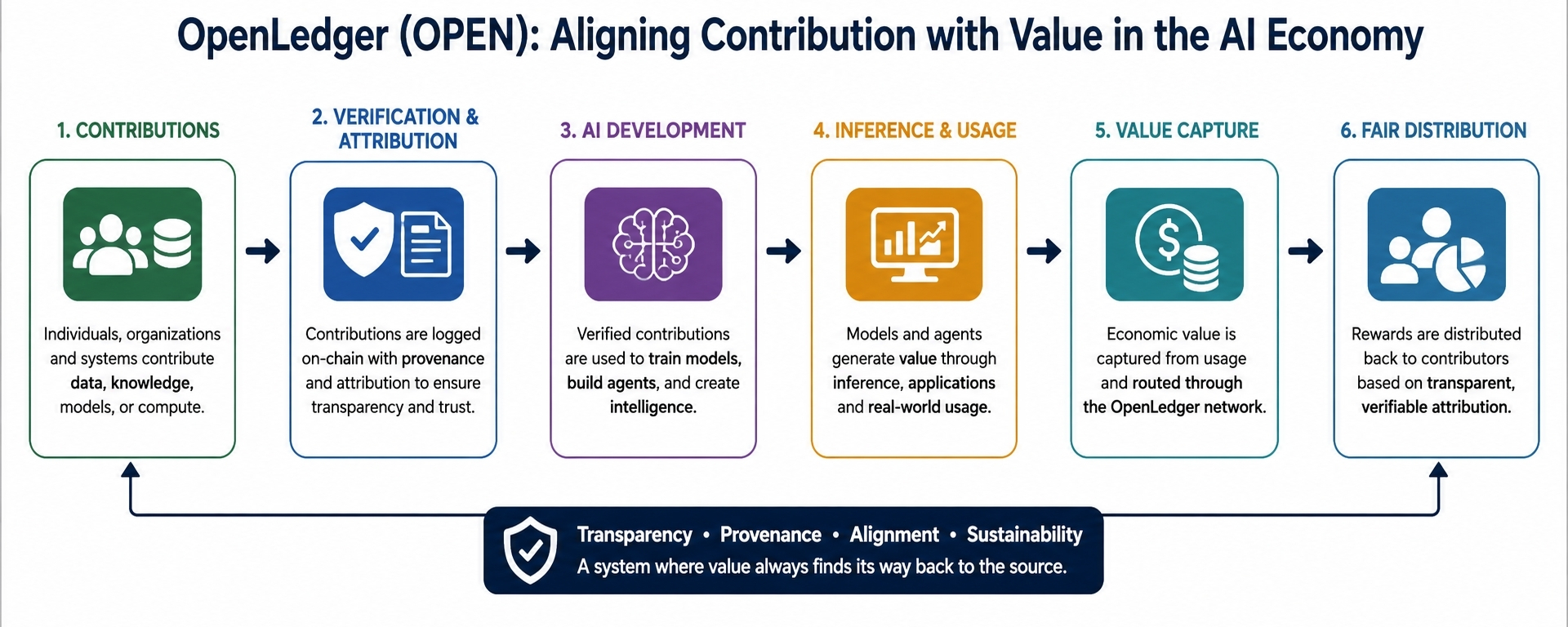

I have been watching the crypto industry for long enough to recognize a familiar pattern. Every cycle introduces a new narrative that promises to redefine how value is created, distributed, and sustained. Most of these narratives generate attention long before they generate durable systems. Over time I have become less interested in market excitement and more interested in architecture. I spend far more time studying how a network coordinates incentives than how it attracts participants. That is the lens through which I have been looking at OpenLedger. I am not trying to predict outcomes. I am trying to understand whether the underlying structure addresses a problem that has quietly existed across both artificial intelligence and crypto for years.
What immediately stands out to me is that OpenLedger appears to be built around a question that many networks avoid confronting. Where does value actually originate inside an intelligence driven economy. Most discussions around AI focus on models, computation, and outputs. Most discussions around blockchain focus on transactions, liquidity, and ownership. Yet there is often very little attention given to the resources that make intelligence possible in the first place. Data is treated as a raw material that somehow appears from nowhere. Knowledge becomes an invisible input. Contributions become increasingly difficult to identify as systems scale. I find myself returning to this issue because it sits at the center of a much larger economic challenge.
Over the years I have watched countless crypto protocols attempt to solve coordination through incentives alone. The assumption is usually straightforward. If rewards exist participants will contribute value. The reality is often more complicated. Participants eventually learn how to optimize around incentives rather than around the health of the network itself. The result is a gradual separation between activity and genuine contribution. Systems become efficient at distributing rewards while losing clarity about what is actually being rewarded. This is one of the most common failure points in digital economies. It is rarely discussed during periods of growth because rising activity can hide structural weaknesses. Those weaknesses only become visible when conditions change.
When I look at OpenLedger I see an attempt to approach coordination from a different direction. The project seems less concerned with creating another marketplace and more concerned with preserving the connection between contribution and economic value. That distinction matters. A marketplace can generate transactions. A coordination system attempts to create alignment. In my experience the latter is significantly harder to achieve. Real coordination requires a network to understand not only what happened but also why it happened and who participated in creating the outcome. That challenge becomes even more complex when intelligence itself becomes the product being generated.
The more I think about it the more I believe that attribution may become one of the defining economic questions of the next decade. Artificial intelligence is rapidly increasing the amount of value that can be created through information. Yet the systems responsible for producing that information often remain fragmented. Contributors operate in one environment while economic rewards emerge somewhere else. This disconnect has become normalized across much of the digital world. OpenLedger appears to be exploring whether blockchain infrastructure can create a more direct relationship between creation and compensation. What interests me is not the mechanics themselves but the philosophical direction behind them. The project seems to recognize that sustainable economies require visibility into how value is formed.
I often find that the strongest systems are not necessarily the most complex. They are the systems that maintain coherence as they grow. Complexity can always be added later. Alignment is much harder to retrofit. This is why I pay attention to projects that focus on economic structure rather than short term expansion. OpenLedger gives me the impression of a network that is attempting to establish foundations before chasing scale. Whether that approach succeeds remains uncertain because every architecture eventually encounters pressures that were impossible to predict during its design phase. Incentives evolve. Participants adapt. Markets behave in unexpected ways. No framework is immune to these realities.
Still I believe there is something valuable in observing projects that challenge existing assumptions. OpenLedger does not appear to be asking how intelligence can be produced more efficiently. It appears to be asking how intelligence can remain economically connected to the resources that made it possible. That is a different question entirely. It shifts the conversation away from performance and toward accountability. It shifts attention from outputs to origins. After spending years watching digital systems emerge expand and eventually confront their limitations I have become convinced that these are the questions that matter most.
For that reason I continue to study OpenLedger with cautious curiosity. Not because I view it as a finished answer but because it represents an attempt to rethink a problem that many networks simply accept as unavoidable. The future of digital economies may depend less on how much intelligence can be generated and more on whether value can be traced back to the sources that created it. If that relationship can be preserved at scale then the implications extend far beyond any single protocol. That possibility is what keeps my attention. It is also what makes OpenLedger one of the more intellectually interesting architectures to emerge from the intersection of AI and blockchain.