
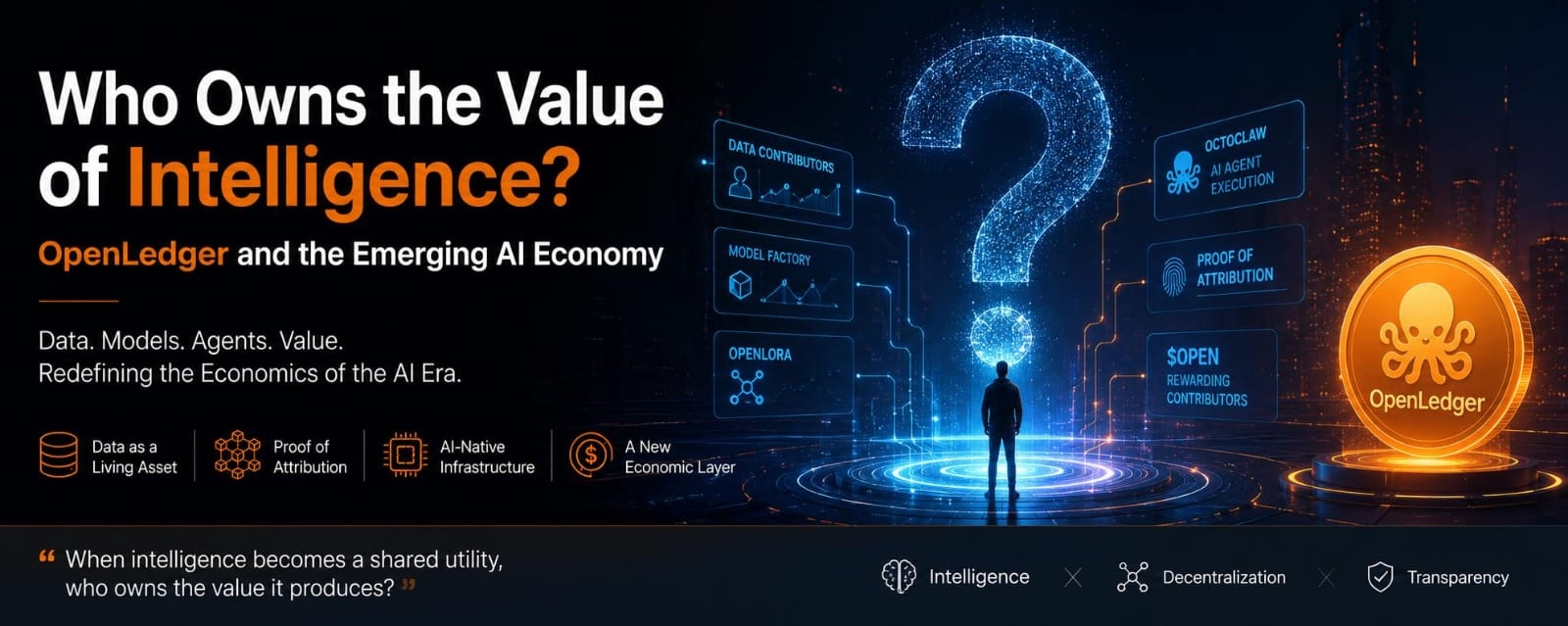
When I look at the wave of AI and blockchain systems I keep coming back to one uncomfortable question. Are we actually seeing the stages of a new digital economy?. Are we just too early to tell what's real and whats just hype.
It feels like when the internet was first starting out. Every experiment seemed like it could either be a game-changer or a total waste of time.. In the middle of all that uncertainty is @OpenLedger. They want to be more than another blockchain project. They want to be the foundation for an AI-based economy.
The real question isn't what they say they're building. It's what kind of rules they're introducing.
The Core Question
If you cut through all the terms like AI-based blockchain, payable AI and decentralized intelligence you're left with a simple but uncomfortable question.
If data creates value, who actually gets that value?
For most of the history of machine learning data has been like an ingredient. Its used, cleaned up and then forgotten. The value is captured by the model or platform.
Systems like @OpenLedger are trying to flip that assumption on its head. They want to make data a clear economic unit, not a silent resource.
Data as a Living Economic Asset
The idea of a datanet changes how we think about data. It's not just storage; it's a part of the economy. Users upload, take care of and contribute data thats used to train AI systems.
In theory this makes data into an asset that can be tracked, valued and rewarded.
In practice it raises some deeper questions.
Is this really people intentionally creating value by contributing to AI training?
Is it just people doing things because they're rewarded not because they care?
Those two outcomes might look the same. Economically they're not.
The Technical Stack
Looking deeper into the system parts like ModelFactory. Openlora aim to decentralize model fine-tuning and make GPU use more efficient.
On paper this is exciting. It suggests a future where AI development isn't controlled by a big players but is spread out across networks that optimize usage.
Then there's OctoClaw, which takes it further by moving from AI to real-time action.
Proof of Attribution
One of the ambitious ideas in OpenLedgers design is Proof of Attribution (PoA).
The idea is simple. If a model generates output the system should be able to track which data contributed to that output and reward those contributors in $OPEN tokens.
The difficulty comes from the nature of modern AI systems.
Data influence isn't straightforward. It's complex and often unpredictable.
Signals of Growth vs Signals of Reality
Like emerging ecosystems #OpenLedgers metrics suggest momentum.
Momentum alone doesn't distinguish between real adoption and just experimentation.
The Pressure of Time
The token structure adds another layer of tension.
With a fixed supply model and low circulating percentage the system naturally enters a phase where future unlocks become structurally important.
The Central Tension
What makes systems, like OpenLedger interesting is the tension they expose.
On one side there's the vision of an AI economy where data, models and execution exist in a loop.
On the side there's the reality of markets, where value is shaped by liquidity, timing and participant behavior.
he Real Question
I keep coming to the same unresolved thought.
We're building systems that try to formalize intelligence, data contribution and machine behavior into primitives.. We still don't fully understand where the value of intelligence ultimately settles.
Maybe the real question is simpler and harder:
When intelligence becomes an utility, who owns the value it produces?
All we have are early systems, early incentives, early architectures—and the uncertainty that comes with building something that might either define a new economic layer or simply be remembered as one of its many first attempts.