OpenLedger’s Ecosystem Feels Designed for AI-Native Web3 Applications
I keep thinking about how much of the conversation around AI still focuses on intelligence itself.
Bigger models. Better reasoning. Faster inference.
Yet the deeper challenge increasingly seems to exist somewhere else.
Not intelligence.
Coordination.
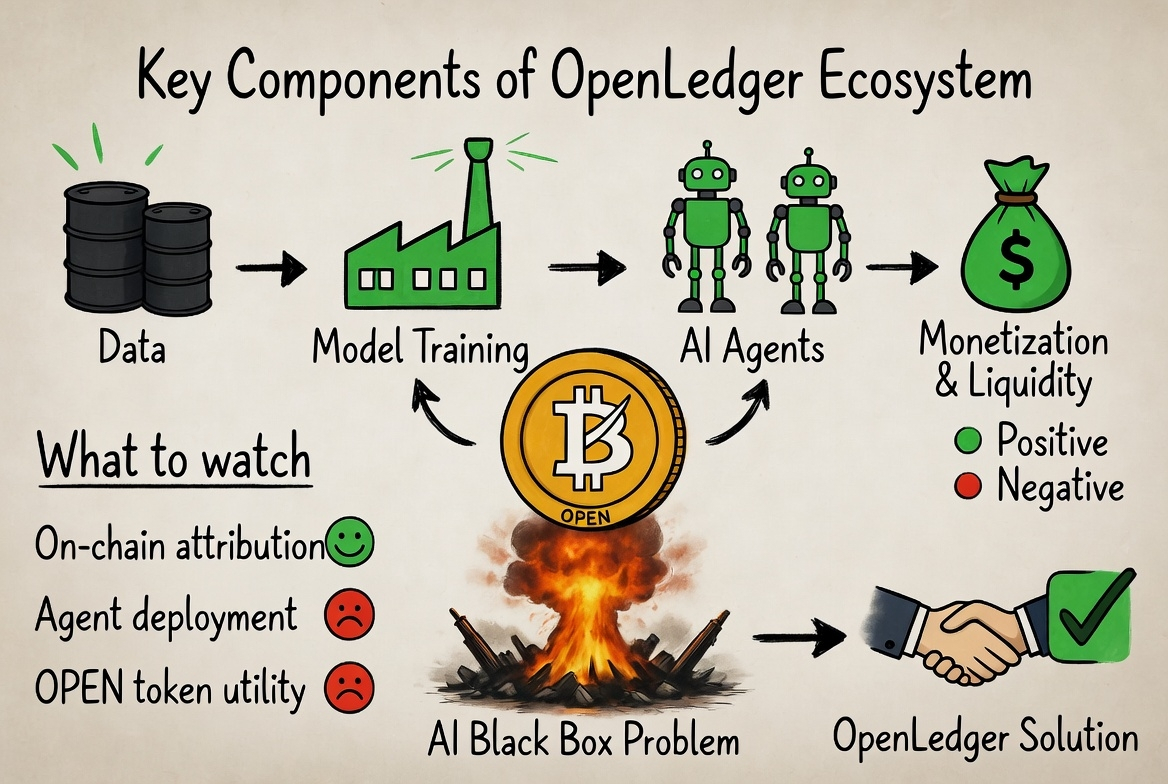
As AI systems become more capable, the bottleneck gradually shifts away from generating outputs and toward managing relationships between data, attribution, execution, incentives, and economic ownership. The question stops being whether machines can create value and becomes whether systems can reliably recognize where that value originated, who contributed to it, and how participation should be rewarded.
That distinction matters.
The internet spent decades optimizing for information movement. AI is now forcing us to think about value movement inside information systems. The infrastructure required for that transition looks very different from traditional software architecture.
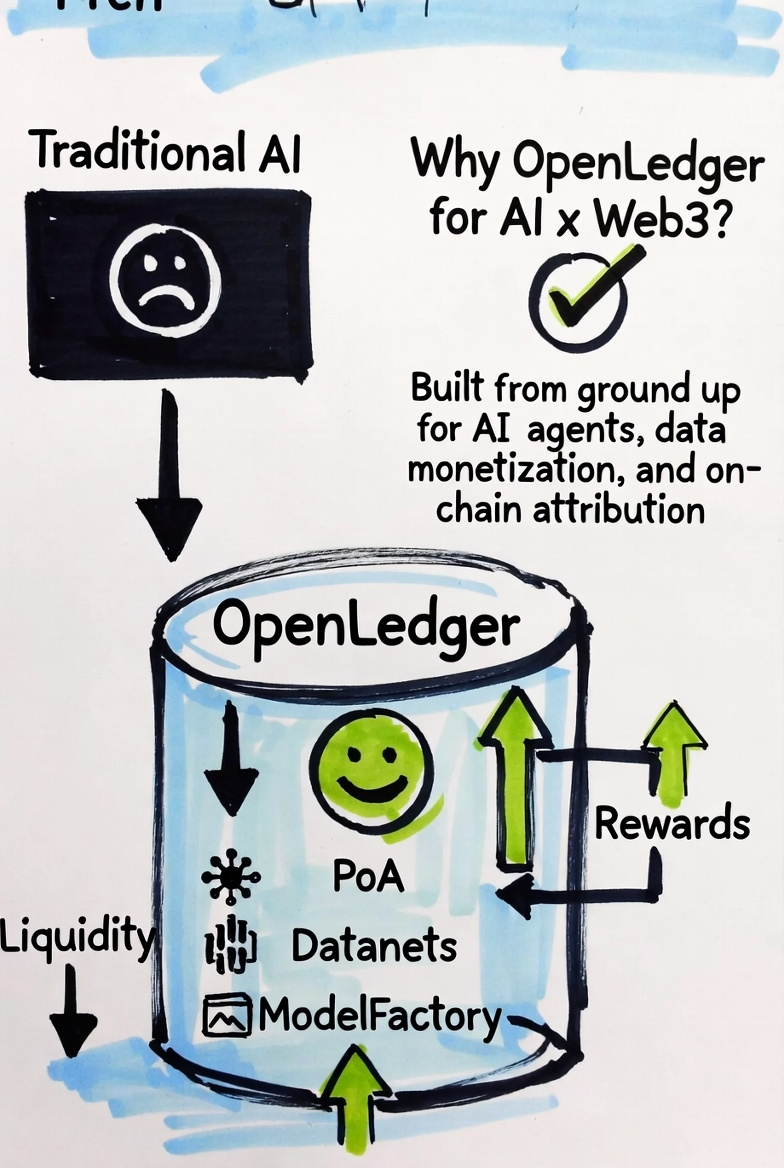
This is one reason OpenLedger keeps appearing in conversations about AI-native Web3 systems.
Not because it represents another AI application.
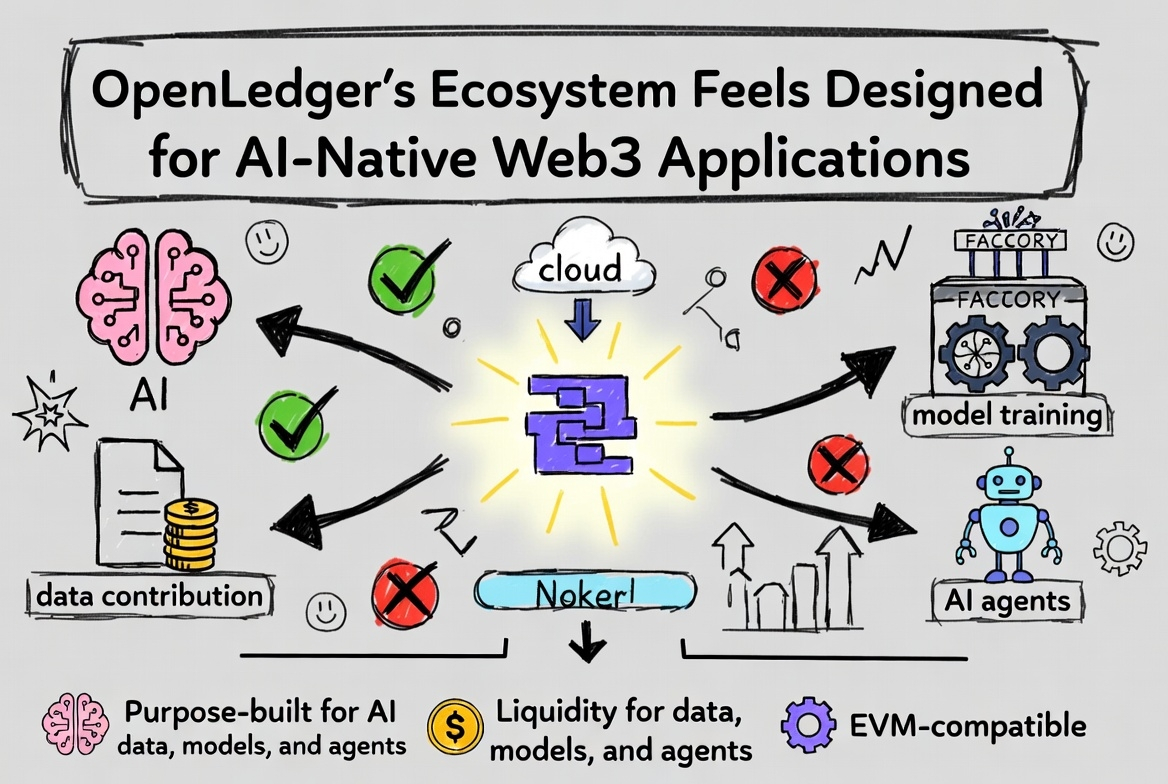
But because its ecosystem seems designed around a different assumption entirely: that future networks may be composed of autonomous participants continuously producing, exchanging, evaluating, and consuming machine-readable intelligence.
The hidden challenge is that intelligence alone does not create a functioning economy.
Coordination does.
Most AI systems today remain surprisingly fragmented when viewed from an infrastructure perspective. Models are developed in one environment. Data originates elsewhere. Attribution is often incomplete. Economic incentives are disconnected from contribution. Distribution channels operate independently of creation layers.
The result is abundance at the capability layer but scarcity at the coordination layer.
The market often notices visible products before it notices invisible constraints.
Yet invisible constraints are often where entire industries eventually reorganize themselves.
OpenLedger appears interesting because it treats attribution, interoperability, and economic participation as foundational design problems rather than secondary features. That may sound subtle, but it changes how we think about AI infrastructure.
Instead of asking how intelligence is produced, the focus shifts toward how intelligence becomes legible.
Legibility is becoming increasingly important.
A machine-readable economy requires systems capable of understanding provenance, tracking contribution, establishing ownership relationships, and creating incentive structures that scale beyond human supervision. Without these capabilities, AI networks eventually encounter the same limitation that many decentralized systems have faced for years: participation becomes difficult to coordinate at scale.
Visibility is not the same as legitimacy.
A model may generate useful outputs, but usefulness alone does not explain who should be compensated. Data may create value, but value creation alone does not establish attribution. An agent may execute tasks autonomously, but execution alone does not define governance rights.
These are infrastructure questions disguised as economic questions.
And increasingly, they are becoming AI questions as well.
What becomes scarce then?
Not intelligence.
Trusted coordination.
The deeper issue may be that AI-native ecosystems require a level of operational interoperability that traditional software environments were never designed to support. Multiple agents, datasets, execution layers, and economic systems must interact continuously without introducing excessive complexity.
This is where ecosystem architecture starts to matter.
OpenLedger's broader design philosophy feels aligned with a future in which intelligence behaves less like a standalone product and more like an interconnected economic resource. Data, models, contributors, applications, and agents become components within a larger coordination framework rather than isolated entities competing for attention.
The infrastructure layer quietly becomes the marketplace.
Not necessarily a marketplace for assets.
A marketplace for participation.
That shift has significant implications.
Historically, digital systems rewarded distribution. AI systems increasingly reward coordination. The ability to connect contributors, verify provenance, manage permissions, and enable economic interaction may become more valuable than the ability to simply generate content or deploy models.
Before usage, most possibilities are already gone.
The system decides what it was allowed to see.
That observation keeps returning whenever discussions around decentralized intelligence emerge. The quality of intelligence is often constrained by the quality of infrastructure beneath it. Not because intelligence lacks capability, but because ecosystems lack mechanisms for organizing capability efficiently.
OpenLedger appears to be exploring this challenge from an ecosystem perspective rather than a product perspective.
And that may ultimately be the more important question.
Not whether AI becomes more powerful.
It almost certainly will.@OpenLedger
The more interesting question is whether economic systems become capable of coordinating that intelligence in ways that remain open, verifiable, and scalable.
Because as autonomous agents become more active participants in digital economies, coordination itself starts to resemble infrastructure. Attribution becomes infrastructure. Interoperability becomes infrastructure. Governance becomes infrastructure.
The visible applications may attract attention first.
They usually do.
But beneath those applications, a quieter transformation is taking place. Systems are being built not simply to create intelligence, but to organize it, track it, distribute it, and assign economic meaning to it.
The future consequence is difficult to measure today because much of this infrastructure remains invisible.
Yet history has a pattern.#openledger
The most important infrastructure rarely feels essential while it is being built.
Only later, when entire ecosystems depend on it, does its significance become obvious.
Perhaps that is what makes projects like OpenLedger worth studying. Not because they provide definitive answers, but because they expose the questions the industry is slowly being forced to confront.
Questions about coordination.
Questions about attribution.
Questions about who owns value in a world increasingly shaped by machine-generated intelligence.$OPEN
Those questions remain unresolved.
But the need for systems capable of answering them feels increasingly unavoidable. #CustodiaBankFedAppealExtension $PORTAL