
I once noticed something while using different crypto applications that stayed with me longer than I expected.
A Basic transact ion that usually clears in seconds suddenly to0k longer than normal. Nothing looked broken. No error messages, no obvious issues. It just stayed pending for a while before finally going through. A few days later, I saw a similar delay in another app during a busy period. That is when it stopped feeling like a one off event and started feeling like something worth understanding.
what I realized is that most blockchain systems do not fail in clear ways. They behave inconsistently under pressure. When usage is low, everything feels smooth. But when demand increases, the experience changes. Some actions complete instantly, while others slow down without any clear explanation from the user’s point of view.
From a system perspective, this is usually not about raw performance. It is about coordination between different layers. Execution, verification, scheduling, and data handling all run at the same time, and they depend 0n each other more than it appears on the surface. When these parts are tightly linked, a delay in one area can quietly affect everything else.
I often think of it like a busy airport.
On a normal day, everything moves in a steady rhythm. Flights land, passengers clear checks, and baggage moves without much delay. But when traffic increases, the issue is no longer about how fast a single process works. It becomes about coordination. If one checkpoint slows down, the effect spreads across gates, queues, and boarding schedules even if everything else is functioning properly.
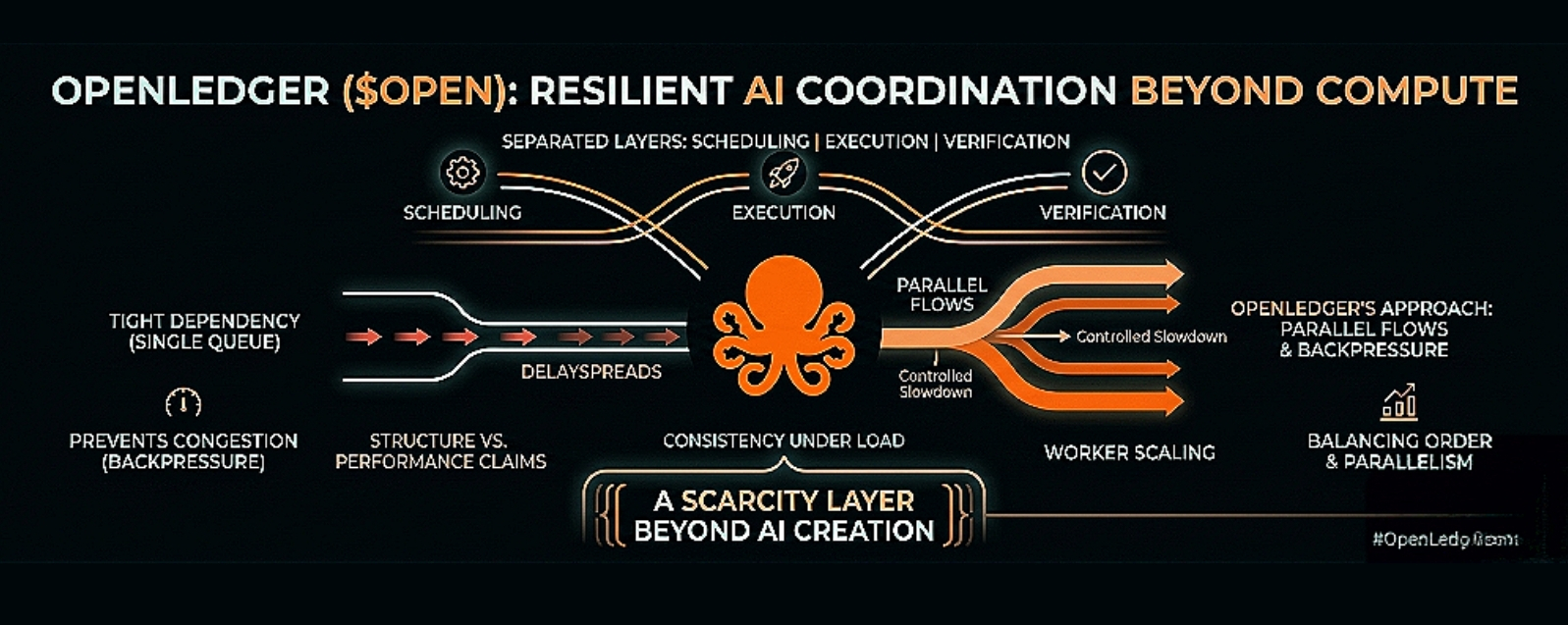
When I look at how @OpenLedger approaches this, what stood out to me is that it feels more focused on structure than on performance claims. The idea seems to be that AI related workloads need more than compute power. They need a system that can handle coordination across multiple parts without creating unnecessary dependency.
What matters in practice is how scheduling, execution, and verification are organized. In many systems, these are connected in a way that creates a single chain of dependency. If verification slows down, execution waits. If execution slows, scheduling gets blocked. Over time, everything turns into one long queue instead of separate flows that can move independently.
what interests me more is how separating these layers changes the behavior under real load. Scheduling can continue without being blocked by execution. Verification can run alongside instead of holding up the entire system. Execution can move forward where possible instead of waiting for strict sequential completion. From a system perspective, this reduces the chance that one slow part brings everything else down.
Backpressure is another concept that often gets overlooked. In real systems, overload usually does not appear suddenly. It builds gradually. Backpressure allows the system to slow down in a controlled way before things become unstable. It is not about reducing capability. It is about preventing congestion from spreading across the entire system.
Worker scaling also depends on how well the workload is distributed. If tasks are not balanced properly, adding more workers does not solve the core problem. It just moves the bottleneck somewhere else. What matters is whether the system can spread work evenly instead of concentrating it in one place.
there is also a constant tradeoff between ordering and parallel execution. Strict ordering makes systems easier to reason about, but it reduces flexibility. Parallel execution improves speed, but it requires careful coordination to avoid conflicts. Most systems end up balancing both depending on what the workload actually needs.
From my experience watching different networks, the real difference is not how they perform when everything is stable. It is how they behave when conditions are not ideal. When demand spikes, when multiple processes overlap, and when delays start to spread through the system.
What stood out to me about OpenLedger is not a single feature, but the way it approaches that problem. It feels designed with real operating conditions in mind rather than only ideal benchmarks.
A system does not need to feel impressive when everything is calm. It needs to stay consistent when things are not.
Good infrastructure is usually not something you notice directly. It is something that keeps working quietly when everything around it becomes busy.