
For years, the AI industry has been chasing a single goal: bigger.
Bigger models. Bigger datasets. Bigger training budgets. Bigger infrastructure.
Every new breakthrough seems to come with a larger parameter count and a larger price tag. The common assumption is that intelligence scales linearly with compute, and whoever spends the most wins.
But the more I study the space, the more I believe the future won't belong exclusively to the biggest models.
I think the real opportunity lies somewhere else.
And that's why OpenLedger stands out to me.
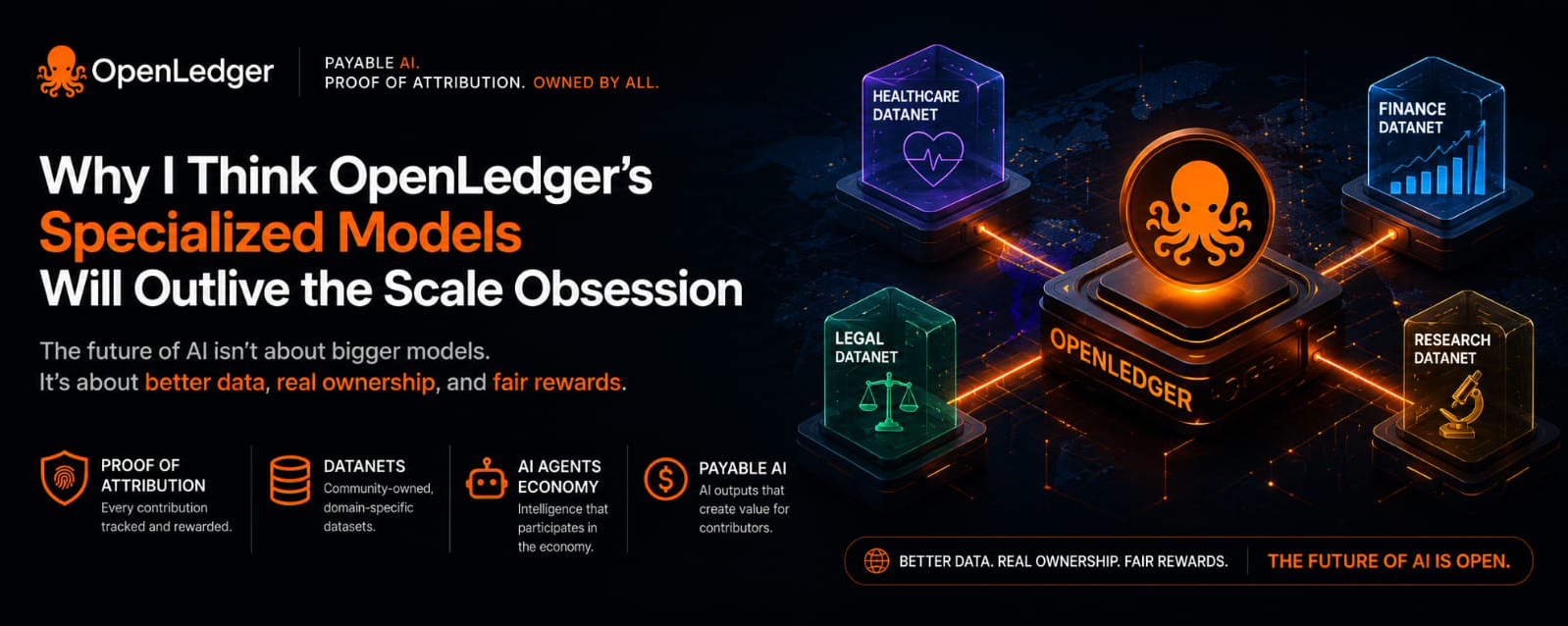
While much of the AI world remains focused on building larger general-purpose systems, OpenLedger is quietly building around a different thesis: specialized intelligence powered by specialized data.
At first, this sounds less exciting than trillion-parameter models.
But when I think about where actual value is created, I become convinced that OpenLedger's approach may have far more staying power than the industry's obsession with scale.
The Problem With General Intelligence
Today's frontier models are impressive.
They can write essays, generate code, answer questions, summarize documents, and hold conversations on almost any topic.
But there is a hidden weakness.
They know a little about everything, yet often lack deep expertise in specific domains.
A model trained on the entire internet may understand medicine, law, finance, gaming, engineering, and biotechnology.
But understanding something broadly is not the same as understanding it deeply.
When billions of dollars, human health, scientific research, or critical business decisions are involved, general knowledge isn't enough.
Accuracy matters.
Context matters.
Domain expertise matters.
This is where specialized models begin to shine.
Why Specialized Models Make Sense
Imagine two AI systems.
The first is trained on everything.
The second is trained on years of highly curated financial data, market research, earnings reports, institutional analysis, and trading behavior.
Which one would you trust to analyze a complex financial problem?
The answer seems obvious.
The same applies to healthcare.
Legal services.
Scientific research.
Supply chain optimization.
Cybersecurity.
In many industries, specialized knowledge creates exponentially better outcomes than broad knowledge.
This is why human expertise works the way it does.
The world's best heart surgeon isn't also the world's best lawyer.
The world's best lawyer isn't also the world's best engineer.
Specialization creates value.
OpenLedger appears to understand this fundamental principle.
Data Is Becoming More Important Than Models
One of the biggest lessons from modern AI is that data quality often matters more than model size.
A smaller model trained on exceptional data can outperform a larger model trained on mediocre data.
This is where OpenLedger's Datanet concept becomes incredibly interesting.
Instead of relying on generic internet-scale datasets, OpenLedger encourages communities to build domain-specific data networks.
These Datanets create an environment where expertise becomes an asset.
Contributors can provide valuable information.
Datasets can be refined over time.
Models can be trained on highly relevant knowledge.
And perhaps most importantly, contributors can be rewarded for the value they create.
That changes the incentive structure entirely.
The Hidden Bottleneck Nobody Talks About
Most discussions around AI focus on compute.
GPUs dominate headlines.
Data centers dominate investment.
Infrastructure dominates conversations.
But I think the next major bottleneck is trust.
How do we know where an AI system learned something?
How do we know which data influenced an output?
How do contributors get compensated?
How do we verify the origins of intelligence?
These questions become more important as AI becomes integrated into every industry.
OpenLedger's Proof of Attribution framework attempts to address exactly this problem.
Instead of treating intelligence as a black box, it introduces a system where contributions can be tracked, verified, and rewarded.
If this works at scale, it could become one of the most important pieces of AI infrastructure.
Why OpenLedger's Timing Matters
The AI industry is reaching an interesting stage.
For years, bigger models produced dramatically better results.
But improvements are becoming more expensive.
Training costs continue rising.
Competition for compute continues increasing.
Infrastructure requirements continue expanding.
Meanwhile, businesses are asking a different question:
"Can AI solve my specific problem?"
That question favors specialization.
A pharmaceutical company doesn't need an AI that knows everything.
It needs an AI that understands drug discovery.
A law firm doesn't need an AI that can discuss every topic imaginable.
It needs an AI that understands legal reasoning.
A trading firm doesn't need universal intelligence.
It needs superior market intelligence.
The future may not belong to one giant model.
It may belong to thousands of specialized models solving specific problems better than anyone else.
The Economic Layer Is What Makes OpenLedger Different
What really separates OpenLedger from many AI projects is that it isn't simply focused on building models.
It is focused on building an economy around intelligence.
Data contributors can participate.
Model builders can participate.
AI agents can participate.
Value can flow back to the people who create it.
Most AI platforms focus on generating outputs.
OpenLedger focuses on creating incentives.
And historically, incentive systems have often proven more durable than individual technologies.
The internet scaled because incentives aligned.
Open-source software scaled because incentives aligned.
Blockchains scaled because incentives aligned.
OpenLedger is attempting to create similar incentive structures for AI.
My Contrarian View
I don't think the winners of the next AI era will necessarily be the companies with the biggest models.
I think many winners will be the platforms that own the best data, the strongest attribution systems, and the most valuable specialized intelligence networks.
That's why I keep coming back to OpenLedger.
While others are competing in an endless race toward larger models, OpenLedger appears to be building for a world where expertise matters more than size.
A world where data ownership matters.
A world where attribution matters.
A world where contributors are rewarded.
And a world where specialized intelligence becomes more valuable than generalized intelligence.
The scale obsession has dominated the AI narrative for years.
But history has a way of rewarding those who solve real problems rather than those who simply build bigger systems.
That's why I believe OpenLedger's specialized model strategy isn't just different.
It may ultimately prove more sustainable than the race for scale itself.