
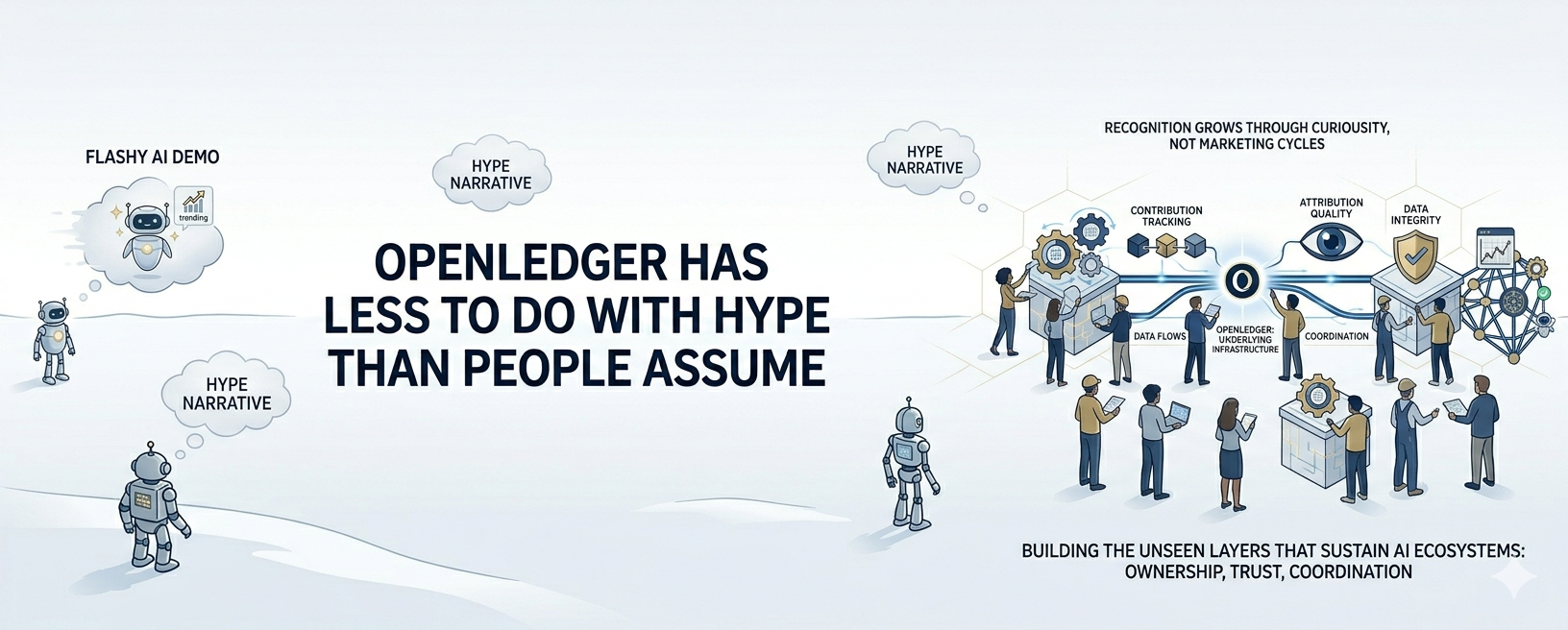
Open is getting recognition and I think it has less to do with hype than people assume.
Over the few months I have noticed something interesting about OpenLedger.
The project keeps appearing in conversations.
Not among people who are chasing the latest artificial intelligence trend but among people who are trying to understand where artificial intelligence infrastructure might actually be heading.
That caught my attention because recognition in crypto usually follows a pattern.
A project launches the market gets excited everyone talks about it for a weeks then attention moves somewhere else.
Open does not feel like it is following that path
The recognition seems more gradual, almost like people are discovering the project through curiosity rather than being pushed toward it by a marketing cycle.
Maybe I am wrong. That is the impression I have been getting lately.
What makes this interesting is that OpenLedger is not attached to the narrative in the artificial intelligence sector.
The easy narrative is building a product people can instantly understand, like an intelligence assistant or an artificial intelligence agent or an automation tool.
Those things are simple people see the output. Immediately understand the value proposition.
OpenLedger sits in a complicated area the project spends a lot of time around contribution systems, data flows, attribution and coordination between different participants inside an artificial intelligence ecosystem.
Those are not ideas to explain in a thirty second conversation.
Yet somehow the project keeps attracting attention.
I think that is because the market itself is changing.
A year ago most people were obsessed with model intelligence everything was about who had the artificial intelligence.
Now the discussion feels different models are improving everywhere new releases arrive constantly access is becoming easier.
As that happens people naturally start looking into the structure underneath, where does the data come from how do contributors fit into the system how do builders access reliable information how does value move between participants.
Those questions do not create headlines but they become more important as ecosystems mature.
That is where OpenLedger seems positioned the project appears less focused on the artificial intelligence output itself and more focused on the environment supporting those outputs.
That distinction feels small at first the longer I think about it the bigger it seems.
Because artificial intelligence systems do not operate in isolation every model depends on data every application depends on models every ecosystem depends on contributors.
If those relationships break down intelligence alone does not solve much.
One thing I have noticed recently is that OpenLedgers recognition seems connected to this growing awareness people are beginning to realize that infrastructure around intelligence may end up mattering just as much as artificial intelligence itself.
Not because infrastructure is exciting usually it is the opposite infrastructure tends to look boring right until everyone suddenly needs it.
I have seen patterns before the projects that quietly build underlying systems often receive little attention early then as the ecosystem expands those same systems become difficult to ignore.
That does not automatically mean OpenLedger succeeds, far from it infrastructure projects face challenges that application projects do not.
The biggest one is patience users can immediately understand a chatbot it is much harder for users to appreciate contribution attribution systems or decentralized data coordination.
Those concepts require people to think ahead crypto markets are not always known for thinking far ahead.
That is one reason I remain cautious recognition is one thing sustained adoption is something entirely.
I also think people sometimes underestimate how difficult OpenLedgers approach actually is, building around contribution sounds reasonable maintaining contribution quality is another story.
Open systems tend to attract all kinds of behavior some participants genuinely create value others optimize around incentives.
The moment rewards exist, behavior changes, that pattern repeats across crypto constantly.
DeFi saw it GameFi saw it social platforms saw it why would artificial intelligence ecosystems be different.
This is probably the question I have when looking at OpenLedger can contribution remain meaningful as participation grows.
Because growth alone does not solve anything if the network collects amounts of low quality information scale becomes a problem instead of an advantage.
That risk feels very real.
At the time I respect that the project appears aware of this challenge the recent direction seems increasingly focused on attribution quality, contribution tracking and data integrity.
That tells me the team understands the part is not gathering activity the difficult part is maintaining useful activity.
That is a more serious problem to solve.
Another reason I think recognition around Open is increasing comes down to timing the artificial intelligence sector itself is entering a practical phase.
The early excitement has not disappeared, but it feels more grounded now people are asking questions how sustainable are these systems how do contributors benefit, who owns the data what happens when artificial intelligence generated content starts overwhelming human created content.
Those concerns are becoming more visible across the industry OpenLedgers design seems connected to those discussions.
Whether not the project keeps landing in areas that are becoming increasingly relevant.
That is probably why curiosity keeps growing not because every question has been answered, actually maybe the opposite because the project is operating inside a set of questions the industry still has not solved.
I also find it interesting that OpenLedger creates dependency between ecosystem participants contributors need builders builders need datasets applications need reliable outputs.
The ecosystem appears designed around interaction than isolation that can create stronger utility over time it can also create more points of failure.
Interconnected systems are powerful when everything works, when something breaks problems spread quickly.
That is another reason I watch cautiously a lot depends on execution a lot depends on whether contributors continue participating when incentives normalize a lot depends on whether quality can remain high without introducing centralization.
Those are not issues they are fundamental issues.
Still recognition usually follows relevance. Lately it feels like the questions OpenLedger is asking are becoming more relevant across the broader artificial intelligence landscape.
Not questions about the flashy artificial intelligence demo, questions about ownership, contribution, trust, coordination, the less visible parts of artificial intelligence the parts most people ignore until they become impossible to ignore.
Maybe that is why Open keeps appearing in conversations lately not because it is making the most noise because it is operating in a part of the artificial intelligence stack that people are slowly starting to pay attention to.
Honestly I think we are still very early, in understanding how important those layers might become.