
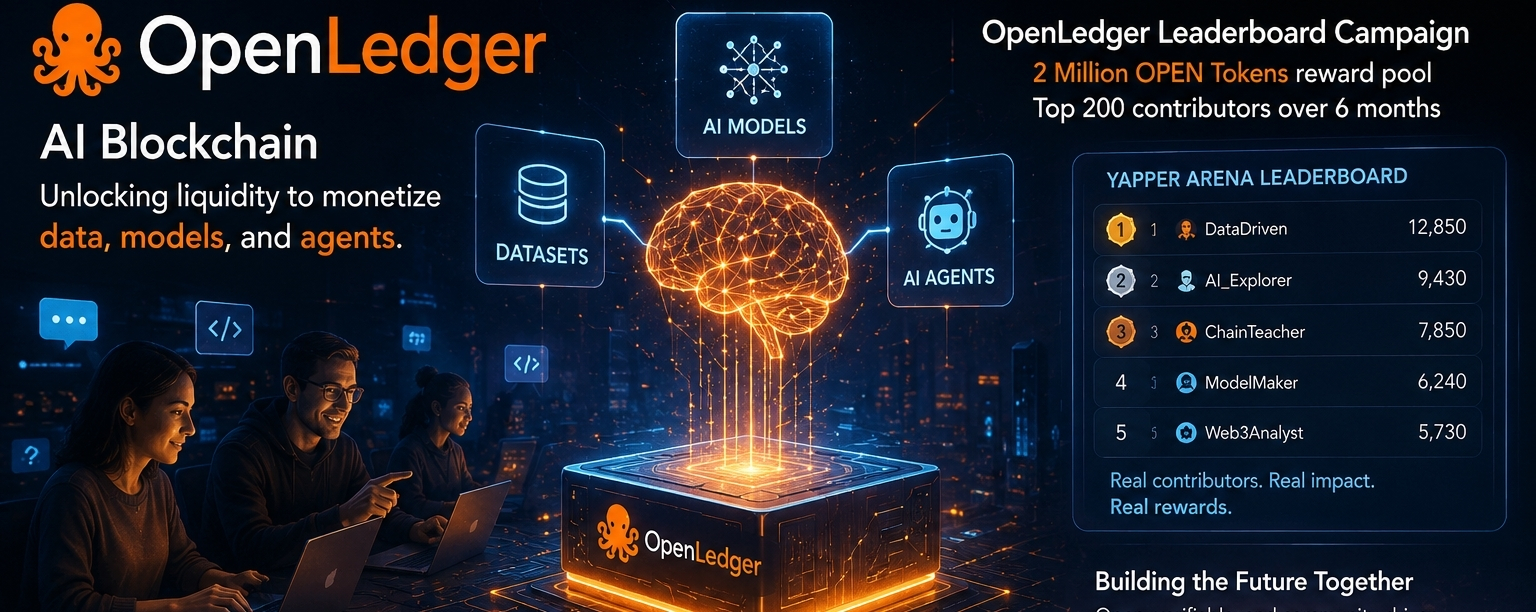
Most people see a leaderboard and instantly understand the game. Post more, get noticed, climb higher, collect rewards. That's usually the entire story. OpenLedger's leaderboard feels different. The longer you look at it, the less it resembles a competition and the more it looks like an experiment in measuring something the internet has struggled to value for years: contribution.
The modern internet runs on invisible work. Someone spends hours reading technical documentation and turns it into a simple thread. Someone else answers the same beginner question for the hundredth time. A creator records a tutorial. A community member tests a feature before launch and reports problems. None of these activities grab headlines, yet they help projects grow, attract users, and build trust. The value is real, even if it rarely appears on a balance sheet.
This is the backdrop that makes OpenLedger interesting. The project presents itself as an AI blockchain focused on monetizing data, models, and agents. At first glance, that sounds like another piece of crypto terminology. Look deeper, and the idea becomes much more practical. AI systems depend on data. Data comes from people. Valuable information doesn't appear out of thin air. Behind every dataset, every model, and every useful output, there are contributors whose efforts often disappear once the system begins generating value.
OpenLedger's approach revolves around a simple belief: contributions should not become invisible the moment they become useful. The project places significant emphasis on attribution, creating systems that can track where value originates and who helped create it. In a world where AI often feels like a giant machine consuming information without acknowledging its sources, that idea stands out.
Viewed through that lens, the leaderboard becomes more than a marketing campaign. It becomes an extension of the project's broader philosophy. Instead of treating community activity as free promotion, OpenLedger is attempting to recognize participation as a meaningful contribution. The distinction may seem small, but it changes the entire conversation. Promotion benefits a project. Contribution helps build it.
The internet has always depended on people who voluntarily make complicated things easier to understand. Every successful ecosystem has individuals who write guides, explain concepts, answer questions, and help newcomers find their footing. Without those people, growth becomes much harder. Yet their work is often taken for granted because it doesn't fit neatly into traditional measurements of value.
That is why the leaderboard feels less like a reward system and more like a test. What happens when a network tries to acknowledge the people creating knowledge around it? What happens when engagement is treated as a form of contribution rather than background noise? OpenLedger appears to be exploring whether community participation can be measured in a way that reflects actual impact rather than simple activity.
There is, of course, a challenge hidden inside this idea. Every incentive system changes behavior. Reward people for posting, and many will post more. Reward visibility, and some will chase attention rather than substance. Crypto communities have seen this pattern countless times. A campaign launches, timelines fill with repetitive content, and meaningful discussion gets buried beneath a flood of low-effort engagement.
The real challenge is not rewarding attention. Attention is easy to generate. The difficult part is identifying valuable attention. The people who genuinely educate, inform, and contribute are not always the loudest voices in the room. Any system attempting to measure contribution has to separate signal from noise, and that is much harder than simply counting interactions.
What makes OpenLedger worth watching is that it sits at the intersection of two industries wrestling with the same question. Both AI and blockchain are fundamentally changing how value is created online. Yet neither has fully solved the issue of attribution. If data helps train a model, who should benefit? If a community helps grow a network, how should that contribution be recognized? If people create value together, how can that value be traced back to its source?
These are not technical questions. They are human ones.
For years, the internet has operated on an assumption that contribution is endless and freely available. People will keep sharing knowledge, creating content, testing products, and helping others without expecting much in return. OpenLedger is built around a different assumption. It suggests that contribution matters enough to be recorded, measured, and rewarded.
The leaderboard itself is only a small piece of that vision. Rankings will rise and fall. Campaigns will come and go. Token rewards will eventually be distributed. The bigger idea remains long after those details fade away: in a digital economy increasingly powered by data and intelligence, value should remember where it came from. And perhaps the future belongs to the systems that never forget the people behind it.
