
The more I watched autonomous agents execute trades, manage portfolios, and make real-time decisions, the more one uncomfortable realization settled in. We have spent years teaching machines how to think. But in the next wave, the real edge won’t come from how well they reason. It will come from how confidently and transparently they act with actual value.
I used to see agents as sophisticated recommendation engines — extremely smart assistants that analyze and suggest. That view feels increasingly outdated now. The agents that will matter most are the ones that don’t just output answers. They move capital, allocate resources, and trigger economic consequences across chains. And once money starts moving at machine speed, the old questions of trust, proof, and accountability become impossibly loud.
This is the boundary where OpenLedger keeps pulling my attention. While much of the industry still chases raw intelligence, OpenLedger appears to be building the economic plumbing that lets agents act responsibly with real stakes. The difference is subtle but profound. An agent can generate a perfect investment thesis. But can it prove why it chose that particular data, how much influence each contributor had, and who should be rewarded when the decision creates profit? Without that layer, we are handing over capital to black boxes.
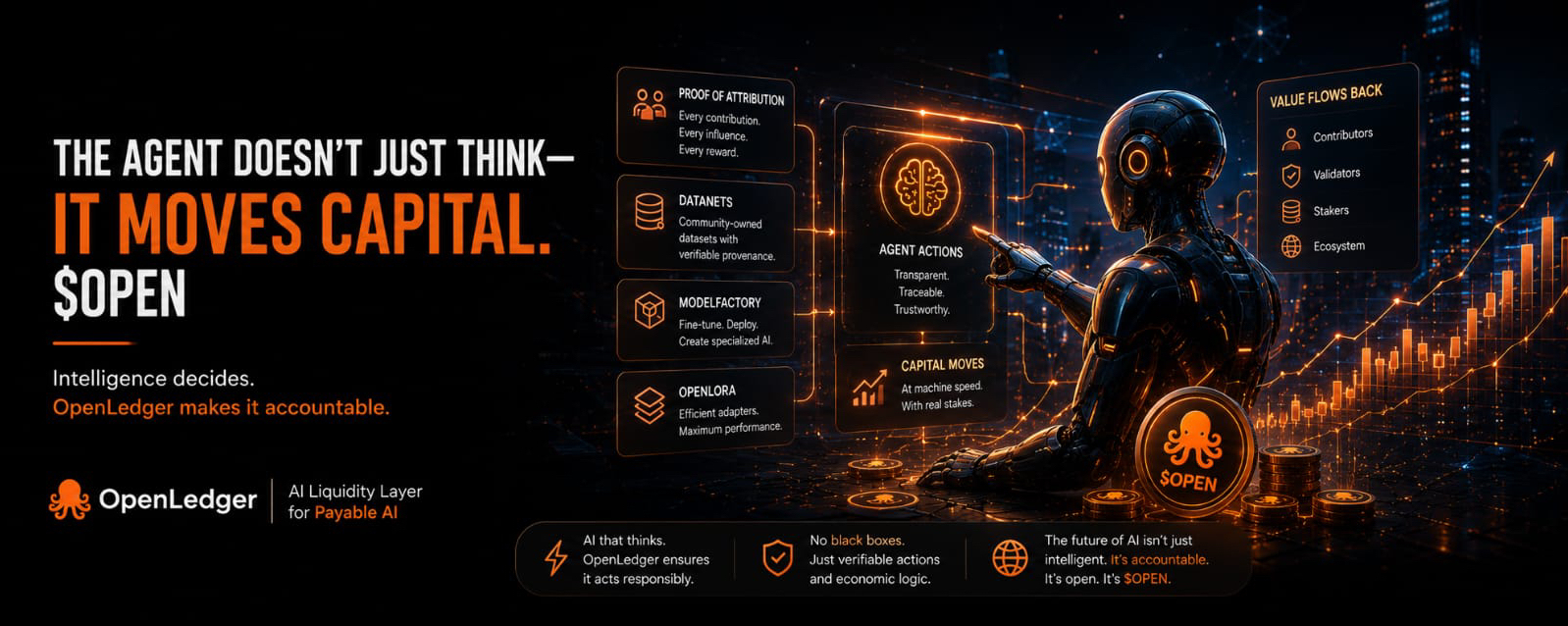
At its core, OpenLedger is positioning itself as the AI Liquidity Layer — a system built for Payable AI. Every contribution, every piece of context, and every inference can become part of a traceable economic loop. Through Proof of Attribution, the network records not just the final output but the influence path that produced it. When an agent uses data from various Datanets — community-owned, verifiable datasets — the original contributors can receive direct rewards. The token $OPEN flows as gas, as staking collateral for model deployment, and as the mechanism that settles these attribution rewards. The loop feels self-reinforcing: more usage, more transparent value movement, more incentive for high-quality specialized knowledge to enter the system.
What fascinates me is how this changes the nature of agents themselves. An agent running on OpenLedger through ModelFactory or powered by OpenLoRA adapters isn’t just consuming static training data. It operates inside an environment where its actions have visible economic consequences. It can fine-tune on narrow, high-signal datasets, deploy efficiently even on modest hardware thanks to OpenLoRA, and then execute while leaving a verifiable trail. The agent doesn’t disappear into the ether after making a move. Its reasoning path, data sources, and impact remain legible.
I keep returning to a simple but heavy question: When capital moves at the speed of thought, what kind of system do we want standing between the agent’s decision and real-world outcomes? A closed model that offers no receipt? Or a ledger that makes every meaningful contribution visible and compensable?
This feels bigger than one project. We are moving from an era of AI experimentation to an era of AI-native economies. In that world, intelligence alone is table stakes. The ability to act with verifiable accountability might become the actual scarce resource. Specialized knowledge that can prove its relevance, agents that can show their work, and data owners who earn ongoing returns — these start to form the backbone of something that looks less like today’s chatbots and more like distributed economic infrastructure.
OpenLedger doesn’t promise perfect agents. What it offers is a foundation where agents can think, act, and settle value in the open — with clear rules for who provided what and who earns when the outcome succeeds. In a market that will soon be full of autonomous capital movers, that distinction may prove decisive.
The deeper I sit with this, the more I wonder whether we have been optimizing for the wrong thing. We optimized for intelligence. Perhaps the next great unlock lies in making intelligence economically legible at every step.
That shift, if it happens, won’t just change how agents work. It could quietly reshape where value accumulates in the entire AI economy.