I didn’t take it seriously at first…
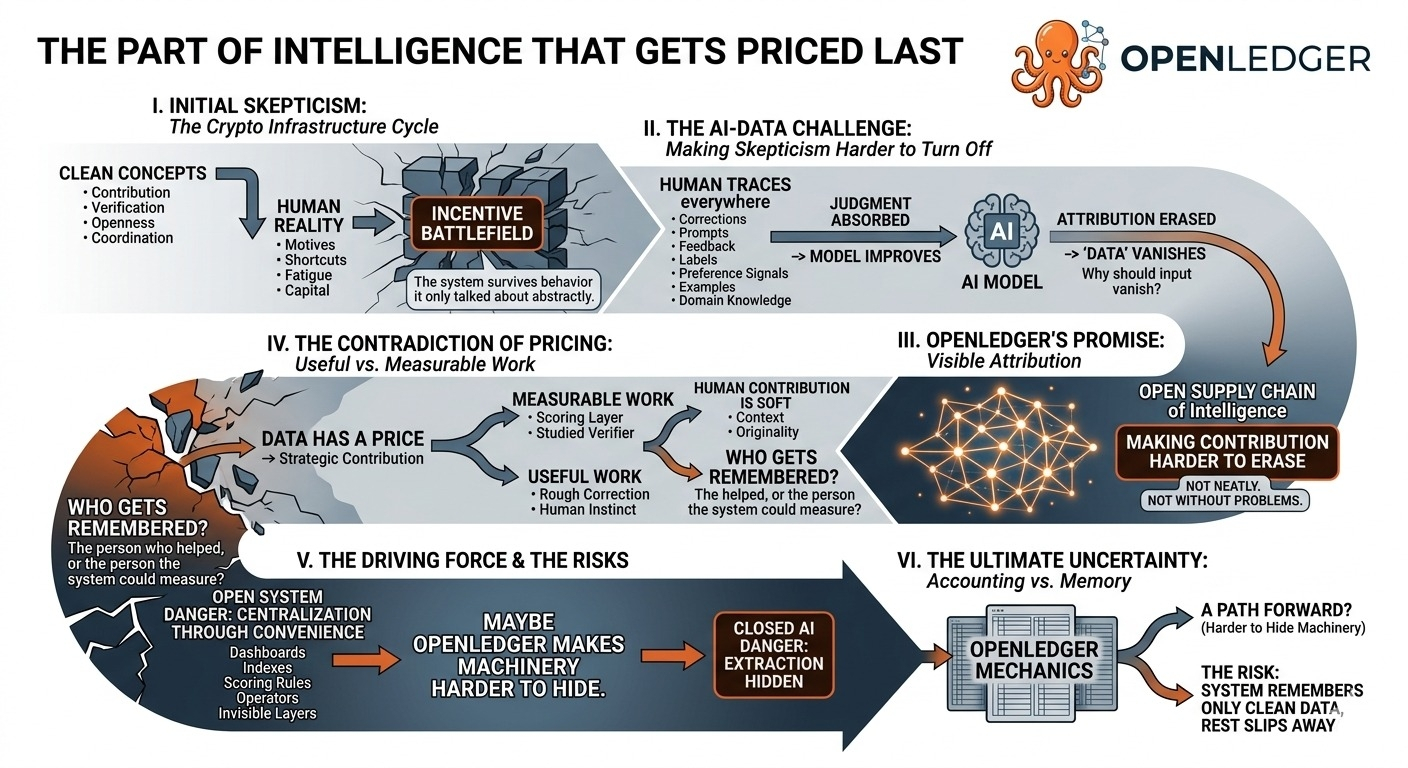
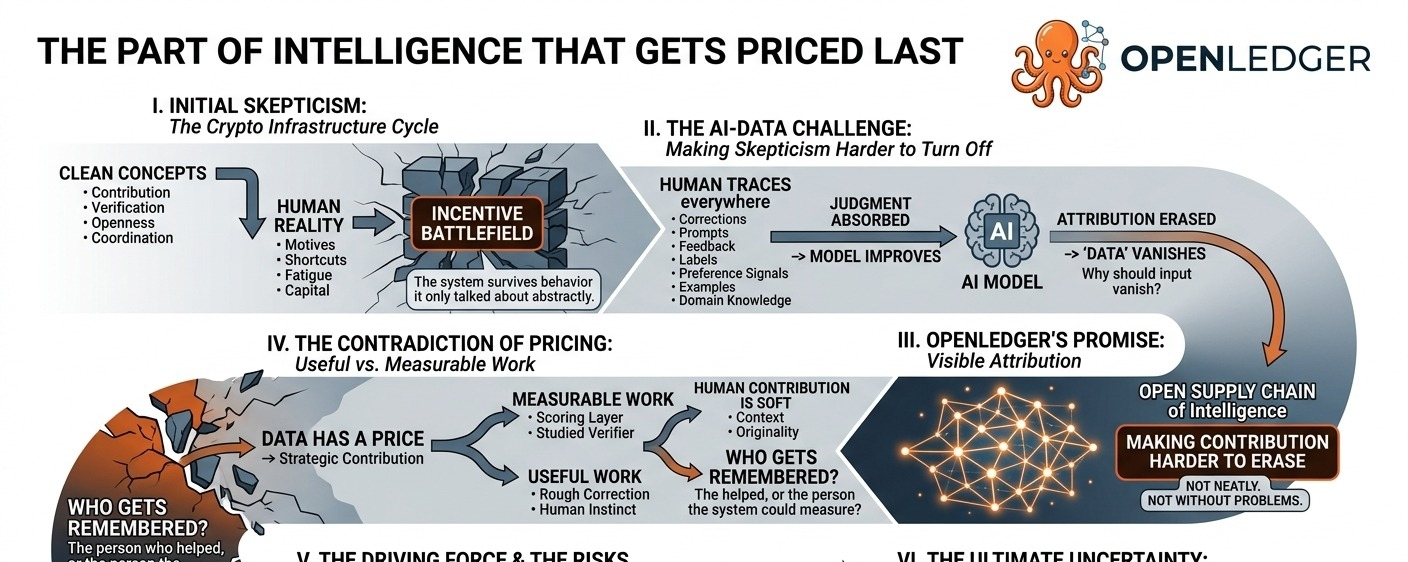
not because OpenLedger sounded hollow. more because I’ve watched too many infrastructure ideas enter crypto with careful language and leave as another incentive battlefield.
everything starts clean. contribution. verification. openness. coordination. then people arrive with motives, shortcuts, fatigue, and capital. and suddenly the clean system has to survive behavior it only talked about abstractly.
Maybe that’s too harsh.
but AI-data makes that skepticism harder to switch off. models are being shaped by human traces everywhere. corrections, prompts, feedback, labels, preference signals, examples, domain knowledge. small bits of judgment that look forgettable until they are absorbed into something valuable.
then the model improves.
then the contribution disappears into “data.”
I keep coming back to attribution.
there is something necessary in it. if intelligence has a supply chain, maybe that supply chain should not stay hidden inside closed systems. maybe people should not vanish the second their input becomes useful. maybe OpenLedger matters because it tries to make contribution harder to erase.
not neatly.
not without problems.
but visibly enough to make the question harder to avoid.
Still, attribution changes once it becomes financial.
That’s where things start to feel uncomfortable.
once data has a price, contribution becomes strategic. people learn what gets counted. they study the verifier. they produce toward the scoring layer. useful work and measurable work begin drifting apart, and the system has to keep proving it knows the difference.
It works in theory. Most things do.
The problem isn’t really the technology… or not only the technology. human contribution is soft. context is soft. originality is soft. a rough correction might matter more than a polished dataset. synthetic input might look cleaner than human instinct. copied work might fit the system better than the messy thing it copied.
so who gets remembered?
the person who helped, or the person the system could measure?
That part keeps bothering me more than it should.
and then there is the old Web3 drift. open systems rarely recentralize loudly. they narrow through convenience, fatigue, dashboards, indexes, scoring rules, operators, invisible layers nobody audits forever.
still, I can’t dismiss OpenLedger.
centralized AI has not earned that comfort either. closed datasets, invisible labor, vague ownership, extraction hidden behind smooth products. that version already feels broken.
maybe OpenLedger makes the machinery harder to hide.
or maybe once incentives get sharp enough, it remembers only what fits cleanly into its own accounting, while the rest slips away again.