
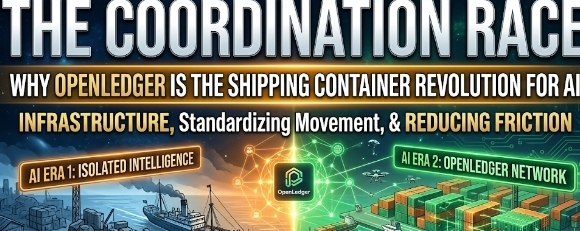
We can kept thinking about shipping containers the other day.
Which sounds strange, because shipping containers are probably one of the least exciting things anyone could spend time thinking about.
They're just metal boxes.
Most people never notice them.
Yet those simple boxes quietly changed global trade more than many inventions that received far more attention.
Before containers became standard, moving goods between countries was slow, expensive, and chaotic. Every port handled cargo differently. Every transfer created friction. Every delay multiplied costs.
Then something surprisingly simple happened.
The industry standardized the box.
Not the ships.
Not the ports.
The box.
And suddenly thousands of disconnected systems could work together far more efficiently because they were all speaking the same operational language.
The strange thing is that I keep seeing a similar pattern emerging inside AI.
Most people still look at AI through the lens of intelligence.
Which model performs better?
Which model is faster?
Which model generates the best outputs?
Those questions dominate most discussions.
But what started standing out to me is that intelligence may not be the hardest problem forever.
Coordination might be.
Because intelligence becomes significantly less useful when it cannot move efficiently between systems, contributors, applications, and economic participants.
That changes the meaning of infrastructure.
The difficult part is no longer creating isolated pockets of intelligence.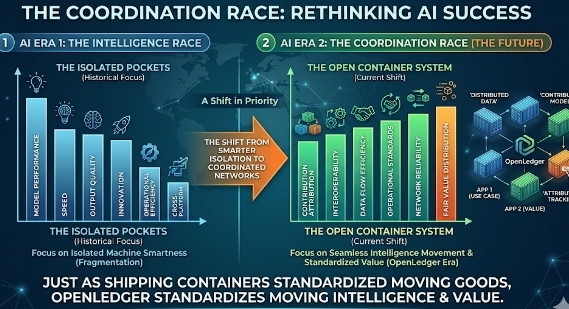
The difficult part is allowing intelligence to operate across environments where ownership, incentives, and contributions are fragmented.
And fragmentation creates pressure.
A lot of pressure.
Data comes from different places.
Contributors operate under different incentives.
Developers build different applications.
Users generate different forms of value.
Yet somehow the system still needs to maintain reliability while keeping attribution intact.
That feels less like a software problem and more like a logistics problem.
Which is where my thoughts kept circling back to @OpenLedger.
At first, I approached it the same way many people approach AI projects.
I focused on models.
Data.
Performance.
The usual things.
But the deeper layer may actually be about creating operational standards around intelligence itself.
Not standardizing intelligence in the sense of making everything identical.
More like creating systems that allow intelligence, data, and value to move across participants without losing context along the way.
The shipping container didn't make products better.
It made movement better.
And once movement improved, entire industries reorganized themselves around the new efficiency.
That's where things start shifting quietly.
Because large-scale systems rarely break under the weight of innovation alone.
They break under the weight of coordination failures.
Over time, that pressure compounds.
Every additional participant creates new dependencies.
Every dependency introduces potential friction.
Every friction point creates operational costs that become increasingly difficult to ignore as networks grow.
Most people still look at this as an AI race.
I increasingly think parts of it may become a coordination race.
A competition to determine which systems can manage contribution, attribution, ownership, and operational flow across decentralized environments without becoming fragile.
Once systems become persistent, reliability becomes more valuable than people initially expect.
Not because reliability is exciting.
Because dependency quietly forms around it.
Businesses depend on it.
Applications depend on it.
Users eventually stop thinking about it altogether.
That's usually the moment infrastructure becomes truly important.
Not when people notice it.
When they stop noticing it.
Looking at $OPEN through that lens feels different from looking at it as a traditional AI project.
The interesting question isn't simply how intelligence gets created.
It's how intelligence moves.
How contributors are recognized.
How value is distributed.
How coordination remains functional as the number of participants grows larger and larger.
Those are infrastructure questions.
And history has a habit of rewarding infrastructure that successfully reduces friction across entire systems.
Shipping containers didn't transform trade because they were sophisticated.
They transformed trade because they quietly solved a problem everyone was forced to work around.
Maybe AI is approaching a similar phase.
A phase where the biggest breakthroughs are no longer measured solely by intelligence itself, but by the systems that allow intelligence to move, scale, and remain coordinated under pressure.
If that's true, then the future of AI may end up looking a little less like a race to build smarter machines.
And a little more like a race to build better containers for intelligence itself.
