
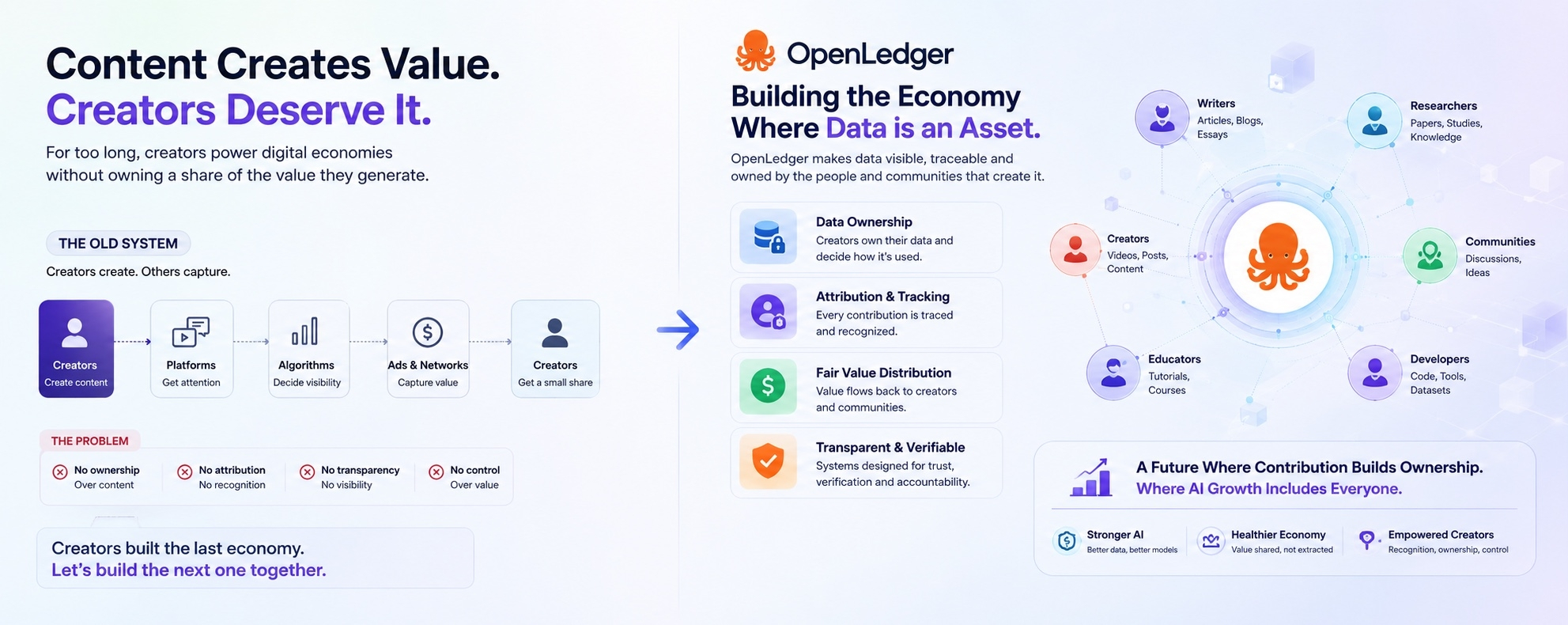
For years people who create content have been helping digital economies grow without owning them.
The pattern became familiar.
Creators make videos, posts, articles, discussions and tutorials.
Platforms get peoples attention.
Algorithms decide what is visible.
Advertising networks take most of the value.
The people who create the content often get a small share of what their work generates.
That is why I look at OpenLedger differently than people.
Many focus on AI.
Others focus on infrastructure.
I am interested in the possibility that content itself may finally become a recognized asset, not just free fuel for someone elses platform.
The idea sounds simple.
The reality is much harder.
Most AI systems today rely on amounts of human-generated content.
Articles teach language models how people explain things.
Forum discussions teach them how people debate.
Research papers teach them knowledge.
Social posts teach them how people communicate naturally.
The strange part is that the creators who produced this knowledge are disconnected from the value created afterward.
Data enters the system.
Models improve.
Companies grow.
The original contributors often disappear from the picture.
OpenLedger seems to be questioning that structure.
Of treating data as invisible the system tries to make data a visible asset.
That sounds obvious until you realize how differently most AI ecosystems operate.
In systems it is often hard to know where information came from.
When datasets are documented the relationship between contributors and future value creation is usually weak.
The model becomes the product.
The data providers become history.
OpenLedger seems to be attempting something
The project focuses on tracking who created what and data ownership.
The design suggests a future where datasets are not just collected and forgotten but stay connected to the people and communities that created them.
Whether that works at scale is still a question.
Tracking ownership sounds clean in theory.
Reality is messy.
Information overlaps.
Content gets modified.
Ideas spread across thousands of contributors.
At some point attribution becomes extremely difficult.
That is one of the places I expect pressure to appear.
The larger the ecosystem grows the harder it becomes to determine who deserves what share of value.
Still I think the attempt itself matters.
Ai projects focus on model quality.
OpenLedger seems concerned with the economic structure surrounding the model.
That feels different.
The project is not just asking how to build AI.
It is asking who should benefit when AI becomes better.
That question has been largely ignored across the industry.
Content creators have already lived through one internet cycle.
They built audiences on platforms they did not control.
They generated engagement they could not fully monetize.
They accepted changing rules because there were alternatives.
Now AI is creating another layer on top of that content.
Without systems the same pattern could repeat.
Creators provide material.
Platforms capture value.
Everyone else watches from the outside.
OpenLedger appears to be trying to prevent that outcome before it becomes permanent.
The interesting part is that success does not require replacing every existing AI company.
It only requires creating a standard that others eventually have to respect.
If creators begin expecting attribution.
If developers begin expecting data sourcing.
If businesses begin demanding data ownership.
Then the entire market may gradually move in that direction.
That might be more important than any model or application.
Course there are risks.
Economic incentives can attract gaming behavior.
People may optimize for rewards of quality.
Low-value content could flood systems designed to reward contribution.
Verification becomes critical.
Without filtering mechanisms the economics stop making sense.
OpenLedger seems aware of that challenge. Awareness and execution are different things.
The real test comes when incentives meet behavior.
That is where many systems discover their weaknesses.
What keeps my attention is that the project is focused on a problem that feels increasingly unavoidable.
AI keeps getting stronger.
Data keeps becoming more valuable.
Yet the people producing that data remain surprisingly disconnected from the economics, around it.
That gap cannot stay invisible forever.
Whether OpenLedger becomes the solution is impossible to know now.
The problem it is targeting feels real.
Content creators already lost one economy because ownership arrived too late.
The next economy is being built now.
That alone makes OpenLedger worth watching.
#Openledger #openledger @OpenLedger $OPEN
