
I remember exactly when I stopped understanding crypto hype.
It was the hundredth time someone explained their "revolutionary AI blockchain" to me. Every project sounded the same. Faster models. Smarter agents. Cheaper compute. Honestly? My eyes just glazed over.
Then I opened the @OpenLedger whitepaper. And at first? Same feeling. More technical diagrams. More buzzwords. I almost closed it.
But something kept me reading.
Not because it was exciting. Actually, it was the opposite. The more I read, the more I realized I wasn't reading about a project anymore. I was reading about a problem. A really uncomfortable one that nobody in AI seems to want to talk about.
Let me ask you something simple.
Where does AI value actually come from?
Go ahead. Think about it for a second.
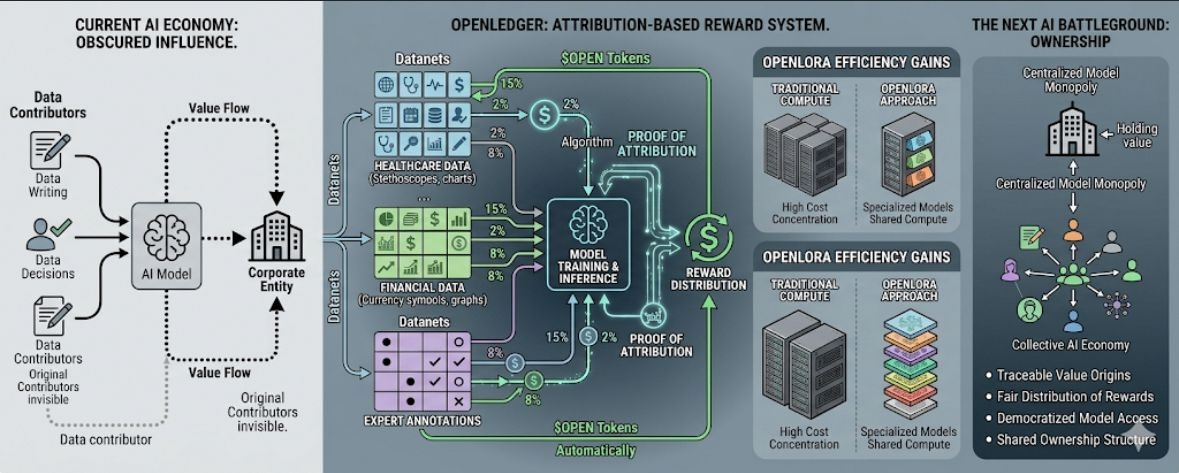
A model doesn't wake up smart. It doesn't magically understand jokes or write emails or trade stocks. It learns from data. Human data. Your writing. My decisions. Somebody's corrections. Thousands of human fingerprints all over every "intelligent" output.
Now here's the uncomfortable part.
When value gets created, when revenue flows, when companies hit billion-dollar valuations... where do those original contributors go?
Nowhere. They just become invisible.
And that's when OpenLedger stopped feeling like just another blockchain to me.
Their obsession isn't really AI. It's attribution.
I know. "Attribution" sounds boring. Crypto has trained us to love flashy words like autonomous agents and on-chain intelligence. Attribution sounds like homework, I get it.
But here's what I slowly realized.
If you cannot prove which data influenced a model's output, how do you pay the people who made that data valuable? How do you track ownership? How do you distribute rewards fairly?
You can't. Plain and simple.
So OpenLedger built something called Proof of Attribution. Fancy name. Simple idea. When an AI generates something, the system traces back which data contributed to that result. Then rewards flow automatically in $OPEN tokens to the people who provided that data.
Sounds clean, right?
Here's where I got uncomfortable again.
Is influence actually measurable? Like, really measurable? Whose data point was more valuable? The person who labeled the first thousand images or the person who corrected the last fifty mistakes? Who gets to decide?
I don't have perfect answers. Neither does OpenLedger, I think. And that honesty actually made me trust them a little more.
Because solving technology is easy compared to solving human incentives. Crypto history proves this over and over. Beautiful protocols have crashed because people gamed the system. Because rewards attracted the wrong behavior. Because decentralization worked until coordination got hard, then centralization snuck back in.
OpenLedger's real battle isn't technical. It's human. Messy, unpredictable, sometimes dishonest human.
They built something called Datanets. Decentralized data networks where communities contribute specialized datasets. Healthcare data. Financial data. Whatever domain experts care about. Then models train on that data. And every contribution gets recorded permanently on-chain.
Beautiful idea.
But then I started thinking about all the ways people cheat. Spam. Low-quality submissions. Multiple fake identities to steal rewards. OpenLedger talks about reputation systems and slashing penalties. Makes sense on paper.
But real markets don't live on paper. People optimize for rewards. People find shortcuts. People break systems. Always.
That's not really a criticism of OpenLedger. That's just being honest about what they're up against. The question isn't whether their code works. The question is whether their incentive design can survive human nature.
I don't know the answer. But I respect that they're at least asking the question.
Another piece caught my attention. OpenLoRA.
Technical name. Simple purpose. Letting many specialized models run on a single GPU instead of needing expensive hardware for each one.
On the surface, that's just efficiency. But underneath, it's accessibility. Because compute concentration is a real problem right now. Only big companies can afford to train and run serious models. OpenLoRA tries to lower that wall.
Will it work? Maybe. Technology alone doesn't build ecosystems. Ecosystems grow when enough people believe participation is worth their time.
And belief is a weird thing. Sometimes narratives come before utility. Sometimes utility takes years to catch up to hype.
Which one will happen with OpenLedger? Honestly? I'm not sure.
Here's my real takeaway after spending way too much time thinking about this project.
The next AI war probably won't be about models. It won't even be about data, not directly. It'll be about attribution. The ability to prove where value actually came from in the first place.
Because eventually, every industry faces the same hard questions. If data is valuable, what role should data contributors play? If AI generates revenue, how should that revenue be distributed? If intelligence comes from collective human input, shouldn't ownership be collective too?
Those questions feel abstract today. In five years, they'll feel urgent.
OpenLedger might succeed. Might fail. I honestly can't predict that. Markets are brutal. Liquidity overshadows vision all the time. Good projects die. Bad projects survive on narrative alone.
But here's what I know.
They're taking the ownership problem seriously. And they're building something that actually tries to answer the question almost everyone else is ignoring.
Who gets paid when AI creates value?
That question isn't going away. OpenLedger is just the first project I've seen that built its entire economy around it.
And maybe that's enough to pay attention.
Not because the technology is perfect. Not because the token will moon. But because they're asking something real. And in a sea of projects shouting the same hype, asking a real question might be the most valuable thing of all.