I didn't take it seriously at first That's just where I am with most new protocols these days After a few cycles, you learn that enthusiasm is cheap and maintenance is expensive AI blockchain Liquidity for data Agents earning autonomously It sounded like narrative alignment more than infrastructure
But OpenLedger keeps nagging at me and not in a hype driven way More like an itch under the surface of the current AI moment
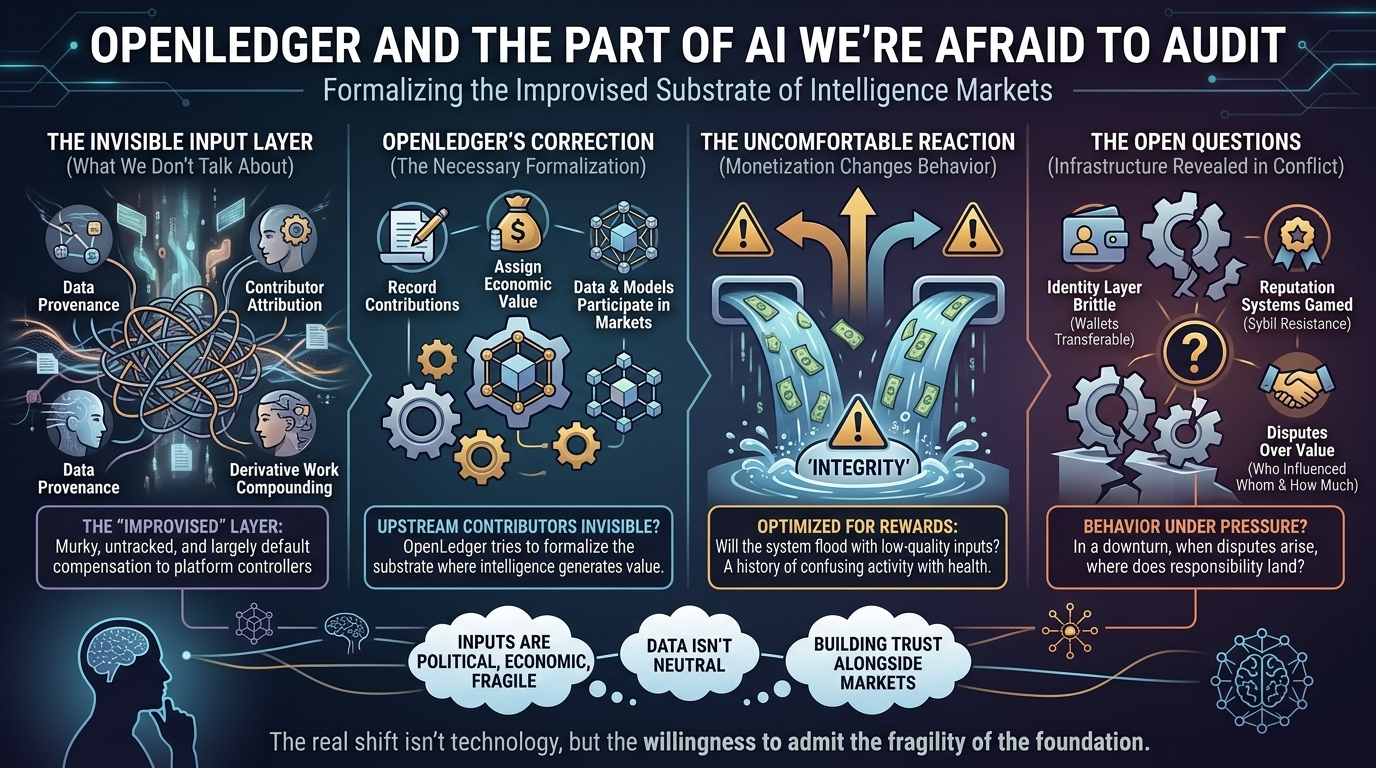
We talk about outputs constantly Model performance Agent capabilities Latency Benchmarks The visible stuff What we don't talk about much is the input layer where the data comes from who contributed to a model's training how derivative work compounds across systems
That layer feels improvised I keep coming back to that word Improvised
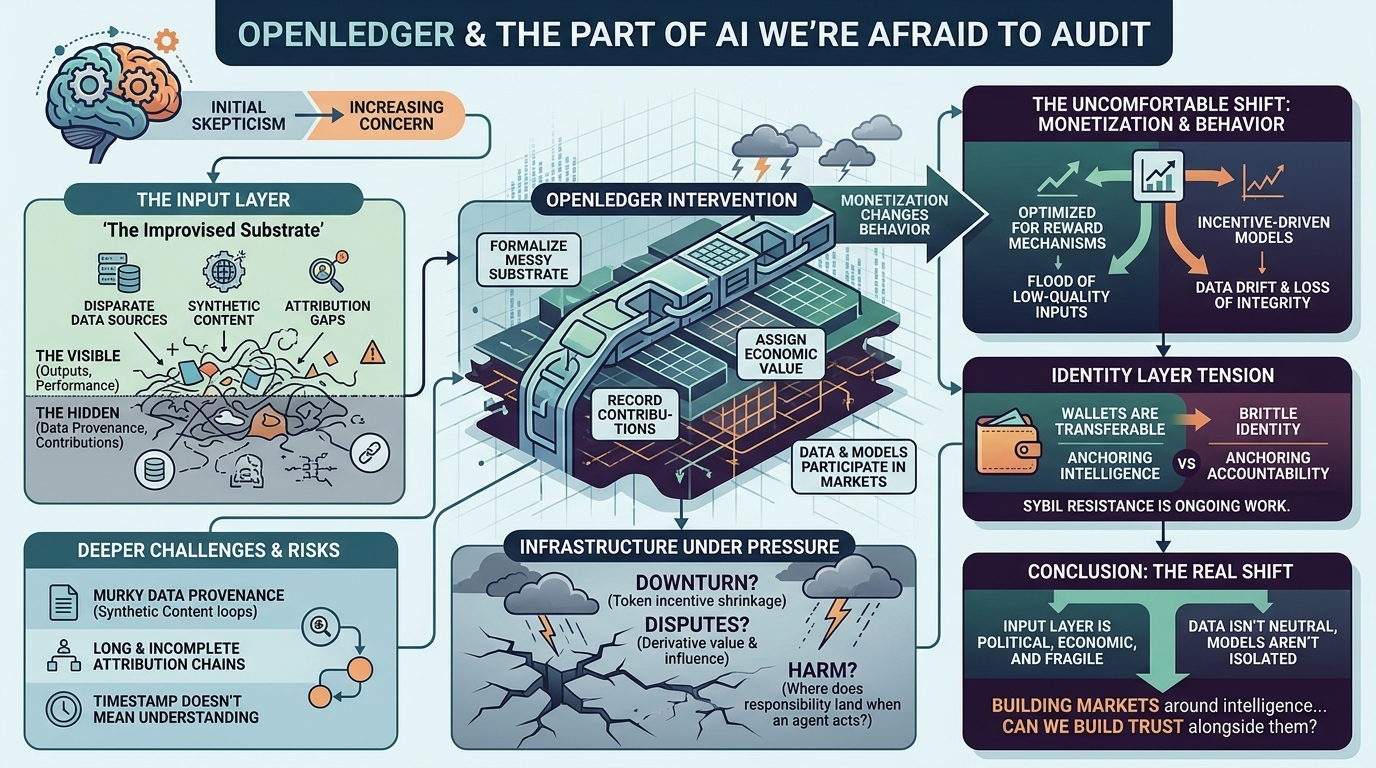
OpenLedger seems to be trying to formalize the messy substrate record contributions assign economic value let data and models participate in markets On one level that feels like a necessary correction If intelligence is generating value the upstream contributors shouldn't be invisible But monetization changes behavior That's where things start to feel uncomfortable
The moment data contributions become liquid, they become optimized for. People will produce whatever the reward mechanism measures That might increase participation It might also flood the system with low quality inputs Crypto has a long history of confusing activity with health
Maybe that’s too harsh Incentives can align long term stewardship But they can also distort it subtly A model trained on incentivized data might drift toward whatever drives payout rather than what preserves integrity And integrity is already fragile in AI systems
Data provenance is murky Synthetic content feeds into training loops Attribution chains are long and incomplete A blockchain can timestamp a contribution but it can't automatically evaluate its quality or context Recording something doesn't mean understanding it
I didn't take it seriously at first because I assumed this was another attempt to financialize abstraction But the more centralized AI becomes the more the absence of shared rails feels risky Right now ownership and compensation largely default to whoever controls the platform A public ledger at least introduces contestation
Still contestation isn't stability
I keep asking myself how OpenLedger behaves under pressure In a downturn when token incentives shrink When disputes arise over derivative value who influenced which model and by how much When an agent trained on monetized data causes harm and the community has to decide where responsibility lands Infrastructure reveals itself during conflict not launch
There's also the identity layer Agents acting economically implies persistent identities But crypto identity remains brittle Wallets are transferable Reputation systems can be gamed Sybil resistance is ongoing work Anchoring intelligence to wallets doesn't automatically anchor accountability
And yet doing nothing feels naïve Intelligence is becoming embedded in economic systems If we don't formalize ownership and provenance openly they'll calcify privately
I’m not convinced OpenLedger solves that tension I'm not convinced it doesn't matter either
Maybe the real shift isn’t the technology but the willingness to admit that the input layer is political economic and fragile That data isn't neutral That models aren't isolated artifacts That agents aren't just code
I didn't take it seriously at first Now I'm less certain of my dismissal
We're building markets around intelligence Whether we can build trust alongside them that's still an open question