Lately I've found myself staring at AI projects for longer than I probably should, not because of what they're building, but because of the feeling that something larger is forming underneath them.
That feeling came back when I started looking at $OPEN.
At first, the idea seems straightforward. AI systems have spent years learning from people who rarely receive recognition, ownership, or economic participation in the value that gets created afterward. On the surface, a system that tries to reconnect contribution with reward feels reasonable. Maybe even necessary.
But the longer I sat with it, the less I thought about the solution and the more I thought about what the solution requires.
To reward contribution, you have to identify it.
To identify it, you have to track it.
To track it, you have to measure it.
And somewhere along that path, human activity starts becoming something the system can organize, categorize, and eventually assign value to.
That's the part I can't stop thinking about.
For years, people worried about AI taking value from human knowledge without permission or attribution. Now we're moving toward systems that want to make those contributions visible. That sounds like progress until you realize visibility changes the relationship too.
Once a contribution has value attached to it, people begin paying attention to what the system recognizes. They learn what matters. They adjust. Not because anyone forces them to, but because incentives have a way of quietly reshaping behavior.
I've seen that happen everywhere in crypto.
The metric arrives first.
The optimization follows.
Then eventually people stop behaving naturally around the system and start behaving according to it.
Maybe that's unavoidable.
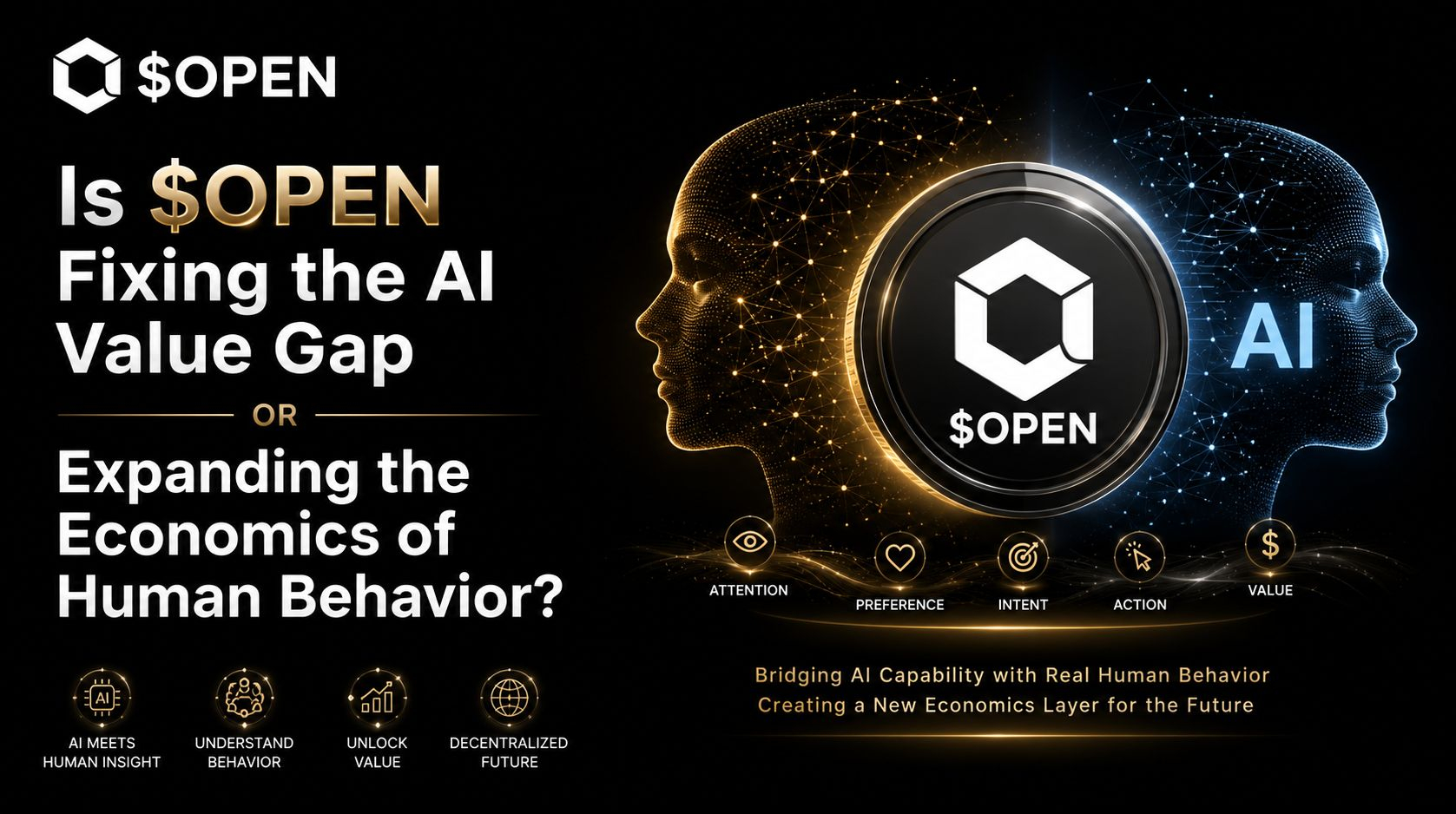
What makes open interesting isn't that it talks about ownership. A lot of projects talk about ownership. What catches my attention is the possibility that ownership and monetization are becoming harder to separate from each other.
The project seems to ask an important question: if AI is creating value from human contributions, shouldn't contributors share in that value?
I think most people would say yes.
But another question sits right beside it.
What happens when every contribution becomes something that can be measured, recorded, priced, and integrated into an economic network?
The difference sounds subtle, but it feels significant.
AI no longer looks like software to me. Software is something you use. Infrastructure is something you organize your behavior around.
That's where this starts feeling bigger than a protocol.
The more intelligence becomes infrastructure, the more systems will emerge that try to map where value originates, who created it, who deserves compensation, and how rewards should flow. On paper, that sounds fair. In practice, it means human activity itself becomes increasingly legible to machines and markets.
Maybe that's the price of solving the attribution problem.
Maybe there is no way to restore balance without creating new forms of measurement.
What I can't decide is whether $OPEN is primarily correcting an old imbalance or helping build a future where more and more of human contribution becomes part of a machine-readable economy.
And maybe the reason that question keeps lingering is because both outcomes seem possible at the same time.
The old AI world made people invisible.
The new one might make them visible in ways we don't fully understand yet.
Somewhere between those two realities is where $OPEN seems to exist, and the longer I look at it, the harder it becomes to tell whether I'm looking at a solution, a transition, or the beginning of something much larger.
@OpenLedger #OpenLedger #OpenLedger # $OPEN